


CNS relapse in patients with DLBCL treated with lenalidomide plus R-CHOP (R2CHOP): analysis from two phase 2 studies
- PMID: 29946110
- PMCID: PMC6018787
- DOI: 10.1038/s41408-018-0097-0
CNS relapse in patients with DLBCL treated with lenalidomide plus R-CHOP (R2CHOP): analysis from two phase 2 studies
Abstract
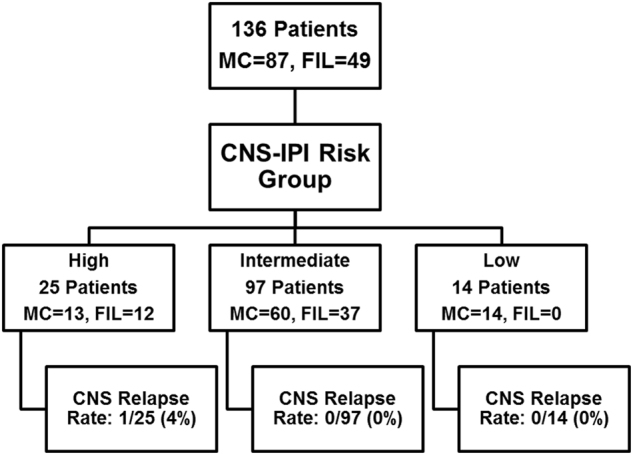
Central nervous system (CNS) relapse of diffuse large B-cell lymphoma (DLBCL) is a devastating event occurring in ~ 5% of patients treated with R-CHOP. We hypothesized that adding lenalidomide to R-CHOP (R2CHOP) may decrease the risk of CNS relapse. We analyzed records for patients with DLBCL from two R2CHOP trials. We assessed variables pertinent to the CNS-International Prognostic Index (CNS-IPI) scoring system and classified patients into groups of low, intermediate, and high risk of CNS relapse. The 2-year CNS relapse rate for each risk group was estimated using the Kaplan-Meier method and compared with reported rates in cohorts treated with contemporary chemoimmunotherapy. A total of 136 patients were included. Mean age was 65 and median follow-up was 48.2 months. 10.3, 71.3, and 18.4% of patients were classified into low, intermediate, and high-risk CNS-IPI groups, respectively. Only one of 136 patients developed CNS relapse, corresponding to an incidence of 0.7% and an estimated 2-year CNS relapse rate of 0.9% for the entire R2CHOP cohort. The estimated 2-year CNS relapse rates for the low, intermediate, and high-risk groups were 0, 0, and 5.0%, respectively. Frontline therapy with R2CHOP in patients with DLBCL is associated with a lower-than-expected rate of CNS relapse.
Conflict of interest statement
Institutional review board committee approval
The two phase 2 trials from which the data were collected have been approved by the local institutional review board or ethics committee of each participating site. All research involving human subjects was conducted in accordance with the Declaration of Helsinki. Informed consent was obtained from all patients participating in the clinical trials.
Conflict of interest
AC: advisory board: Celgene; honoraria for lectures: Amgen, Celgene, Janssen, Nanostring, Pfizer, Roche, Teva. GG: consultancy: Roche, Karyopharm, Morphosys, Gilead, Janssen, Novartis; honoraria: Roche, Karyopharm, Morphosys, Gilead, Janssen, Novartis; speakers bureau: Roche, Gilead, Janssen, Novartis. MS: advisory board: Teva, Mundipharma; speaker fees: Teva, Mundipharma. FC: honoraria: Celgene, Onyx, Janssen. UV: advisory board: Roche, Celgene, Janssen; honoraria for lectures: Roche, Celgene, Takeda, Gilead, Janssen, Mundipharma; research funding: Roche, Celgene. GN: consultancy: Bayer; research funding: Bayer, Celgene, Morphosys. A.O.A., L.P., B.R.L., A.G.C., A.R., G.M., W.R.M., and T.W.: declare no conflict of interest.
Figures
References
-
- Boehme V, Schmitz N, Zeynalova S, Loeffler M, Pfreundschuh M. CNS events in elderly patients with aggressive lymphoma treated with modern chemotherapy (CHOP-14) with or without rituximab: an analysis of patients treated in the RICOVER-60 trial of the German High-Grade Non-Hodgkin Lymphoma Study Group (DSHNHL) Blood. 2009;113:3896–3902. doi: 10.1182/blood-2008-10-182253. - DOI - PubMed
Publication types
MeSH terms
Substances
LinkOut - more resources
Full Text Sources
Other Literature Sources
Research Materials
