. 2018 Jun 26;8(1):9701.
doi: 10.1038/s41598-018-27924-x.

S-nitrosation of protein phosphatase 1 mediates alcohol-induced ciliary dysfunction

Affiliations

S-nitrosation of protein phosphatase 1 mediates alcohol-induced ciliary dysfunction

Michael E Price et al. Sci Rep. .

Abstract

Alcohol use disorder (AUD) is a strong risk factor for development and mortality of pneumonia. Mucociliary clearance, a key innate defense against pneumonia, is perturbed by alcohol use. Specifically, ciliated airway cells lose the ability to increase ciliary beat frequency (CBF) to β-agonist stimulation after prolonged alcohol exposure. We previously found that alcohol activates protein phosphatase 1 (PP1) through a redox mechanism to cause ciliary dysfunction. Therefore, we hypothesized that PP1 activity is enhanced by alcohol exposure through an S-nitrosothiol-dependent mechanism resulting in desensitization of CBF stimulation. Bronchoalveolar S-nitrosothiol (SNO) content and tracheal PP1 activity was increased in wild-type (WT) mice drinking alcohol for 6-weeks compared to control mice. In contrast, alcohol drinking did not increase SNO content or PP1 activity in nitric oxide synthase 3-deficient mice. S-nitrosoglutathione induced PP1-dependent CBF desensitization in mouse tracheal rings, cultured cells and isolated cilia. In vitro expression of mutant PP1 (cysteine 155 to alanine) in primary human airway epithelial cells prevented CBF desensitization after prolonged alcohol exposure compared to cells expressing WT PP1. Thus, redox modulation in the airways by alcohol is an important ciliary regulatory mechanism. Pharmacologic strategies to reduce S-nitrosation may enhance mucociliary clearance and reduce pneumonia prevalence, mortality and morbidity with AUD.


Conflict of interest statement

The authors declare no competing interests.

Figures
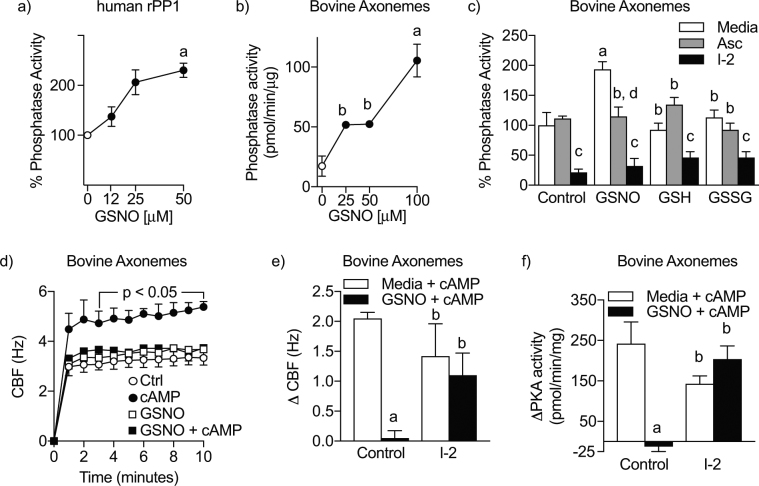
Figure 1
Figure 1
GSNO drives PP1 activity to block cAMP-responsiveness in bovine axonemes. (a) S-nitrosoglutathione (GSNO) dose-dependently (0–100 μM; 10 minutes) increases recombinant human PP1 activity. ap < 0.05 compared to 0 μM GSNO, n = 3. (b) GSNO (0–100 μM; 10 minutes) dose-dependently increases protein phosphatase activity in isolated bovine axonemes. ap < 0.01 compared to 0 μM GSNO, bp < 0.05 compared to 100 uM GSNO. n = 3 axoneme preparations. (c) GSNO activation of PP1 in bovine axonemes is nitrosothiol-dependent. ap < 0.001 compared to media control, bp < 0.001 compared to media GSNO, cp < 0.001 compared to Asc of same condition. n = 3–4 axoneme preparations. (d,e) GSNO (100 μM; at time of reactivation) blocks cAMP-dependent CBF responsiveness, which is reversed by I-2. ap < 0.0001 compared to media control; bp < 0.005 compared to control GSNO. n = 5 axoneme preparations. (f) I-2 (2.0 nM; 5 minutes pre-GSNO) restores cAMP-dependent PKA-responsiveness to GSNO treated axonemes. ap < 0.0001 compared to media control. bp < 0.01 compared to control GSNO. n = 5 axoneme preparations. rPP1 = recombinant protein phosphatase 1, GSH = reduced glutathione, GSSG = oxidized glutathione, Asc = ascorbate, I-2 = inhibitor 2.
Figure 2
Figure 2
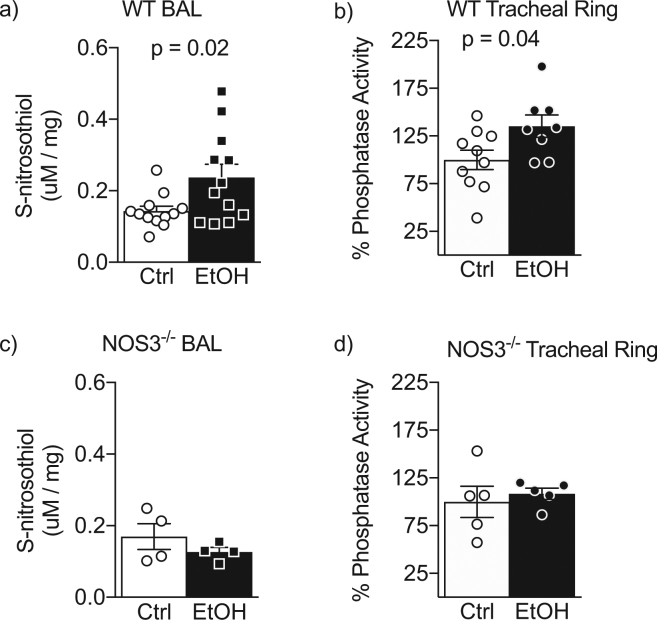
Alcohol drinking drives NOS3-dependent airway S-nitrosothiol production and PP1 activity in mice. (a,b) Alcohol drinking (6 weeks × 20% in drinking water) increases bronchoalveolar lavage (BAL) s-nitrosothiol (SNO) (a) and tracheal ring PP1 activity (b) in WT mice. n = 8–12 per group. (c,d) Alcohol does not increase BAL SNO (c) nor PP1 activity (d) in NOS3−/− mice. n = 4 per group BAL SNO and n = 5 per group PP1 activity. P-values are from Student’s t-test; bars represent mean ± SEM.
Figure 3
Figure 3
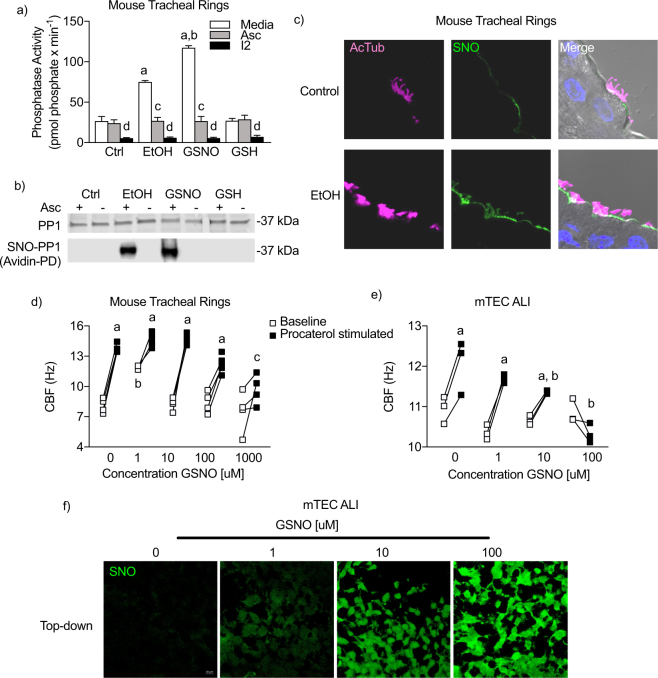
GSNO recapitulates AICD in mouse tracheal rings. (a) GSNO 4 h × 1 mM) and alcohol (EtOH; 100 mM × 10 days) increase PP1 activity in mouse tracheal rings, which is reversed by ascorbate (10 min × 30 μM). Data are representative of the mean of 3–6 tracheal rings from 4 mice. ap < 0.05 compared to media control. bp < 0.005 compared to EtOH. cp < 0.05 compared to media within group. dp < 0.05 compared to Asc within group. (b) GSNO and EtOH increase biotin switch detection of PP1 in mouse tracheal rings. The absence of Asc is a negative control for the biotin switch assay. (c) In vitro EtOH increases cilia S-nitrosation in mouse tracheal rings. Acetylated tubulin (AcTub) - pink; Avidin-fluorescein (SNO) - green (d) GSNO (4 h) blocks procaterol (1 h × 10 nM) stimulation in mouse tracheal rings. ap < 0.0001 compared to baseline of the same condition. bp < 0.001 compared to control baseline. cp < 0.01 compared to control stimulated. Data are representative of 3–4 tracheal rings from 4–5 mice per condition. (e) GSNO (4 h) blocks procaterol stimulation in cultured mouse tracheal epithelial cells. ap < 0.001 compared to baseline of the same condition. bp < 0.001 compared to control stimulated. n = 13–24 cultures per group. (f) GSNO (4 h) increases S-nitrosation in mouse tracheal epithelial cells. Top: Looking down on ALI culture. Avidin-fluorescein (SNO) – green.
Figure 4
Figure 4
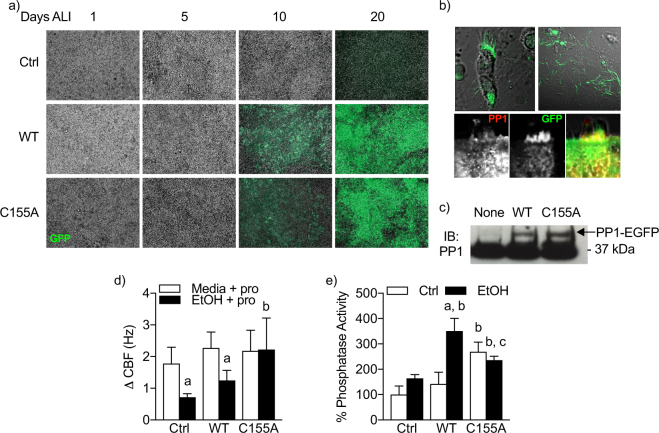
Mutagenesis of PP1 cysteine 155 protects against AICD in cells. (a) Foxj1-driven PP1 expression is consistent with differentiation of human airway epithelial cells. Green = GFP. 10X magnification. (b) Left, Foxj1-driven PP1eGFP expression localizes to the nucleus and cilia in an intact cell from a hBEC ALI culture. Right, PP1eGFP fluorescence persists in isolated demembranated axonemes from an hBEC ALI culture. Bottom, PP1 and GFP colocalize. (c) Western blot for PP1α in control, PP1WT-EGFP and PP1C155A-EGFP. D) Change in CBF (Δ CBF) pre and post-1 hr procaterol (pro) treated ± alcohol (24 h × 100 mM). ap < 0.05 compared to no alcohol within same PP1 genotype. bp < 0.05 compared to media ctrl. Data are representative of mean CBF of 3 cultures with at least 6 CBF readings per condition for at least 3 experiments. (e) Phosphatase activity from whole cell lysates of human airway epithelial cells treated as in D. ap < 0.05 compared ctrl of same genotype. bp < 0.05 compared to no alcohol non-transduced control. cp < 0.05 compared to WT EtOH.
Figure 5
Figure 5
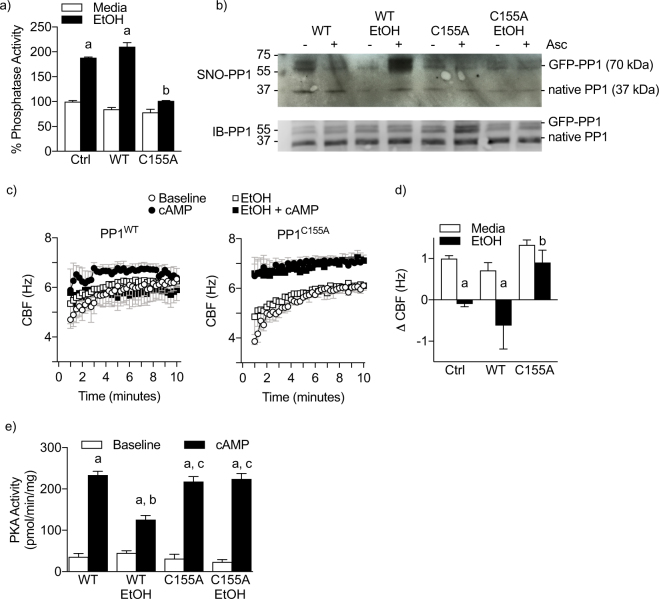
Mutagenesis of PP1 cysteine 155 reverses AICD in isolated axonemes from human airway epithelial cells. (a) Alcohol (24 h × 100 mM) does not increase phosphatase activity in axonemes expressing C155A mutant PP1. ap < 0.05 compared to media of same genotype; bp < 0.05 compared to Ctrl EtOH or WT EtOH; n = 6−7. (b) C155A mutagenesis prevents the majority of S-nitrosation of axonemal PP1. The absence of Asc is a negative control for the biotin switch assay. (c) Representative motility of isolated axoneme motility for 10 minutes following addition of ATP. Left, Axonemes isolated from hBECs expressing PP1WT. Right, Axonemes isolated from hBECs expressing PP1C155A (d) C155A mutagenesis restores cAMP-dependent stimulation of CBF in isolated axonemes from hBECs treated with alcohol. ap < 0.05 compared to media ctrl; bp < 0.05 compared to Ctrl EtOH or WT EtOH. n = 3. (e) PP1C155A restores PKA responsiveness in isolated axonemes from hBECs treated with alcohol. ap < 0.05 compared to baseline of same genotype; bp < 0.05 compared to EtOH Ctrl or WT, cp < 0.05 compared WT EtOH; n = 4.
Figure 6
Figure 6
Regulation of PP1 and CBF stimulation by alcohol and S-nitrosation. Alcohol activates Nitric Oxide Synthase 3 to promote S-nitrosation of Protein Phosphatase 1 (PP1) at cysteine 155 (Cys155). S-nitrosation of PP1 at Cys155 activates PP1 preventing activation of cilia-localized cyclic AMP-dependent protein kinase (PKA) and stimulation of ciliary beat frequency (CBF).

References

    1. Thavorncharoensap M, Teerawattananon Y, Yothasamut J, Lertpitakpong C, Chaikledkaew U. The economic impact of alcohol consumption: a systematic review. Subst. Abuse Treat. Prev. Policy. 2009;4:20-597X-4-20. doi: 10.1186/1747-597X-4-20. - DOI - PMC - PubMed
    1. Carpenter C, Dobkin C. The Effect of Alcohol Consumption on Mortality: Regression Discontinuity Evidence from the Minimum Drinking Age. Am. Econ. J. Appl. Econ. 2009;1:164–182. doi: 10.1257/app.1.1.164. - DOI - PMC - PubMed
    1. Boe DM, Vandivier RW, Burnham EL, Moss M. Alcohol abuse and pulmonary disease. J. Leukoc. Biol. 2009;86:1097–1104. doi: 10.1189/jlb.0209087. - DOI - PMC - PubMed
    1. Yeligar SM, et al. Alcohol and lung injury and immunity. Alcohol. 2016;55:51–59. doi: 10.1016/j.alcohol.2016.08.005. - DOI - PMC - PubMed
    1. Tilley AE, Walters MS, Shaykhiev R, Crystal RG. Cilia dysfunction in lung disease. Annu. Rev. Physiol. 2015;77:379–406. doi: 10.1146/annurev-physiol-021014-071931. - DOI - PMC - PubMed

Publication types