


Multi-Drug Resistant Coliform: Water Sanitary Standards and Health Hazards
- PMID: 29946253
- PMCID: PMC6005870
- DOI: 10.3389/fphar.2018.00311
Multi-Drug Resistant Coliform: Water Sanitary Standards and Health Hazards
Abstract
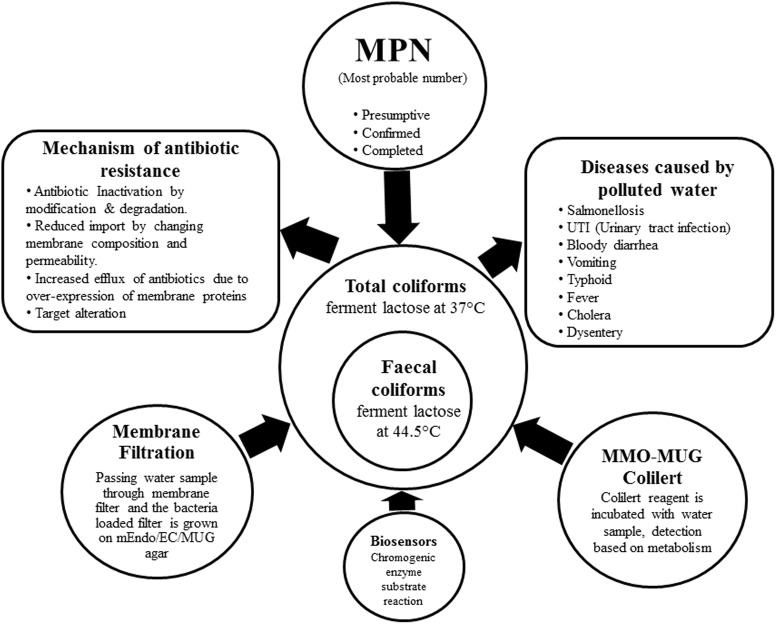
Water constitutes and sustains life; however, its pollution afflicts its necessity, further worsening its scarcity. Coliform is one of the largest groups of bacteria evident in fecally polluted water, a major public health concern. Coliform thrive as commensals in the gut of warm-blooded animals, and are indefinitely passed through their feces into the environment. They are also called as model organisms as their presence is indicative of the prevalence of other potential pathogens, thus coliform are and unanimously employed as adept indicators of fecal pollution. As only a limited accessible source of fresh water is available on the planet, its contamination severely affects its usability. Coliform densities vary geographically and seasonally which leads to the lack of universally uniform regulatory guidelines regarding water potability often leads to ineffective detection of these model organisms and the misinterpretation of water quality status. Remedial measures such as disinfection, reducing the nutrient concentration or re-population doesn't hold context in huge lotic ecosystems such as freshwater rivers. There is also an escalating concern regarding the prevalence of multi-drug resistance in coliforms which renders antibiotic therapy incompetent. Antimicrobials are increasingly used in household, clinical, veterinary, animal husbandry and agricultural settings. Sub-optimal concentrations of these antimicrobials are unintentionally but regularly dispensed into the environment through seepages, sewages or runoffs from clinical or agricultural settings substantially adding to the ever-increasing pool of antibiotic resistance genes. When present below their minimum inhibitory concentration (MIC), these antimicrobials trigger the transfer of antibiotic-resistant genes that the coliform readily assimilate and further propagate to pathogens, the severity of which is evidenced by the high Multiple Antibiotic Resistance (MAR) index shown by the bacterial isolates procured from the environmental. This review attempts to assiduously anthologize the use of coliforms as water quality standards, their existent methods of detection and the issue of arising multi-drug resistance in them.
Keywords: E. coli; MAR index; coliform; fecal pollution; gut microflora; indicator bacteria; multi-drug resistance.
Figures
References
-
- Al-Agamy M. H., Shibl A. M., Hafez M. M., Al-Ahdal M. N., Memish Z. A., Khubnani H. (2014). Molecular characteristics of extended-spectrum β-lactamase-producing Escherichia coli in Riyadh: emergence of CTX-M-15-producing E. coli ST131. Ann. Clin. Microbiol. Antimicrob. 13:4. 10.1186/1476-0711-13-4 - DOI - PMC - PubMed
-
- American Public Health Association (APHA) American Water Works Association (AWWA) and Water Pollution Control Federation (WPCF) (1992). Standard Methods for the Examination of Water and Wastewater 18th Edn. Washington, DC: APHA Publication Office.
-
- Ashbolt N. J., Grabow W. O., Snozzi M. (2001). “Indicators of microbial quality,” in Water Quality: Guidelines, Standards and Health, eds Fewtrell F., Batrem J. (Geneva: World Health Organization; ) 289–316.
Publication types
LinkOut - more resources
Full Text Sources
Other Literature Sources
Research Materials
