Genetic Polymorphism Predisposing to Differentiated Thyroid Cancer: A Review of Major Findings of the Genome-Wide Association Studies
- PMID: 29947173
- PMCID: PMC6021315
- DOI: 10.3803/EnM.2018.33.2.164
Genetic Polymorphism Predisposing to Differentiated Thyroid Cancer: A Review of Major Findings of the Genome-Wide Association Studies
Abstract
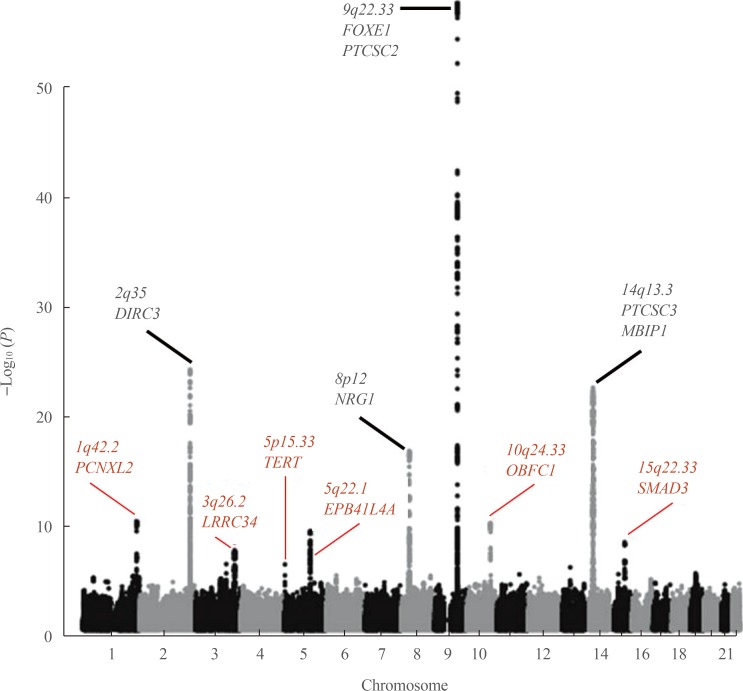
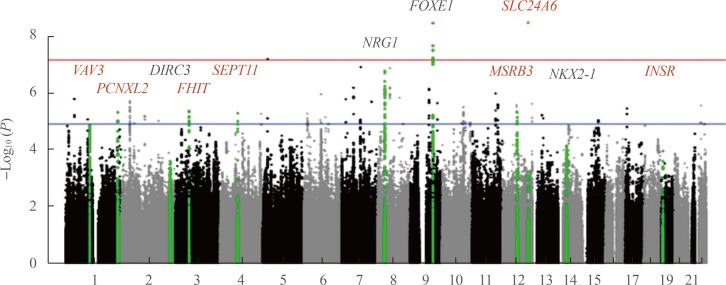
Thyroid cancer has one of the highest hereditary component among human malignancies as seen in medical epidemiology investigations, suggesting the potential meaningfulness of genetic studies. Here we review researches into genetic variations that influence the chance of developing non-familial differentiated thyroid cancer (DTC), focusing on the major findings of the genome-wide association studies (GWASs) of common single-nucleotide polymorphisms (SNPs). To date, eight GWAS have been performed, and the association of a number of SNPs have been reproduced in dozens of replication investigations across different ethnicities, including Korea and Japan. Despite the cumulative effect of the strongest SNPs demonstrates gradual increase in the risk for cancer and their association signals are statistically quite significant, the overall prediction ability for DTC appears to be very limited. Thus, genotyping of common SNPs only would be insufficient for evidence-based counseling in clinical setting at present. Further studies to include less significant and rare SNPs, non-SNP genetic information, gene-gene interactions, ethnicity, non-genetic and environmental factors, and development of more advanced computational algorithms are warranted to approach to personalized disease risk prediction and prognostication.
Keywords: Genetic loci; Genetic predisposition to disease; Genetic testing; Genome-wide association study; Polymorphism, single nucleotide; Thyroid neoplasms.
Copyright © 2018 Korean Endocrine Society.
Conflict of interest statement
No potential conflict of interest relevant to this article was reported.
Figures
References
-
- Statistics Korea. Cancer incident cases and incidence rates by site (24 items) and sex [Internet] Daejeon: Statistics Korea; c2014. [cited 2018 May 3]. Available from: http://kosis.kr/eng/statisticsList/statisticsList_01List.jsp?vwcd=MT_ETI....
-
- Center for Cancer Control and Information Services, National Cancer Center. Projected cancer statistics, 2017 [Internet] Tokyo: National Cancer Center; 2017. [updated 2017 Oct 27]. [cited 2018 May 3]. Available from: https://ganjoho.jp/en/public/statistics/short_pred.html.
-
- Saika K, Matsuda T, Sobue T. Incidence rate of thyroid cancer by histological type in Japan. Jpn J Clin Oncol. 2014;44:1131–1132. - PubMed
-
- Sueta A, Ito H, Kawase T, Hirose K, Hosono S, Yatabe Y, et al. A genetic risk predictor for breast cancer using a combination of low-penetrance polymorphisms in a Japanese population. Breast Cancer Res Treat. 2012;132:711–721. - PubMed
Publication types
LinkOut - more resources
Full Text Sources
Other Literature Sources