


Characteristics of recurrent fractures
- PMID: 29947869
- PMCID: PMC6076437
- DOI: 10.1007/s00198-018-4502-0
Characteristics of recurrent fractures
Abstract
The present study, drawn from a sample of the Icelandic population, quantified high immediate risk and utility loss of subsequent fracture after a sentinel fracture (at the hip, spine, distal forearm and humerus) that attenuated with time.
Introduction: The risk of a subsequent osteoporotic fracture is particularly acute immediately after an index fracture and wanes progressively with time. The aim of this study was to quantify the risk and utility consequences of subsequent fracture after a sentinel fracture (at the hip, spine, distal forearm and humerus) with an emphasis on the time course of recurrent fracture.
Methods: The Reykjavik Study fracture registration, drawn from a sample of the Icelandic population (n = 18,872), recorded all fractures of the participants from their entry into the study until December 31, 2012. Medical records for the participants were manually examined and verified. First sentinel fractures were identified. Subsequent fractures, deaths, 10-year probability of fracture and cumulative disutility using multipliers derived from the International Costs and Utilities Related to Osteoporotic fractures Study (ICUROS) were examined as a function of time after fracture, age and sex.
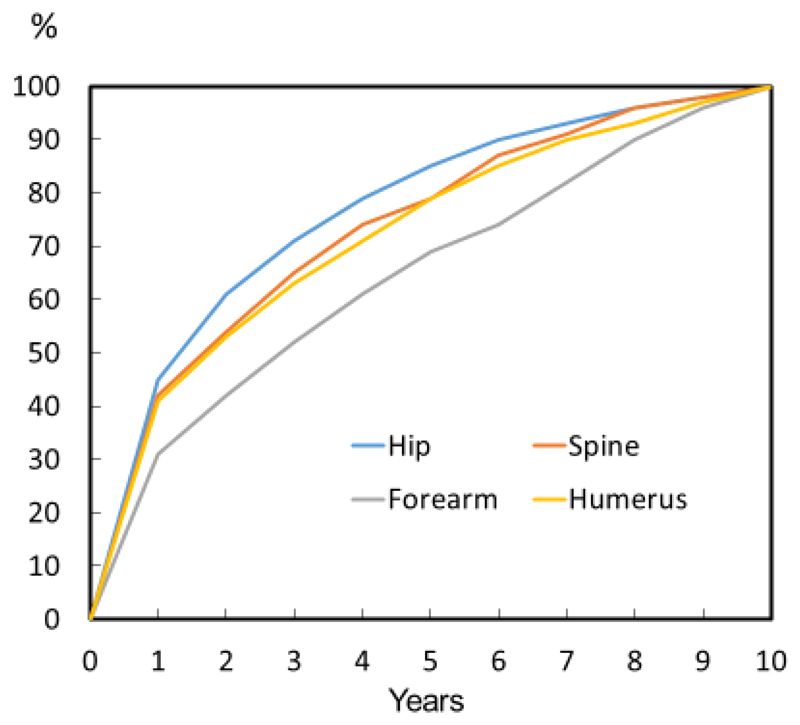
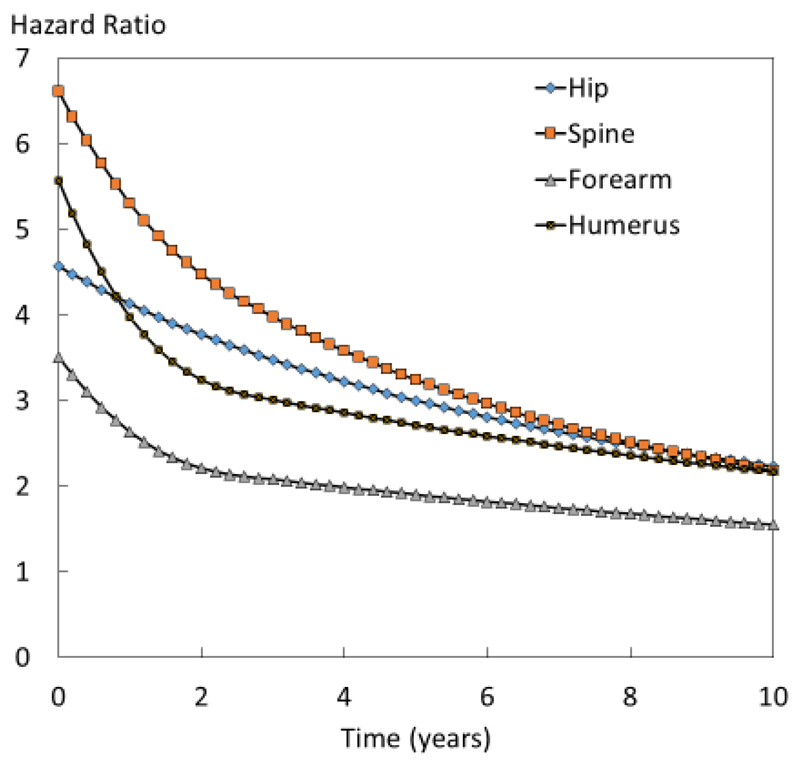
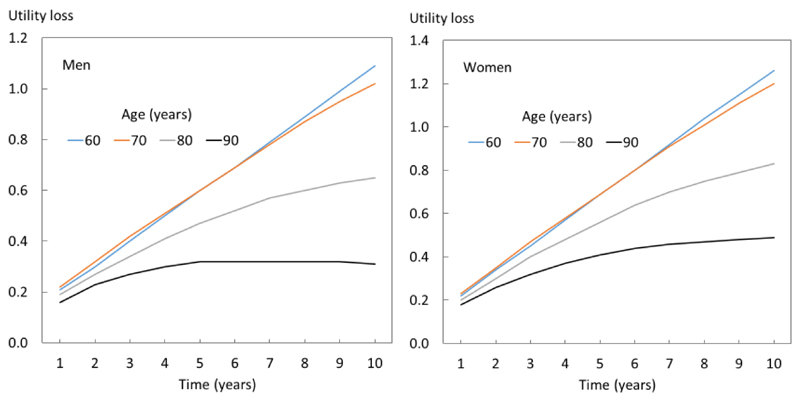
Results: Over 10 years, subsequent fractures were sustained in 28% of 1498 individuals with a sentinel hip fracture. For other sentinel fractures, the proportion ranged from 35 to 38%. After each sentinel fracture, the risk of subsequent fracture was highest in the immediate post fracture interval and decreased markedly with time. Thus, amongst individuals who sustained a recurrent fracture, 31-45% did so within 1 year of the sentinel fracture. Hazard ratios for fracture recurrence (population relative risks) were accordingly highest immediately after the sentinel fracture (2.6-5.3, depending on the site of fracture) and fell progressively over 10 years (1.5-2.2). Population relative risks also decreased progressively with age. The utility loss during the first 10 years after a sentinel fracture varied by age (less with age) and sex (greater in women). In women at the age of 70 years, the mean utility loss due to fractures in the whole cohort was 0.081 whereas this was 12-fold greater in women with a sentinel hip fracture, and was increased 15-fold for spine fracture, 4-fold for forearm fracture and 8-fold for humeral fracture.
Conclusion: High fracture risks and utility loss immediately after fracture suggest that treatment given as soon as possible after fracture would avoid a higher number of new fractures compared with treatment given later. This provides the rationale for very early intervention immediately after a sentinel fracture.
Keywords: Fracture probability; Imminent risk; Sentinel fracture; Utility loss.
Conflict of interest statement
Radius Health, Inc., was the sponsor for this study and provided financial support for its completion. LF is an employee of Radius Health. None of the other authors declare competing interests with regard to this paper.
Figures
Comment in
-
Comments on Kanis et al.: Characteristics of recurrent fractures.Osteoporos Int. 2019 Feb;30(2):529-530. doi: 10.1007/s00198-018-4735-y. Epub 2018 Dec 18. Osteoporos Int. 2019. PMID: 30564863 No abstract available.
-
Correspondence in response to OSIN-D-18-00831 quantifying imminent risk.Osteoporos Int. 2019 Feb;30(2):525-526. doi: 10.1007/s00198-018-4796-y. Epub 2019 Jan 7. Osteoporos Int. 2019. PMID: 30617532 No abstract available.
References
-
- Johnell O, Kanis JA, Oden A, et al. Fracture risk following an osteoporotic fracture. Osteoporos Int. 2004;15:175–179. - PubMed
-
- Hansen L, Petersen KD, Eriksen SA, et al. Subsequent fracture rates in a nationwide population-based cohort study with a 10-year perspective. Osteoporos Int. 2015;26:513–9. - PubMed
-
- Kanis JA, Johnell O, De Laet C, et al. A meta-analysis of previous fracture and subsequent fracture risk. Bone. 2004;35:375–382. - PubMed
-
- Haentjens P, Johnell O, Kanis JA, et al. Gender-related differences in short and long-term absolute risk of hip fracture after Colles’ or spine fracture: Colles’ fracture as an early and sensitive marker of skeletal fragility in men. J Bone Miner Res. 2004;19:1933–1944. - PubMed
-
- Klotzbuecher CM, Ross PD, Landsman PB, Abbott TA, 3rd, Berger M. Patients with prior fractures have an increased risk of future fractures: a summary of the literature and statistical synthesis. J Bone Miner Res. 2000;15:721–739. - PubMed
MeSH terms
Grants and funding
- 17702/VAC_/Versus Arthritis/United Kingdom
- MC_U147585827/MRC_/Medical Research Council/United Kingdom
- 21231/VAC_/Versus Arthritis/United Kingdom
- 21231/ARC_/Arthritis Research UK/United Kingdom
- MC_U147585819/MRC_/Medical Research Council/United Kingdom
- 17702/ARC_/Arthritis Research UK/United Kingdom
- MC_UP_A620_1014/MRC_/Medical Research Council/United Kingdom
- MC_UU_12011/1/MRC_/Medical Research Council/United Kingdom
- HTA/10/33/04/DH_/Department of Health/United Kingdom
- G0400491/MRC_/Medical Research Council/United Kingdom
- MC_U147585824/MRC_/Medical Research Council/United Kingdom
LinkOut - more resources
Full Text Sources
Other Literature Sources
Medical
