


The association between physical activity, fitness and body mass index on mental well-being and quality of life in adolescents
- PMID: 29948603
- PMCID: PMC6132966
- DOI: 10.1007/s11136-018-1915-3
The association between physical activity, fitness and body mass index on mental well-being and quality of life in adolescents
Abstract
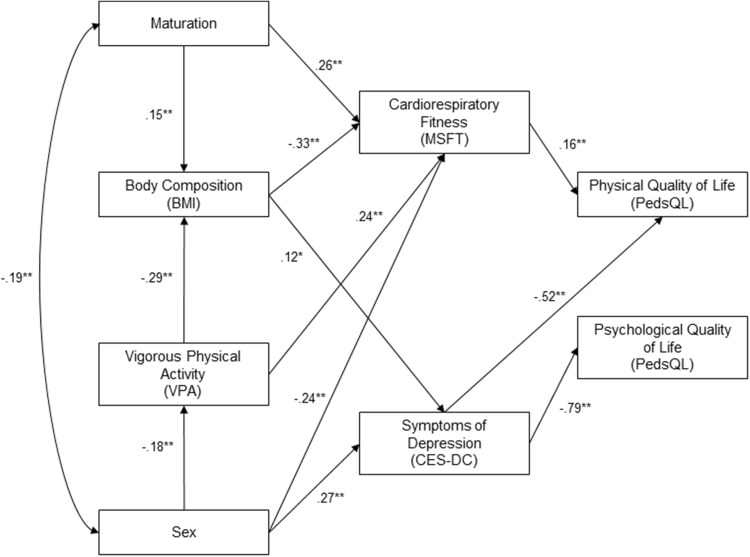
Purpose: The purpose of the current study was to investigate the mediatory role between vigorous physical activity, body mass index (BMI), and cardiorespiratory fitness on symptoms of depression and their subsequent direct and indirect effects on quality of life (QoL).
Methods: Five hundred and seventy-six adolescents' (314 boys, 12.5 ± 1.1 years) physical activity levels, cardiorespiratory fitness, BMI, levels of depressive symptoms, and QoL were measured. Structural equation modelling was used to evaluate the difference in linear structural associations between variables.
Results: The model suggested that cardiorespiratory fitness (β = 0.16, p < 0.001) and symptoms of depression (β = - 0.52, p < 0.001) were both directly associated with physical QoL, with depressive symptoms also directly influencing psychological QoL (β = - 0.79, p < 0.01). Body mass index was indirectly associated with physical QoL, mediated by both symptoms of depression (β = - 0.06, p < 0.001) and cardiorespiratory fitness (β = 0.05, p < 0.001) and psychological QoL mediated by symptoms of depression (β = - 0.09, p < 0.001). Vigorous physical activity was indirectly associated with QoL, mediated by cardiorespiratory fitness (β = - 0.04, p < 0.001).
Conclusions: Models suggested that vigorous physical activity, cardiorespiratory fitness and BMI were associated, both directly and indirectly, with mental well-being and QoL. It could, therefore, be postulated that enhancing cardiorespiratory fitness and BMI through increasing vigorous physical activity may be beneficial to both mental well-being and QoL in adolescents.
Keywords: Adolescents; Body mass index; Cardiorespiratory fitness; Mental well-being; Physical activity; Quality of life.
Conflict of interest statement
Conflict of interest
William Eddolls, Melitta McNarry, Charles Winn, and Kelly Mackintosh received funding by Commando Joe’s Fun and Fitness Ltd. and the Asthma UK Centre for Applied Research to complete this study. Leanne Lester and Gareth Stratton declare that they have no conflicts of interest relevant to the content of this study.
Ethical approval
Approval to conduct this research was granted by Swansea University A-STEM Ethical Advisory Committee (Ethics Number: PG/2014/29). All data collection was performed in accordance with the Declaration of Helsinki.
Informed consent
Written parental or guardian consent and child assent was obtained prior to any data collection.
Figures
References
-
- World Health Organization . Constitution of the World Health Organization. Geneva: World Health Organization; 2006.
-
- Ravens-Sieberer U, Herdman M, Devine J, Otto C, Bullinger M, Rose M, Klasen F. The European KIDSCREEN approach to measure quality of life and well-being in children: development, current application, and future advances. Quality of Life Research. 2014;23(3):791–803. doi: 10.1007/s11136-013-0428-3. - DOI - PMC - PubMed
-
- Zack MM. Health-related quality of life—United States, 2006 and 2010. CDC health disparities and inequalities report—United States, 2013. Morbidity and Mortality Weekly Report. 2013;62:105–111. - PubMed
MeSH terms
Grants and funding
LinkOut - more resources
Full Text Sources
Other Literature Sources
Medical
