. 2019 Feb;48(2):139-152.
doi: 10.1007/s13280-018-1067-2. Epub 2018 Jun 9.

Implementation strategies for systematic conservation planning

Affiliations

Implementation strategies for systematic conservation planning

Vanessa M Adams et al. Ambio. 2019 Feb.

Abstract

The field of systematic conservation planning has grown substantially, with hundreds of publications in the peer-reviewed literature and numerous applications to regional conservation planning globally. However, the extent to which systematic conservation plans have influenced management is unclear. This paper analyses factors that facilitate the transition from assessment to implementation in conservation planning, in order to help integrate assessment and implementation into a seamless process. We propose a framework for designing implementation strategies, taking into account three critical planning aspects: processes, inputs, and context. Our review identified sixteen processes, which we broadly grouped into four themes and eight inputs. We illustrate how the framework can be used to inform context-dependent implementation strategies, using the process of 'engagement' as an example. The example application includes both lessons learned from successfully implemented plans across the engagement spectrum, and highlights key barriers that can hinder attempts to bridge the assessment-implementation gap.

Keywords: Conformance-based evaluation; Performance-based evaluation; Plan implementation; Planning-implementation gap; Protected areas; Research-implementation gap.


Figures

Fig. 1
Fig. 1
Definitions of assessment and implementation in relation to the planning stages of Pressey and Bottrill (2009). Stages in brackets marked “A” (1–9) constitute assessment. The implementation stage (10) is indicated by shading. Asterisks indicate where assessment and implementation inputs (Table 1) should be appropriately scoped and resourced for subsequent stages. The stages that are most aligned with the four broad types of processes (Table 2) are indicated by coloured bars: green (Identify and ensure enabling factors such as timeline, roles, legitimacy, resources, and institutions are in place), pink (Engaging with stakeholders, building relationships, connecting with appropriate governance processes), purple (Supporting the technical aspects of assessment getting data, proposing actions, selecting places), and orange (Supporting implementation, on-ground action). We note that there is further overlap in these stages and processes, and that planners can draw on processes across multiple stages but, for simplicity, indicate only those stages most relevant to each type of process
Fig. 2
Fig. 2
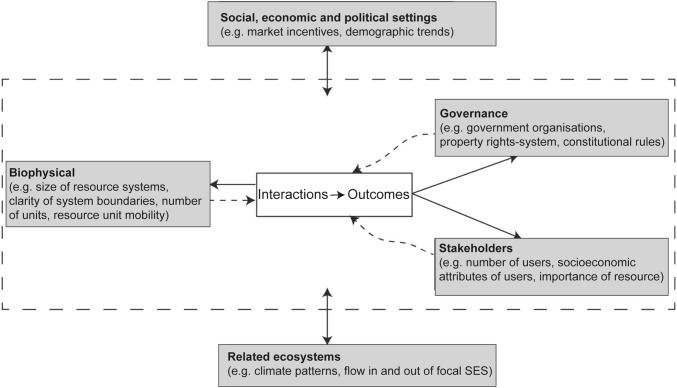
Simplified representation of the components of a social-ecological system, adapted from Ostrom (Ostrom 2007, 2009). The biophysical, governance, and stakeholder boxes represent the local core subsystems (grey boxes inside the dashed rectangle) for understanding social-ecological outcomes in the context of managing common-pool resources such as biodiversity. Interactions among characteristics of the subsystems and their combined effect on stakeholders’ interactions and behaviours shape social-ecological outcomes. External subsystems (grey boxes outside the dashed line), including social, economic and political settings and related ecosystems, affect the local social-ecological system, thus also influencing outcomes
Fig. 3
Fig. 3
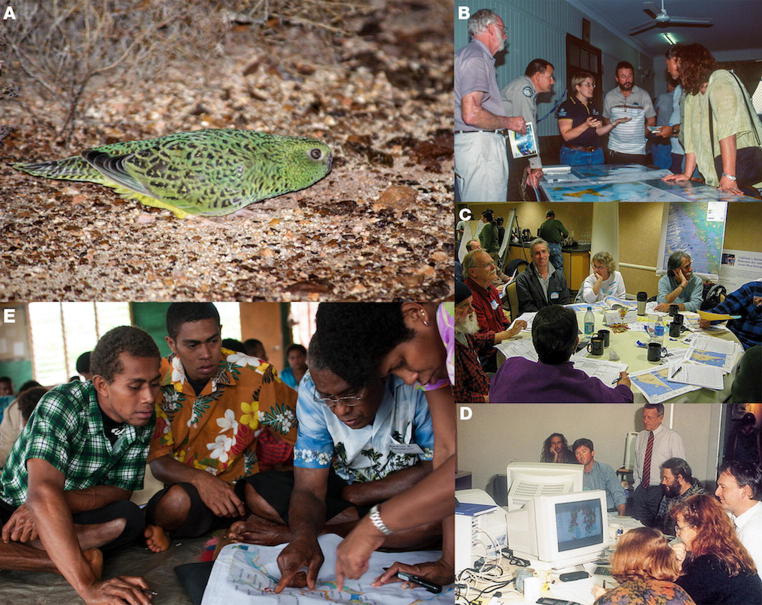
Stakeholder engagement processes vary depending upon the planning context and inputs available for planning. a Pullen Pullen Nature Reserve was established to protect the endangered night parrot (Pezoporus occidentalis); following acquisition of the property, the public were informed of the location of the reserve, to which all access is restricted (Photo: Nicholas Leseberg). b As part of the planning process for the Great Barrier Reef rezoning, public meetings were held in many small local communities; a summary of how public concerns were addressed was published along with the final zoning plan (Photo: GBRMPA). c Stakeholders are involved in drafting marine protected area proposals at a public workshop in California (Photo: Marine Life Protection Act Initiative). d During the New South Wales Regional Forest Agreement process, conservation planning software was used interactively by multi-stakeholder planning teams to identify conservation designs that were acceptable to all parties (Photo: Bob Pressey). e In Kubulau, Fiji, community members and traditional leaders made the final decision on the design of spatial management to be implemented (Photo: Rebecca Weeks)

References

    1. Adams VM, Álvarez-Romero JG, Capon SJ, Crowley GM, Dale AP, Kennard MJ, Douglas MM, Pressey RL. Making time for space: The critical role of spatial planning in adapting natural resource management to climate change. Environmental Science & Policy. 2017;74:57–67. doi: 10.1016/j.envsci.2017.05.003. - DOI
    1. Álvarez-Romero, J.G., M. Mills, V.M. Adams, G.G. Gurney, R.L. Pressey, R. Weeks, N.C. Ban, J. Cheok, et al. 2018. Research advances and gaps in marine planning: Towards a global database in systematic conservation planning. Biological Conservation (in press).
    1. Arias A, Cinner JE, Jones RE, Pressey RL. Levels and drivers of fishers’ compliance with marine protected areas. Ecology and Society. 2015;20:1–4. doi: 10.5751/ES-07999-200419. - DOI
    1. Armitage D. Governance and the commons in a multi-level world. International Journal of the Commons. 2008;2:7–32. doi: 10.18352/ijc.28. - DOI
    1. Baer WC. General plan evaluation criteria: An approach to making better plans. Journal of the American Planning Association. 1997;63:329–344. doi: 10.1080/01944369708975926. - DOI

MeSH terms