Randomized Controlled Trial
. 2018 Jun 26;10(7):826.
doi: 10.3390/nu10070826.

Oral Intake of Low-Molecular-Weight Collagen Peptide Improves Hydration, Elasticity, and Wrinkling in Human Skin: A Randomized, Double-Blind, Placebo-Controlled Study

Affiliations
Randomized Controlled Trial

Oral Intake of Low-Molecular-Weight Collagen Peptide Improves Hydration, Elasticity, and Wrinkling in Human Skin: A Randomized, Double-Blind, Placebo-Controlled Study

Do-Un Kim et al. Nutrients. .

Abstract

Collagen-peptide supplementation could be an effective remedy to improve hydration, elasticity, and wrinkling in human skin. The aim of this study was to conduct a double-blind, randomized, placebo-controlled trial to clinically evaluate the effect on human skin hydration, wrinkling, and elasticity of Low-molecular-weight Collagen peptide (LMWCP) with a tripetide (Gly-X-Y) content >15% including 3% Gly-Pro-Hyp. Individuals (n = 64) were randomly assigned to receive either placebo or 1000 mg of LMWCP once daily for 12 weeks. Parameters of skin hydration, wrinkling, and elasticity were assessed at baseline and after 6 weeks and 12 weeks. Compared with the placebo group, skin-hydration values were significantly higher in the LMWCP group after 6 weeks and 12 weeks. After 12 weeks in the LMWCP group, visual assessment score and three parameters of skin wrinkling were significantly improved compared with the placebo group. In case of skin elasticity, one parameter out of three was significantly improved in the LMWCP group from the baseline after 12 weeks, while, compared with the placebo group, two parameters out of three in the LMWCP group were higher with significance after 12 weeks. In terms of the safety of LMWCP, none of the subjects presented adverse symptoms related to the test material during the study period. These results suggest that LMWCP can be used as a health functional food ingredient to improve human skin hydration, elasticity, and wrinkling.

Keywords: collagen hydrolysate; collagen tripeptide; fish collagen; low-molecular-weight collagen peptide; photoaging; skin elasticity; skin hydration; skin wrinkling; type I collagen.


Conflict of interest statement

The authors and the company, Newtree Co., Ltd., declare no conflict of interest to any extent.

Figures
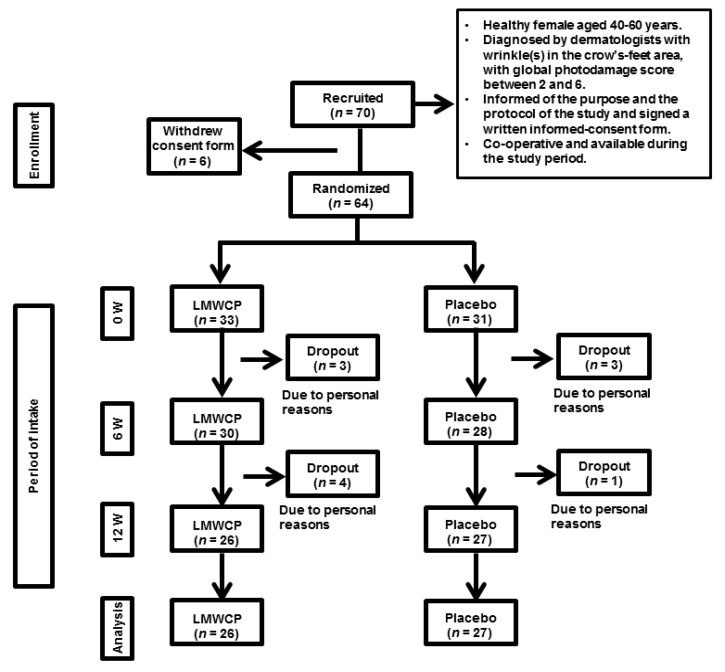
Figure 1
Figure 1
The study flow diagram. Abbreviations: LMWCP, Low-molecular-weight Collagen peptide; W, weeks.
Figure 2
Figure 2
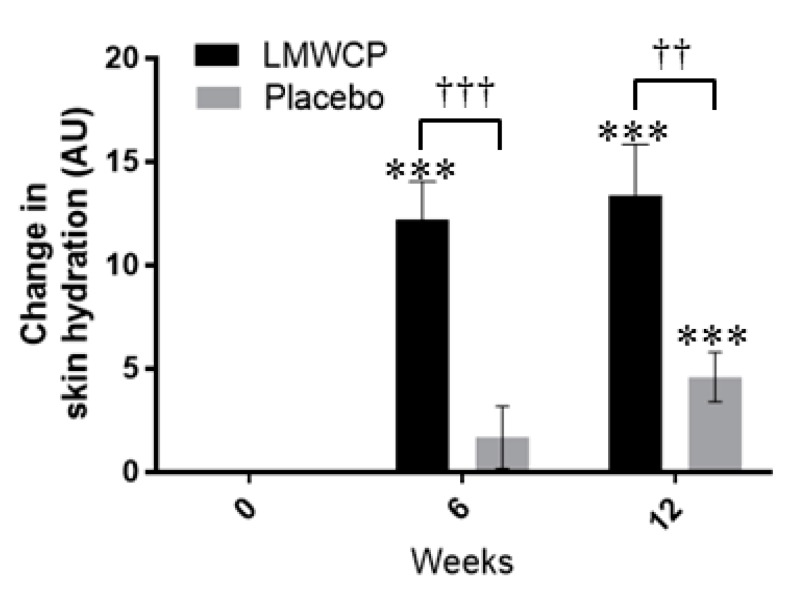
Changes in skin hydration in individuals receiving Low-molecular-weight Collagen peptide (LMWCP) preparation or placebo. Skin hydration was measured with a Corneometer CM825, and changes from baseline values are shown, with arbitrary units (AU). Data are expressed as the mean ± SEM. *** indicates a significant difference from the baseline (p < 0.001; t-test). †† and ††† indicate significant differences between the test group and the placebo group (p < 0.01 and p < 0.001, respectively; t-test).
Figure 3
Figure 3
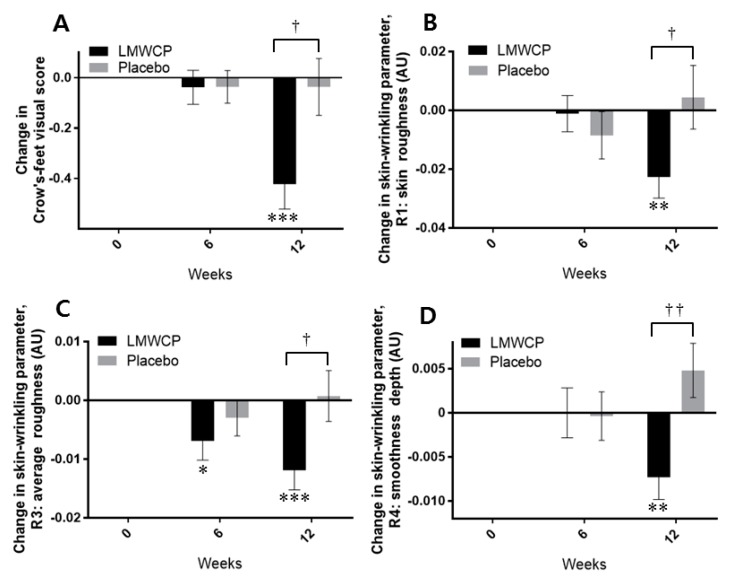
Changes in skin-wrinkling parameters in individuals receiving Low-molecular-weight Collagen peptide (LMWCP) preparation or placebo. (A) Changes in visually assessed Crow’s-feet scores. (B) Changes in skin-wrinkling parameter R1 (skin roughness). (C) Changes in skin-wrinkling parameter R3 (average roughness). (D) Changes in skin-wrinkling parameter R4 (smoothness depth). R1, R3, and R4 were measured instrumentally with a Skin Visiometer SV600. Changes in parameter values from baseline are shown in arbitrary units (AU). Data are expressed as the mean ± SEM. * p-values for t-test comparisons with baseline values; * indicates p < 0.05, ** indicates p < 0.01, *** indicates p < 0.001. p-values for t-test comparisons between values in the test group and the placebo group; indicates p < 0.05, †† indicates p < 0.01.
Figure 4
Figure 4
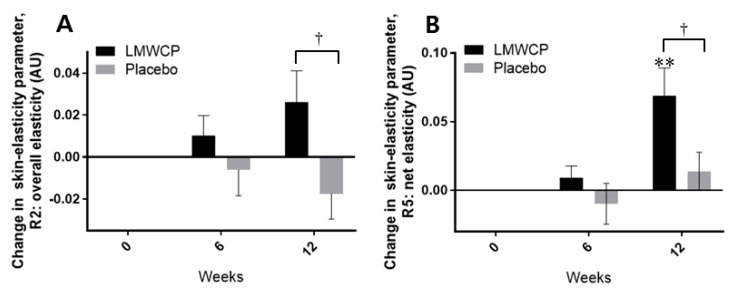
Changes in skin-elasticity parameters in individuals receiving Low-molecular-weight Collagen peptide (LMWCP) preparation or placebo. Skin elasticity was measured with a Cutometer MPA580. (A) Changes in skin-elasticity parameter R2 (overall elasticity). (B) Changes in skin-elasticity parameter R5 (net elasticity). Changes in parameter values from baseline are shown in arbitrary units (AU). Data are expressed as the mean ± SEM. For t-test comparisons with baseline values, ** indicates p < 0.01. For t-test comparisons between the test group and the placebo group, † indicates p < 0.05.

References

    1. Ichihashi M., Ando H., Yoshida M., Niki Y., Matsui M. Photoaging of the skin. Anti-Aging Med. 2009;6:46–59. doi: 10.3793/jaam.6.46. - DOI
    1. Kelly R.I., Pearse R., Bull R.H., Leveque J.-L., de Rigal J., Mortimer P.S. The effects of aging on the cutaneous microvasculature. J. Am. Acad. Dermatol. 1995;33:749–756. doi: 10.1016/0190-9622(95)91812-4. - DOI - PubMed
    1. Chung J.H., Yano K., Lee M.K., Youn C.S., Seo J.Y., Kim K.H., Cho K.H., Eun H.C., Detmar M. Differential effects of photoaging vs intrinsic aging on the vascularization of human skin. Arch. Dermatol. 2002;138:1437–1442. doi: 10.1001/archderm.138.11.1437. - DOI - PubMed
    1. Sherratt M.J. Tissue elasticity and the ageing elastic fibre. Age. 2009;31:305–325. doi: 10.1007/s11357-009-9103-6. - DOI - PMC - PubMed
    1. Watson R.E., Griffiths C.E., Craven N.M., Shuttleworth C.A., Kielty C.M. Fibrillin-rich microfibrils are reduced in photoaged skin. Distribution at the dermal–epidermal junction. J. Investig. Dermatol. 1999;112:782–787. doi: 10.1046/j.1523-1747.1999.00562.x. - DOI - PubMed

Publication types

MeSH terms

LinkOut - more resources