


A predictive model for conversion to psychosis in clinical high-risk patients
- PMID: 29950184
- PMCID: PMC6374204
- DOI: 10.1017/S003329171800171X
A predictive model for conversion to psychosis in clinical high-risk patients
Abstract
Background: The authors developed a practical and clinically useful model to predict the risk of psychosis that utilizes clinical characteristics empirically demonstrated to be strong predictors of conversion to psychosis in clinical high-risk (CHR) individuals. The model is based upon the Structured Interview for Psychosis Risk Syndromes (SIPS) and accompanying clinical interview, and yields scores indicating one's risk of conversion.
Methods: Baseline data, including demographic and clinical characteristics measured by the SIPS, were obtained on 199 CHR individuals seeking evaluation in the early detection and intervention for mental disorders program at the New York State Psychiatric Institute at Columbia University Medical Center. Each patient was followed for up to 2 years or until they developed a syndromal DSM-4 disorder. A LASSO logistic fitting procedure was used to construct a model for conversion specifically to a psychotic disorder.
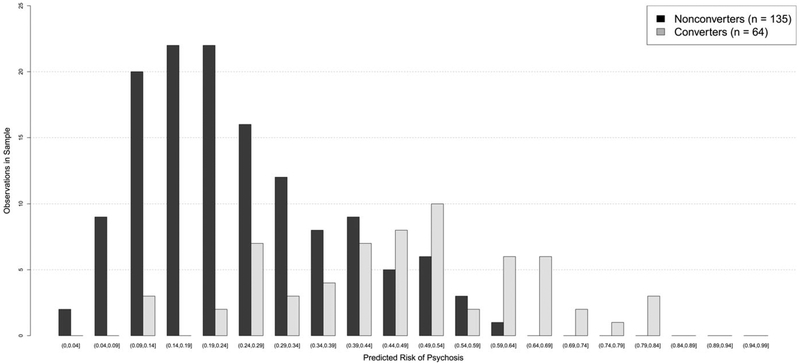
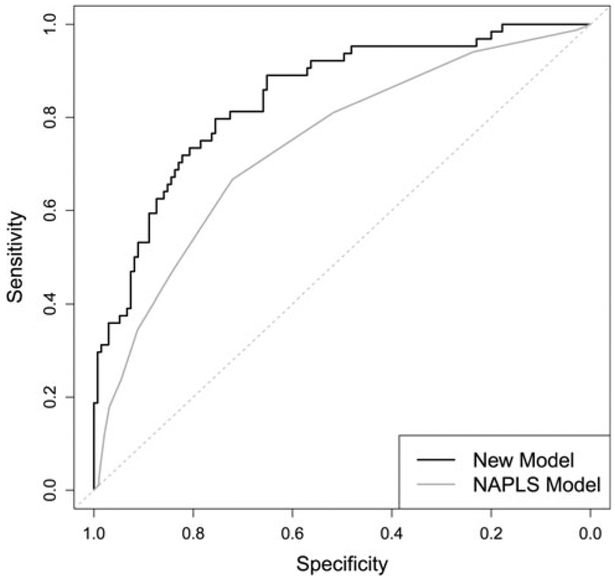
Results: At 2 years, 64 patients (32.2%) converted to a psychotic disorder. The top five variables with relatively large standardized effect sizes included SIPS subscales of visual perceptual abnormalities, dysphoric mood, unusual thought content, disorganized communication, and violent ideation. The concordance index (c-index) was 0.73, indicating a moderately strong ability to discriminate between converters and non-converters.
Conclusions: The prediction model performed well in classifying converters and non-converters and revealed SIPS measures that are relatively strong predictors of conversion, comparable with the risk calculator published by NAPLS (c-index = 0.71), but requiring only a structured clinical interview. Future work will seek to externally validate the model and enhance its performance with the incorporation of relevant biomarkers.
Keywords: Clinical high risk; prediction model; psychosis prediction; schizophrenia.
Figures
References
-
- Addington J, Cadenhead KS, Cannon TD, Cornblatt B, McGlashan TH, Perkins DO, Seidman LJ, Tsuang M, Walker EF, Woods SW and Heinssen R (2007) North American Prodrome Longitudinal Study: a collaborative multisite approach to prodromal schizophrenia research. Schizophrenia Bulletin 33, 665–672. - PMC - PubMed
-
- Addington J, Liu L, Buchy L, Cadenhead KS, Cannon TD, Cornblatt BA, Perkins DO, Seidman LJ, Tsuang MT, Walker EF, Woods SW, Bearden CE, Mathalon DH and McGlashan TH (2015) North American Prodrome Longitudinal Study (NAPLS 2): the prodromal symptoms. Journal of Nervous and Mental Disease 203, 328–335. - PMC - PubMed
-
- American Psychiatric Association (2000) Diagnostic and Statistical Manual of Mental Disorders, 4th Edn Text Revision. Washington DC: American Psychiatric Association.
-
- Andreasen NC, Endicott J, Spitzer RL and Winokur G (1977) The family history method using diagnostic criteria: reliability and validity. Archives of General Psychiatry 34, 1229–1235. - PubMed
Publication types
MeSH terms
Grants and funding
LinkOut - more resources
Full Text Sources
Other Literature Sources
Medical
