


Association between presenteeism and health-related quality of life among Japanese adults with chronic lower back pain: a retrospective observational study
- PMID: 29950467
- PMCID: PMC6042623
- DOI: 10.1136/bmjopen-2017-021160
Association between presenteeism and health-related quality of life among Japanese adults with chronic lower back pain: a retrospective observational study
Abstract
Objectives: This study investigated the relationship between presenteeism and health-related quality of life (HRQoL) among Japanese adults with chronic lower back pain (CLBP).
Design: This was a retrospective, cross-sectional study.
Setting: Data were collected via a self-administered online survey of the Japanese adult general population.
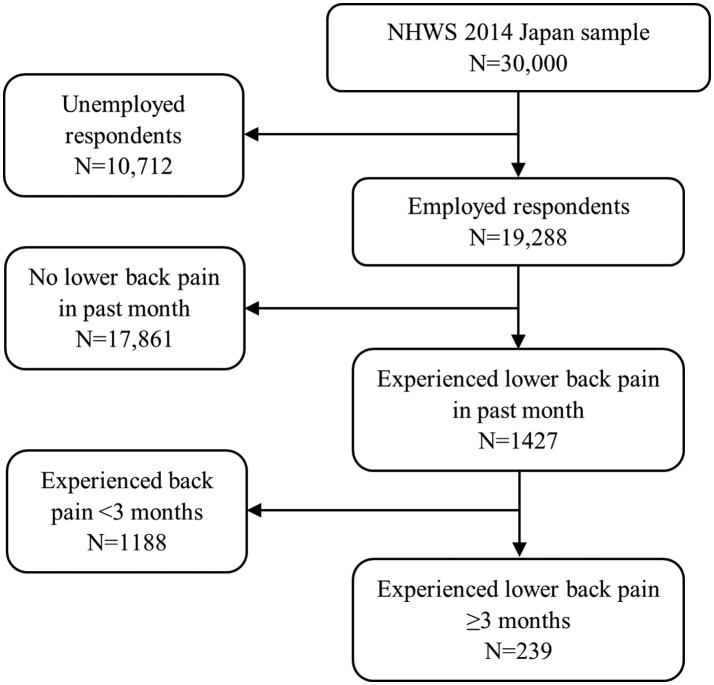
Participants: The present study used 2014 Japan National Health and Wellness Survey (NHWS) data (n=30 000). Specifically, data were included from NHWS respondents who self-reported being employed in the past week and having experienced LBP in the past month, with these symptoms lasting for at least 3 months (n=239). 84 (35.1%) participants in this study were female.
Primary and secondary outcome measures: Presenteeism and HRQoL were measured using the Work Productivity and Activity Impairment Questionnaire-General Health (categorical (none: 0%, low: 10%-20%, high: ≥30%) and continuous) and Medical Outcomes Study 36-Item Short Form Health Survey, respectively. Covariates included patient demographics, health characteristics, pain characteristics and depression severity (Patient Health Questionnaire).
Results: Presenteeism was reported by 77.4% of respondents. High (vs no) presenteeism related to more severe pain in the prior week (4.9±2.2 vs 3.6±2.1, p=0.001) and currently (5.1±2.1 vs 3.9±3.9, p=0.007), more pain sites (1.9±1.6 vs 1.1±1.4, p=0.004) and greater depression severity (7.5±6.5 vs 3.6±3.6, p<0.001). Adjusting for covariates, high (vs no) presenteeism related to lower mental and physical HRQoL. For low versus no presenteeism, significant HRQoL differences were observed in general health (43.0, 95% CI 40.3 to 45.6 vs 46.9, 95% CI 43.9 to 49.8, p=0.015).
Conclusions: Most respondents experienced presenteeism. Those with high or low presenteeism had poorer HRQoL than respondents with no presenteeism. Monitoring presenteeism rates may help identify workers with an unmet need for better CLBP-related pain management.
Keywords: chronic lower back pain; health-related quality of life; presenteeism.
© Article author(s) (or their employer(s) unless otherwise stated in the text of the article) 2018. All rights reserved. No commercial use is permitted unless otherwise expressly granted.
Conflict of interest statement
Competing interests: All authors have completed the International Committee of Medical Journal Editors (ICMJE) uniform disclosure form and declare the following: TT is a full-time employee and minor stock holder of Shionogi. HS is a full-time employee of Shionogi. KM has received speaking fees from Shionogi, Ayumi Pharmaceutical, Eli Lilly Japan K.K., Ono Pharmaceutical, Pfizer Japan, Nippon Zoki Pharmaceutical, Eisai and Teijin Pharma. KM has received research grants from Pfizer Japan, Eisai, Ayumi Pharmaceutical, Nippon Zoki Pharmaceutical, Ono Pharmaceutical, Lilly Japan K.K., Sumitomo Dainippon Pharma, Astellas Pharma, TOTO and Okamura. KM is a consultant to Shionogi. JV was and DHJ is employed by Kantar Health, which received fees from Shionogi, for access to survey data, analysis and reporting.
Figures
References
-
- Vos T, Barber RM, Bell B, et al. Global Burden of Disease Study 2013 Collaborators. Global, regional, and national incidence, prevalence, and years lived with disability for 301 acute and chronic diseases and injuries in 188 countries, 1990-2013: a systematic analysis for the Global Burden of Disease Study 2013. Lancet 2015;386:743–800. 10.1016/S0140-6736(15)60692-4 - DOI - PMC - PubMed
-
- National Institute of Neurological Disorders and Stroke, National Institutes of Health. Low Back Pain Fact Sheet. https://www.ninds.nih.gov/Disorders/Patient-Caregiver-Education/Fact-She... (accessed: May 2017).
-
- Qaseem A, Wilt TJ, McLean RM, et al. Clincial Guidelines Committee of the American College of Physicians: Noninvasive treatments for acute, subacute, and chronic low back pain: a clinical practice guideline from the American College of Physicians. Ann Intern Med 2017;166:514–30. - PubMed
Publication types
MeSH terms
LinkOut - more resources
Full Text Sources
Other Literature Sources
Miscellaneous
