. 2018 Jun 27;9(1):2484.
doi: 10.1038/s41467-018-04867-5.

C-NHEJ without indels is robust and requires synergistic function of distinct XLF domains

Affiliations

C-NHEJ without indels is robust and requires synergistic function of distinct XLF domains

Ragini Bhargava et al. Nat Commun. .

Abstract

To investigate the fidelity of canonical non-homologous end joining (C-NHEJ), we developed an assay to detect EJ between distal ends of two Cas9-induced chromosomal breaks that are joined without causing insertion/deletion mutations (indels). Here we find that such EJ requires several core C-NHEJ factors, including XLF. Using variants of this assay, we find that C-NHEJ is required for EJ events that use 1-2, but not ≥3, nucleotides of terminal microhomology. We also investigated XLF residues required for EJ without indels, finding that one of two binding domains is essential (L115 or C-terminal lysines that bind XRCC4 and KU/DNA, respectively), and that disruption of one of these domains sensitizes XLF to mutations that affect its dimer interface, which we examined with molecular dynamic simulations. Thus, C-NHEJ, including synergistic function of distinct XLF domains, is required for EJ of chromosomal breaks without indels.


Conflict of interest statement

The authors declare no competing interests.

Figures

Fig. 1
Fig. 1
Distal end joining (EJ) without causing indels requires C-NHEJ. a Shown is the EJ7-GFP reporter assay for distal EJ without indels. Representative flow cytometry plots are shown for WT mESCs with EJ7-GFP integrated into the Pim1 locus, which were untransfected (UN), or transfected with expression plasmids for Cas9 and sgRNAs (7a, 7b, or both). Shown is the amplification product and chromatogram from GFP+ WT mESCs to confirm the expected repair product. b Distal EJ without indels requires XRCC4, XLF, and KU70. WT, Xrcc4−/−, Xlf−/−, and Ku70−/− mESCs with EJ7-GFP integrated into the Pim1 locus were transfected with expression vectors for Cas9 and the 7a and 7b sgRNAs, in the presence of a control empty vector (EV) or a complementation vector. Shown are representative flow cytometry plots, as well as the frequency of GFP+ cells for these transfections, normalized to transfection efficiency. N = 6, error bars represent standard deviation (s.d.). *p < 0.0001, mutant cell lines vs. WT using an unpaired t-test, with the Holm-Sidak correction (for multiple comparisons). p ≤ 0.0006, EV vs. complemented compared using an unpaired, two-tailed t-test. Also shown are immunoblots confirming expression of XRCC4, XLF, and KU70
Fig. 2
Fig. 2
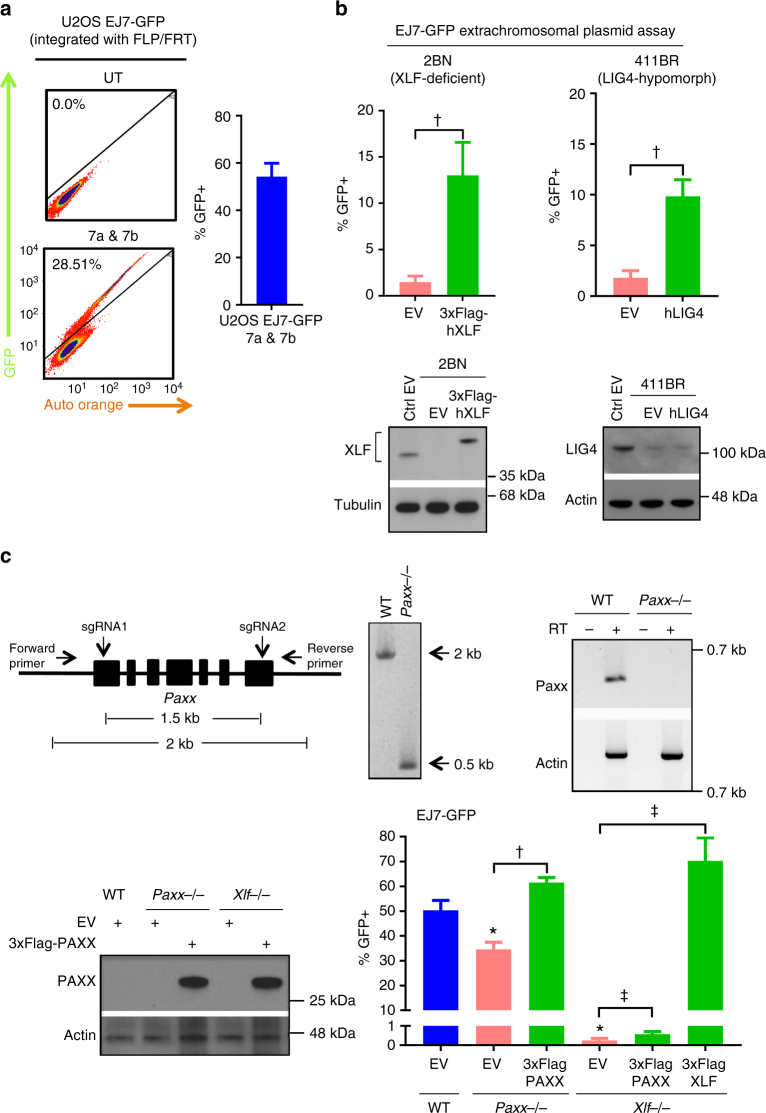
Distal EJ without indels is mediated by C-NHEJ in human cells; PAXX has a modest role on such EJ. a EJ7-GFP in U2OS. Shown are representative flow cytometry plots, and the frequency of GFP+ cells normalized to transfection efficiency, for the EJ7-GFP reporter integrated into U2OS cells, which were transfected with expression vectors for Cas9 and the 7a and 7b sgRNAs. N = 5, and error bar indicates s.d. b EJ7-GFP extrachromosomal plasmid assay in human fibroblasts. XLF-deficient (2BN) and LIG4 hypomorph (411BR) cells were transfected with EJ7-GFP, along with expression vectors for Cas9 and the 7a and 7b sgRNAs. Also included was a control (EV) or human (h) complementing vectors: 3xFlag-hXLF or hLIG4. Shown is the frequency of GFP+ cells normalized to transfection efficiency. N = 6, error bars indicate s.d. p < 0.0001, EV vs. complemented using an unpaired, two-tailed t-test. Shown are immunoblots for XLF and LIG4. The relative migration of 3xFlag-hXLF vs. endogenous XLF is consistent with the difference in molecular weight. c PAXX has a modest influence on EJ7-GFP. Shown is a diagram for Paxx gene disruption, with PCR and RT-PCR analysis for loss of the Paxx gene and transcript, respectively. Shown is the frequency of GFP+ cells normalized to transfection efficiency, for WT, Paxx−/−¸ and Xlf−/− mESCs with EJ7-GFP, and transfected with expression vectors for Cas9 and the 7a and 7b sgRNAs, with either EV or complementation vector. N = 6, error bars indicate s.d. Shown are immunoblots for PAXX expression. *p < 0.0001, WT vs. mutants; p ≤ 0.0008, EV vs. complemented, both using an unpaired t-test with the Holm-Sidak correction. p < 0.0001, EV vs. complemented using an unpaired, two-tailed t-test
Fig. 3
Fig. 3
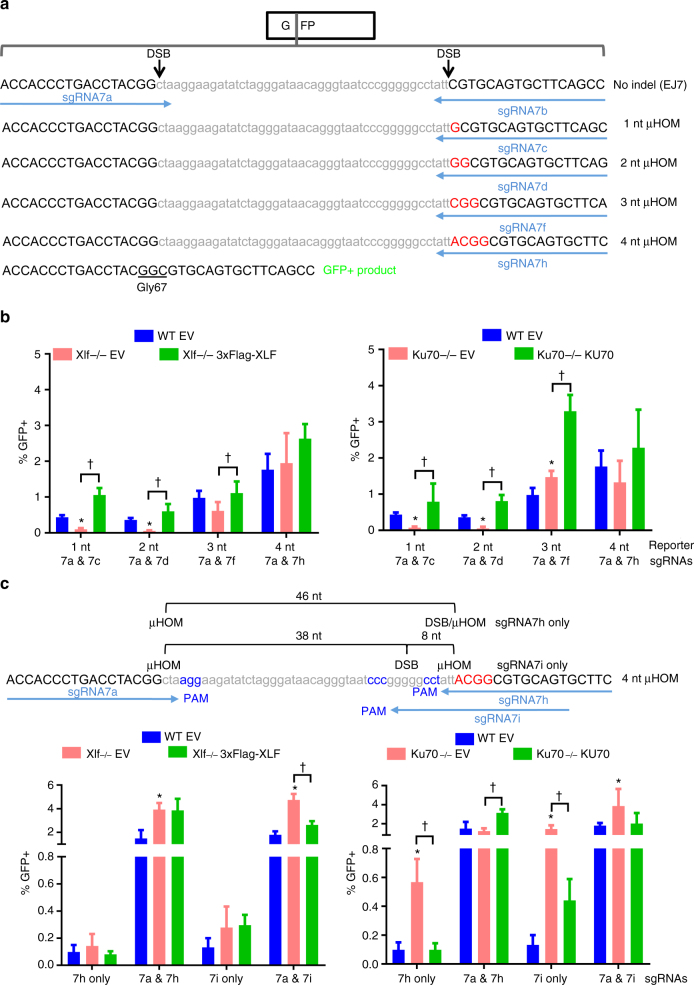
C-NHEJ is required for EJ involving 1–2, but not ≥3, nucleotides of terminal microhomology. a Shown are derivatives of the EJ7-GFP reporter with increasing amounts of terminal microhomology (µHOM) downstream of the 3′ DSB (red, uppercase), which also necessitates each reporter to use a different 3′ sgRNA. Use of the microhomology to form the associated deletion mutation is required to restore the GFP coding sequence. b Influence of XLF and KU70 on EJ using terminal microhomology. The microhomology EJ reporters in (a) were integrated into the Pim1 locus of WT, Xlf−/−, and Ku70−/− mESCs, and were transfected with sgRNA/Cas9 plasmids, along with control (EV) or complementation vector. Shown is the frequency of GFP+ cells normalized to transfection efficiency. N = 6, error bars indicate s.d. *p < 0.004, Xlf−/− and Ku70−/− compared to WT using an unpaired t-test with the Holm-Sidak correction. p < 0.02, control EV vs. complemented using an unpaired, two-tailed t-test. c KU70 suppresses EJ with embedded microhomology. Shown is the 4-nt microhomology reporter in (a) with sgRNAs that generate DSBs positioned at varying distances from the 5′ and 3′ microhomology, which were used for transfections as in (b). Shown are GFP+ cells normalized to transfection efficiency. N = 6, error bars indicate s.d. *p < 0.0003, WT vs. mutant cell line using an unpaired t-test with the Holm-Sidak correction. p ≤ 0.0002, control EV vs. complemented using an unpaired, two-tailed t-test
Fig. 4
Fig. 4
CtIP and POLQ promote EJ events using 4 nts of embedded microhomology. a WT mESCs with the chromosomally integrated EJ7 and microhomology reporters as in Figs. 1a and 3a were transfected with the respective sgRNA/Cas9 plasmids in the presence of either siControl or siCtIP. Shown is the frequency of the GFP+ cells normalized to transfection efficiency. N = 6. Error bars indicate s.d. *p < 0.005, siControl vs. siCtIP using an unpaired t-test with the Holm-Sidak correction. §p < 0.05, but >0.05 when adjusted for multiple comparisons. Also shown is immunoblotting analysis confirming CTIP depletion in WT mESCs. b The EJ7 and microhomology reporters as in Fig. 3a were integrated into Polq−/− mESCs, and were transfected with sgRNA/Cas9 plasmids along with a control (EV) or complementation vector. Shown is the frequency of GFP+ cells normalized to transfection efficiency. The frequencies for WT mESCs are the same as in Figs. 1b and 3b. N ≥ 6 for Polq−/− mESCs and N = 6 for WT mESCs. Error bars indicate s.d. *p < 0.002, WT vs. Polq−/− mESCs using an unpaired t-test with the Holm-Sidak correction. §p < 0.05, but >0.05 when adjusted for multiple comparisons. p < 0.01, control EV vs. complemented using an unpaired, two-tailed t-test. Also shown is immunoblotting analysis confirming expression of the complementation vector
Fig. 5
Fig. 5
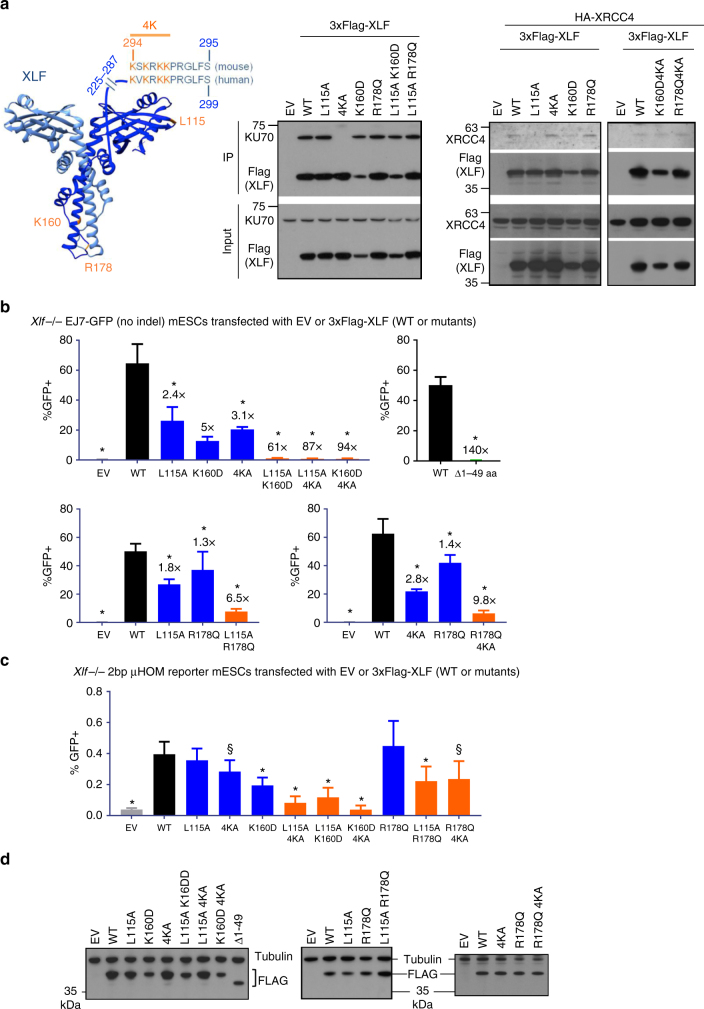
Mutations in distinct domains of XLF have a synergistic effect on distal EJ without indels. a Shown is the known structure of the XLF dimer (aa 1–224, using information from the Protein Data Bank, Code 2R9A, image generated with UCSF Chimera), with the two monomers in dark and light blue. The unstructured C terminus (aa 225–299) is drawn using a blue line. Residues that are being examined in this study are highlighted in orange. Also shown are effects of various XLF mutations on complex formation with KU70 and XRCC4. Lysates were prepared from Xlf−/− mESCs transfected with WT or mutant 3xFlag-tagged XLF (mouse) expression vectors. Experiments examining XRCC4 included an HA-XRCC4 expression vector. A fraction of the lysate was used for the input, and the rest was used for a Flag-immunoprecipitation (Flag-IP). Shown are immunoblot signals for Flag (XLF), KU70, and XRCC4. Numbers denote molecular weight marker positions (kDa). b Shown is the frequency of GFP+ cells of EJ7-GFP in Xlf−/− mESCs transfected with control EV, or 3xFlag-XLF expression vectors for WT and various mutants. N = 6, error bars indicate s.d. Also shown are the fold changes relative to complementation with WT. *p < 0.05, mutants compared to the WT using unpaired t-tests with the Holm-Sidak correction, except WT vs. Δ1–49 aa was compared using an unpaired, two-tailed t-test. c Shown is the frequency of GFP+ cells for the 2-nt microhomology reporter in Xlf−/− mESCs transfected with control (EV), or 3xFlag-tagged expression vectors for WT or mutant XLF. *p < 0.04, mutants compared to the WT using unpaired t-tests with the Holm-Sidak correction. §p < 0.05, but >0.05 when adjusted for multiple comparisons. d Shown are immunoblots examining expression of 3xFlag-XLF WT and the various mutants
Fig. 6
Fig. 6
Molecular dynamics simulations of the dimer interface for XLF WT and several mutants. a We measured the distance between the coiled-coil domains of each monomer of the XLF dimer for WT and mutant dimers from individual replicates of 230 ns simulations. A representative figure (left) shows the extreme distances of the separation between the coiled-coil domain observed in simulations: the WT structure (cyan and magenta dimer pair) in which the dimer interface is kept intact, and the K160D mutant (green and orange dimer pair) in which the dimer interface is disrupted. We observe an increase of ~6 Å in the distance between the coiled-coil interface of each monomer in the K160D mutant compared to the wild type. Also shown (right) are the distances for the coiled-coil domain, centered near residue K160, as the mean of replicates. Error bars show the 95% confidence interval from a one-directional Student’s t-test distribution. Asterisks denote significant difference compared to the WT. b Shown (left) are representative extreme distances for the pi stacking interaction of Y167 and Y167′ in the WT (cyan and magenta dimer pair) and the R178Q mutant dimer (green and orange dimer pair). Also shown (right) is the distance between the center of mass of Y167 and Y167′, plotted as mean of replicates. Error bars represent the 95% confidence interval from a one-directional Student’s t-test distribution. Asterisks denote significant difference compared to the WT
Fig. 7
Fig. 7
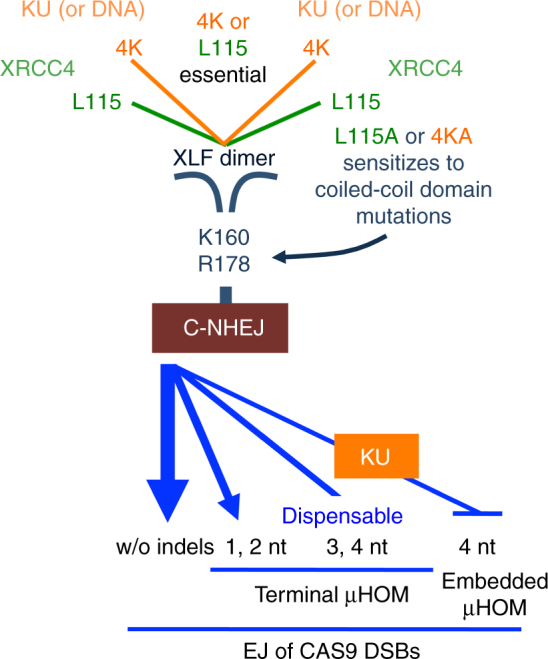
Summary. Shown is a model for the function of distinct XLF domains during C-NHEJ, as well as the role of C-NHEJ in distinct EJ events

References

    1. Ochi T, Wu Q, Blundell TL. The spatial organization of non-homologous end joining: from bridging to end joining. DNA Repair (Amst.) 2014;17:98–109. doi: 10.1016/j.dnarep.2014.02.010. - DOI - PMC - PubMed
    1. Chang HHY, Pannunzio NR, Adachi N, Lieber MR. Non-homologous DNA end joining and alternative pathways to double-strand break repair. Nat. Rev. Mol. Cell Biol. 2017;18:495–506. doi: 10.1038/nrm.2017.48. - DOI - PMC - PubMed
    1. Corneo B, et al. Rag mutations reveal robust alternative end joining. Nature. 2007;449:483–486. doi: 10.1038/nature06168. - DOI - PubMed
    1. McVey M, Lee SE. MMEJ repair of double-strand breaks (director’s cut): deleted sequences and alternative endings. Trends Genet. 2008;24:529–538. doi: 10.1016/j.tig.2008.08.007. - DOI - PMC - PubMed
    1. Zhu C, et al. Unrepaired DNA breaks in p53-deficient cells lead to oncogenic gene amplification subsequent to translocations. Cell. 2002;109:811–821. doi: 10.1016/S0092-8674(02)00770-5. - DOI - PubMed

Publication types