Review
. 2018 Jun 21:11:273-288.
doi: 10.2147/JIR.S128401. eCollection 2018.

The two faces of pannexins: new roles in inflammation and repair

Affiliations
Review

The two faces of pannexins: new roles in inflammation and repair

Helen P Makarenkova et al. J Inflamm Res. .

Abstract

Pannexins belong to a family of ATP-release channels expressed in almost all cell types. An increasing body of literature on pannexins suggests that these channels play dual and sometimes contradictory roles, contributing to normal cell function, as well as to the pathological progression of disease. In this review, we summarize our understanding of pannexin "protective" and "harmful" functions in inflammation, regeneration and mechanical signaling. We also suggest a possible basis for pannexin's dual roles, related to extracellular ATP and K+ levels and the activation of various types of P2 receptors that are associated with pannexin. Finally, we speculate upon therapeutic strategies related to pannexin using eyes, lacrimal glands, and peripheral nerves as examples of interesting therapeutic targets.

Keywords: ATP; Panx1; inflammation; pannexin; purinergic signaling; regeneration.


Conflict of interest statement

Disclosure The authors report no conflicts of interest in this work.

Figures
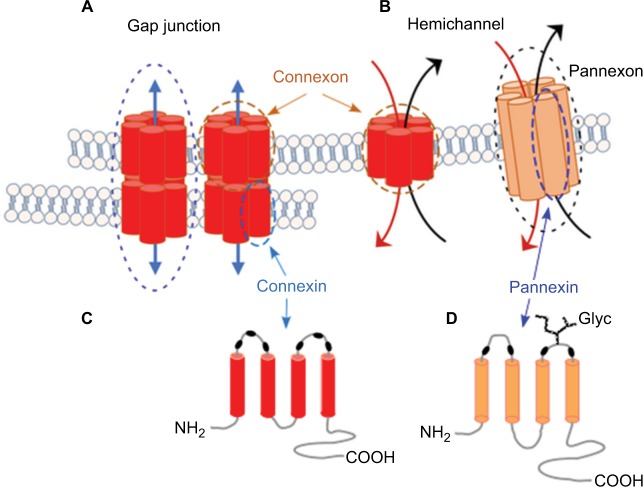
Figure 1
Figure 1
Connexins and pannexins. Notes: (A, B) Connexin and pannexin share a similar structure, despite the absence of sequence homology. Connexin and pannexin form functional connexon and pannexon hemichannels, respectively. (C, D) Connexins and pannexins are transmembrane proteins with four transmembrane domains, two extracellular loops, one cytoplasmic loop, and cytoplasmic N- and C-terminal domains. Connexin channels can assemble into a gap junction (A) that mediates intercellular communication, while pannexin’s extracellular loop has a high level of glycosylation in mammalian cells (D), which prevent the formation of gap junctions. Abbreviation: Glyc, glycosylation.
Figure 2
Figure 2
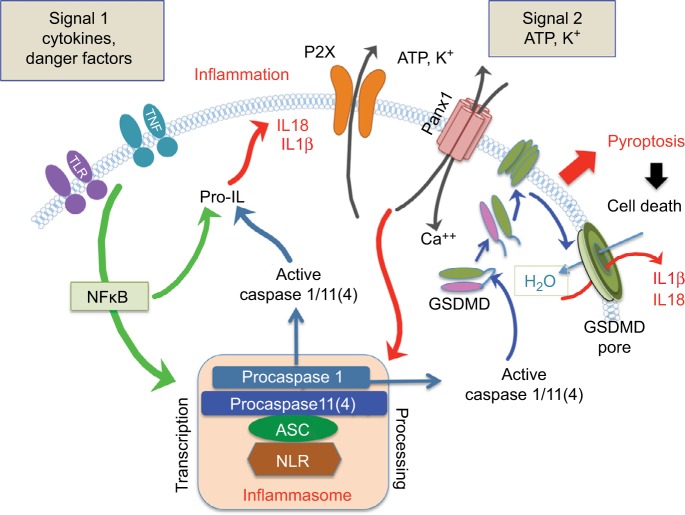
The two signaling arms of the inflammasome-activation cascade. Notes: Signal 1 pathways sense environmental signals via surface Tumor necrosis factor (TNF), Toll-like (TLR) and IL-1 receptors and facilitates transcriptional priming of inflammasome components via the NFκB pathway and upregulates the expression of precursor proteins of IL1β, caspases 1/11(also known as caspase 4), and pro-Nod-like receptors (NLR). Signal 2 facilitates activation of the complex via proteolytic processing and assembly. This arm responds to mechanical stress, activation of a ligand-sensing system within the cytosol or extracellular ATP sensing via Panx1–P2X receptor signalosomes. Upon activation, protease activity of caspases regulates the maturation and release of IL1β and IL18. Recent studies showed that Gasdermin D (GSDMD) is a novel membrane pore-forming protein. Cleaved by inflammatory caspases Casp1 or Casp11(4), GSDMD binds to phosphoinositides in the plasma membrane and oligomerizes to generate membrane pores of ~10–14 nm in diameter. This pore size can allow the passage of mature IL1β, IL18, and caspase 1. The formation of the GSDMD pores also disrupts osmotic potential, resulting in an inflammatory form of cell death known as pyroptosis. Abbreviation: ASC, apoptosis-associate speck-like protein containing a caspase recruitment domain.
Figure 3
Figure 3
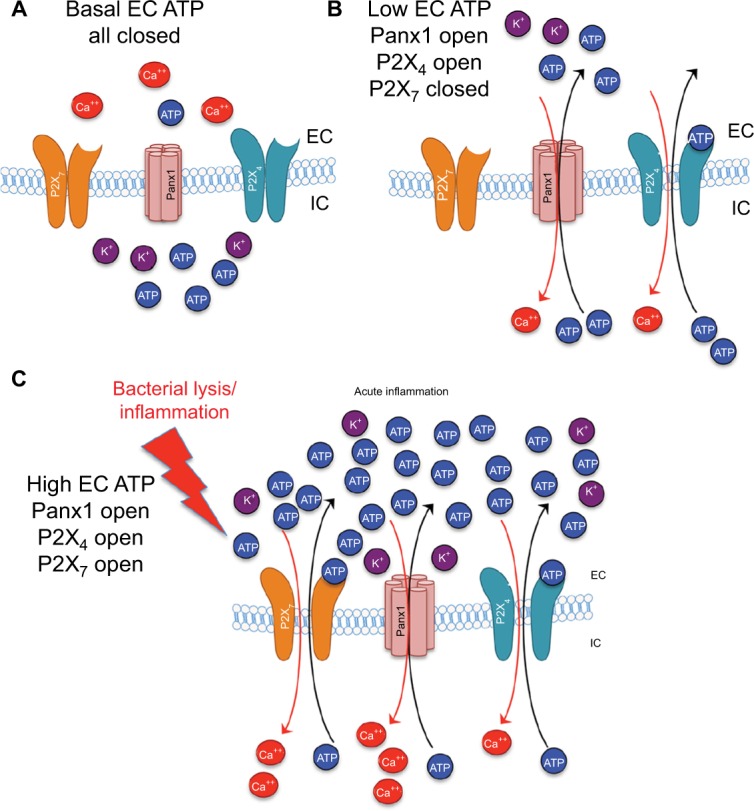
Differential ATP and ion movement depending on Panx1, P2X4, and P2X7 activity. Notes: (A) Basal levels of EC ATP and normal concentration gradients of ATP and ions. (B) Panx1 opening with low levels of EC ATP results in P2X4 activation, but no P2X7 activity. (C) Higher levels of EC ATP, such as those resulting from bacterial lysis or chronic inflammation, result in opening of P2X4 and P2X7 channels and substantial movement of ATP and ions along their concentration gradients. Abbreviations: EC, extracellular; IC, intracellular.
Figure 4
Figure 4
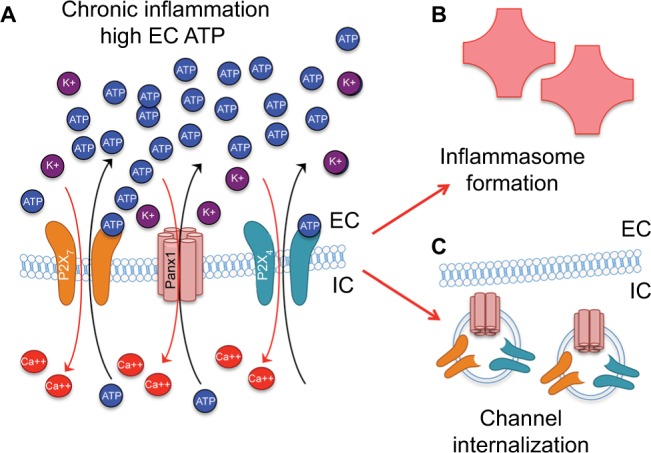
Persistent Panx1 and P2X activation (A) leads to inflammasome formation (B) and channel/receptor plasticity, including channel internalization through endocytosis (C). Abbreviations: EC, extracellular; IC, intracellular.
Figure 5
Figure 5
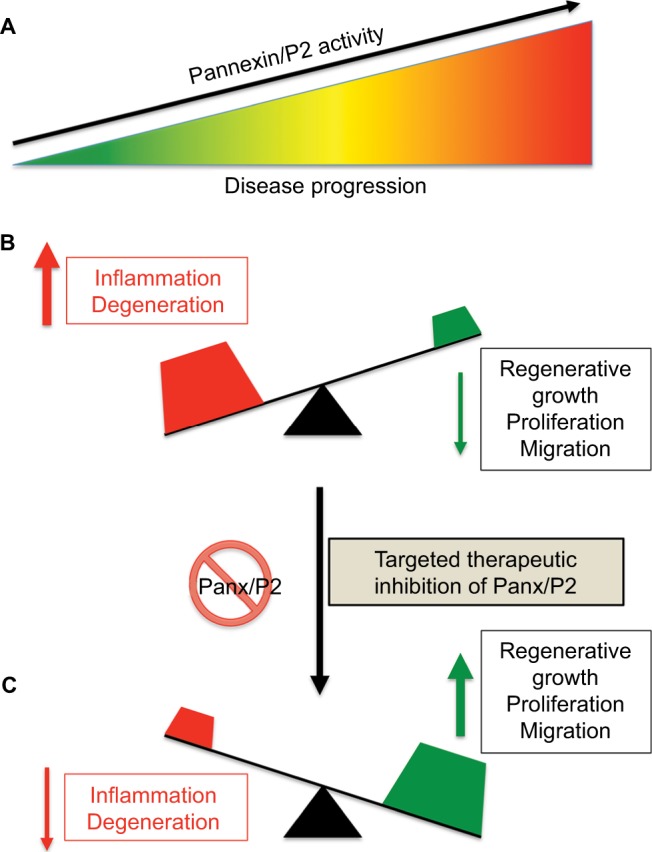
Effect of therapeutic suppression of pannexin function. Notes: (A) Disease progression often correlates with increased Panx/P2-receptor activity and chronic inflammation (B). We hypothesize that therapeutic suppression of pannexin function may tilt the balance of a progressing disease from that of inflammation and degeneration to one of enhanced cellular growth, proliferation, and/or migration (C).

References

    1. Phelan P, Bacon JP, Davies JA, et al. Innexins: a family of invertebrate gap-junction proteins. Trends Genet. 1998;14(9):348–349. - PMC - PubMed
    1. Phelan P, Starich TA. Innexins get into the gap. Bioessays. 2001;23(5):388–396. - PubMed
    1. Herve JC, Phelan P, Bruzzone R, White TW. Connexins, innexins and pannexins: bridging the communication gap. Biochim Biophys Acta. 2005;1719(1–2):3–5. - PubMed
    1. Makowski L, Caspar DL, Phillips WC, Baker TS, Goodenough DA. Gap junction structures – VI: variation and conservation in connexon conformation and packing. Biophys J. 1984;45(1):208–218. - PMC - PubMed
    1. Sáez JC, Retamal MA, Basilio D, Bukauskas FF, Bennett MV. Connexin-based gap junction hemichannels: gating mechanisms. Biochim Biophys Acta. 2005;1711(2):215–224. - PMC - PubMed