Review
. 2018 May 13:2018:1264913.
doi: 10.1155/2018/1264913. eCollection 2018.

The Role of Macrophages in the Pathogenesis of ALI/ARDS

Affiliations
Review

The Role of Macrophages in the Pathogenesis of ALI/ARDS

Xiaofang Huang et al. Mediators Inflamm. .

Abstract

Despite development in the understanding of the pathogenesis of acute lung injury (ALI)/acute respiratory distress syndrome (ARDS), the underlying mechanism still needs to be elucidated. Apart from leukocytes and endothelial cells, macrophages are also essential for the process of the inflammatory response in ALI/ARDS. Notably, macrophages play a dual role of proinflammation and anti-inflammation based on the microenvironment in different pathological stages. In the acute phase of ALI/ARDS, resident alveolar macrophages, typically expressing the alternatively activated phenotype (M2), shift into the classically activated phenotype (M1) and release various potent proinflammatory mediators. In the later phase, the M1 phenotype of activated resident and recruited macrophages shifts back to the M2 phenotype for eliminating apoptotic cells and participating in fibrosis. In this review, we summarize the main subsets of macrophages and the associated signaling pathways in three different pathological phases of ALI/ARDS. According to the current literature, regulating the function of macrophages and monocytes might be a promising therapeutic strategy against ALI/ARDS.


Figures
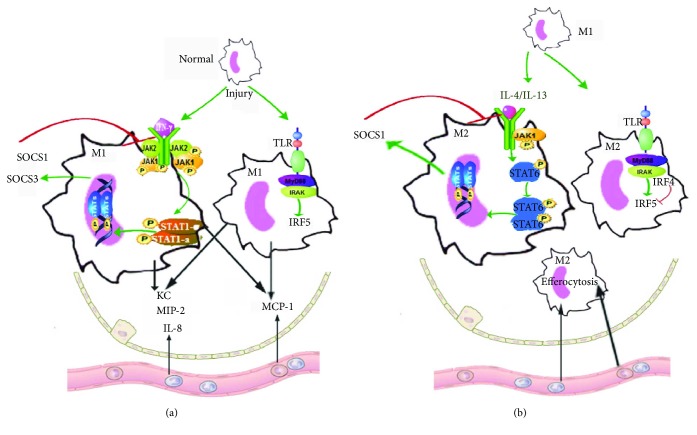
Figure 1
Figure 1
The molecular mechanism of SOCS- and IRF-regulated cytokine signaling in macrophages during ALI/ARDS. (a) Normal resident AMs are activated and shift into the M1 phenotype upon certain stimulation during the exudative phase of ALI/ARDS. Proinflammatory cytokines such as IFN-γ, TNF-α, and IL-β are excreted by M1 macrophages into the site of inflammation. The JAK–STAT1 pathway is activated by IFN-γ, and SOCS1 and SOCS3 are induced. SOCS1 and SOCS3 inhibit the signaling pathway by different mechanisms. IRF5 promotes M1 polarization by directly binding to IL-12 and IL-23 promoters. Leukocytes migrate into the cellular airspace by the activation of chemokines such as KC, MIP-2, and IL-8. Monocytes from the circulation are also recruited by chemokines such as MCP-1 and shift into the M1 phenotype. Crosstalk between SOCS3 and IRF5 may exist. (b) Macrophages shift from the M1 phenotype to the M2 phenotype during the later phase of ALI/ARDS. This process is regulated by several factors, including IL-4, IL-10, IL-13, STAT6, and IRF4. IL-4 or IL-13 activates the JAK–STAT6 pathway, and SOCS1 is induced. SOCS1 feedback inhibits the IL-4/IL-13 signaling. IRF4 inhibits IRF5 activation by a competing interaction with the adaptor MyD88. Recruited macrophages play an important role in eliminating apoptotic cells, debris, and pathogens. AMs: alveolar macrophages; IFN-γ: interferon-γ; JAK: Janus kinase; IL: interleukin; STAT: signal transducer and activator of transcription; IRF: interferon regulator factor; SOCS: suppressors of cytokine signaling; KC: keratinocyte-derived chemokine; MIP: macrophage inflammatory protein; MCP: monocyte chemoattractant protein; TNF-α: tumor necrosis factor α; TLR: toll-like receptor; MyD88: myeloid differentiation factor 88.

References

    1. Ware L. B., Matthay M. A. The acute respiratory distress syndrome. New England Journal of Medicine. 2000;342(18):1334–1349. doi: 10.1056/NEJM200005043421806. - DOI - PubMed
    1. Wheeler A. P., Bernard G. R. Acute lung injury and the acute respiratory distress syndrome: a clinical review. The Lancet. 2007;369(9572):1553–1564. doi: 10.1016/S0140-6736(07)60604-7. - DOI - PubMed
    1. Matuschak G. M., Lechner A. J. Acute lung injury and the acute respiratory distress syndrome: pathophysiology and treatment. Missouri Medicine. 2010;107(4):252–258. - PMC - PubMed
    1. Lomas-Neira J., Chung C. S., Perl M., Gregory S., Biffl W., Ayala A. Role of alveolar macrophage and migrating neutrophils in hemorrhage-induced priming for ALI subsequent to septic challenge. American Journal of Physiology. Lung Cellular and Molecular Physiology. 2006;290(1):L51–L58. doi: 10.1152/ajplung.00028.2005. - DOI - PubMed
    1. Johnston L. K., Rims C. R., Gill S. E., McGuire J. K., Manicone A. M. Pulmonary macrophage subpopulations in the induction and resolution of acute lung injury. American Journal of Respiratory Cell and Molecular Biology. 2012;47(4):417–426. doi: 10.1165/rcmb.2012-0090OC. - DOI - PMC - PubMed

MeSH terms
