Review
. 2018 Jun 13:5:181.
doi: 10.3389/fmed.2018.00181. eCollection 2018.

The Vaginal Microenvironment: The Physiologic Role of Lactobacilli

Affiliations
Review

The Vaginal Microenvironment: The Physiologic Role of Lactobacilli

Emmanuel Amabebe et al. Front Med (Lausanne). .

Abstract

In addition to being a passage for sperm, menstruum, and the baby, the human vagina and its microbiota can influence conception, pregnancy, the mode and timing of delivery, and the risk of acquiring sexually transmitted infections. The physiological status of the vaginal milieu is important for the wellbeing of the host as well as for successful reproduction. High estrogen states, as seen during puberty and pregnancy, promote the preservation of a homeostatic (eubiotic) vaginal microenvironment by stimulating the maturation and proliferation of vaginal epithelial cells and the accumulation of glycogen. A glycogen-rich vaginal milieu is a haven for the proliferation of Lactobacilli facilitated by the production of lactic acid and decreased pH. Lactobacilli and their antimicrobial and anti-inflammatory products along with components of the epithelial mucosal barrier provide an effective first line defense against invading pathogens including bacterial vaginosis, aerobic vaginitis-associated bacteria, viruses, fungi and protozoa. An optimal host-microbial interaction is required for the maintenance of eubiosis and vaginal health. This review explores the composition, function and adaptive mechanisms of the vaginal microbiome in health and those disease states in which there is a breach in the host-microbial relationship. The potential impact of vaginal dysbiosis on reproduction is also outlined.

Keywords: Lactobacillus; bacterial vaginosis; estrogen; glycogen; lactic acid; preterm birth; vaginal microbiota.


Figures
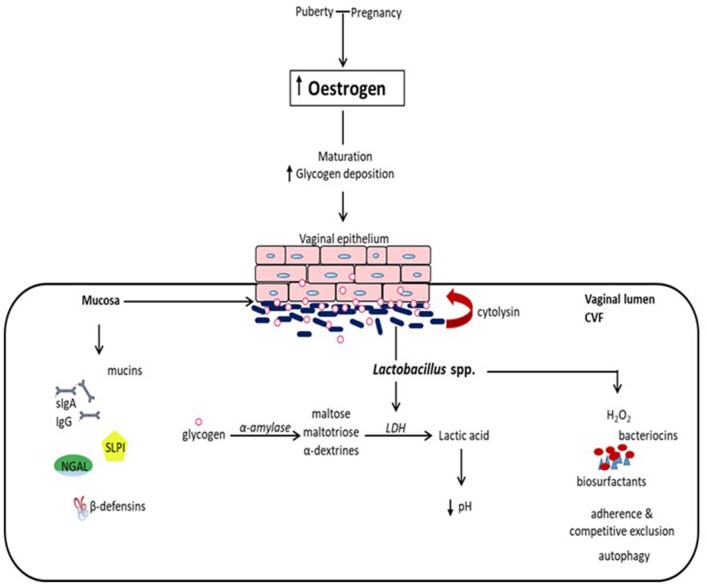
Figure 1
Figure 1
Eubiotic effect of estrogen and Lactobacillus species in the vaginal milieu. At puberty and during pregnancy, elevated levels of estrogen promote the maturation of and deposition of glycogen in vaginal epithelial cells. Glycogen from exfoliated and lysed epithelial cells is catabolized by α-amylase in the vaginal lumen to smaller polymers that are subsequently metabolized to lactic acid by Lactobacillus spp. Lactic acid and cytolysin produced by Lactobacilli stimulate the dissolution of epithelial cells by lysis and enhance the availability of glycogen. Lactic acid acidifies the vaginal milieu favoring the proliferation of Lactobacilli and inhibiting the growth of infection-associated organisms. This is reinforced by Lactobacilli through the production of hydrogen peroxide (H2O2), bacteriocins and biosurfactants, as well as the inhibition of the physical attachment of pathogens to the epithelium by competitive exclusion and the promotion of the engulfment and degradation of infected epithelial cells (autophagy). Additionally, there is concomitant production of mucins, immunoglobulins (secretory IgA and IgG), secretory leucocyte protease inhibitor (SLPI), neutrophil gelatinase-associated lipocalin (NGAL), and β-defensins, and other antimicrobial proteins, which all together provide a formidable first line of defense against infection. (CVF, cervicovaginal fluid; LDH, lactate dehydrogenase).
Figure 2
Figure 2
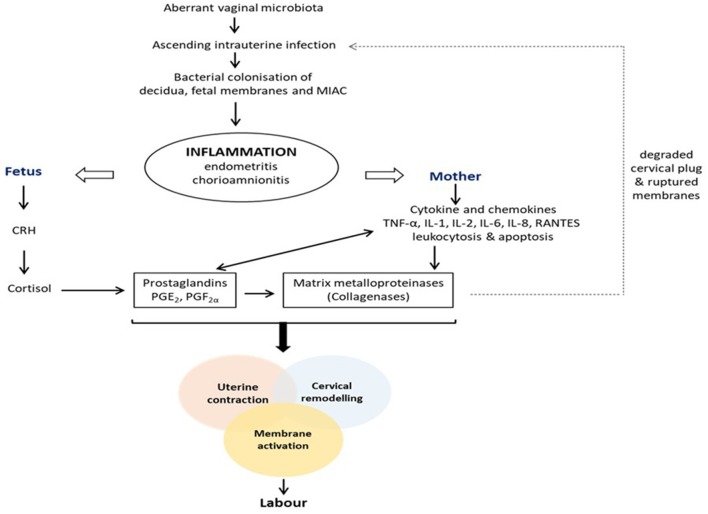
Pathogenesis of infection/inflammation-associated preterm labor and birth. Colonization of the female genital tract by pathogenic anaerobic bacteria due to an altered vaginal microbiota triggers a feed forward inflammatory response that ultimately stimulates the pathways to preterm labor and delivery, i.e., uterine contraction, cervical remodeling and membrane activation. CRH, corticotropin-releasing hormone; IL, interleukin; MIAC, microbial invasion of amniotic cavity; PGE2, prostaglandin E2; PGF, prostaglandin F; TNF, tumor necrosis factor.

References

    1. Aldunate M, Srbinovski D, Hearps AC, Latham CF, Ramsland PA, Gugasyan R, et al. Antimicrobial and immune modulatory effects of lactic acid and short chain fatty acids produced by vaginal microbiota associated with eubiosis and bacterial vaginosis. Front Physiol. (2015) 6:164. 10.3389/fphys.2015.00164 - DOI - PMC - PubMed
    1. Witkin SS. The vaginal microbiome, vaginal anti-microbial defence mechanisms and the clinical challenge of reducing infection-related preterm birth. BJOG (2015) 122:213–8. 10.1111/1471-0528.13115 - DOI - PubMed
    1. Witkin S, Linhares I. Why do lactobacilli dominate the human vaginal microbiota? BJOG (2016) 124:606–11. 10.1111/1471-0528.14390 - DOI - PubMed
    1. Marchesi JR, Ravel J. The vocabulary of microbiome research: a proposal. Microbiome (2015) 3:31. 10.1186/s40168-015-0094-5 - DOI - PMC - PubMed
    1. Smith SB, Ravel J. The vaginal microbiota, host defence and reproductive physiology. J Physiol. (2017) 595:451–63. 10.1113/JP271694 - DOI - PMC - PubMed