


Long-Term Outcomes of Immunosuppression-Naïve Steroid Responders Following Hospitalization for Ulcerative Colitis
- PMID: 29951797
- PMCID: PMC6139272
- DOI: 10.1007/s10620-018-5176-3
Long-Term Outcomes of Immunosuppression-Naïve Steroid Responders Following Hospitalization for Ulcerative Colitis
Abstract
Background: Requirement for hospitalization in ulcerative colitis (UC) is a marker of severity of disease. However, the paradigm of when to escalate therapy in such patients and the benefits of early immunomodulator initiation is less well established.
Aim: To examine the benefits of early therapy escalation in immunosuppression-naïve patients hospitalized with severe ulcerative colitis responsive to steroids.
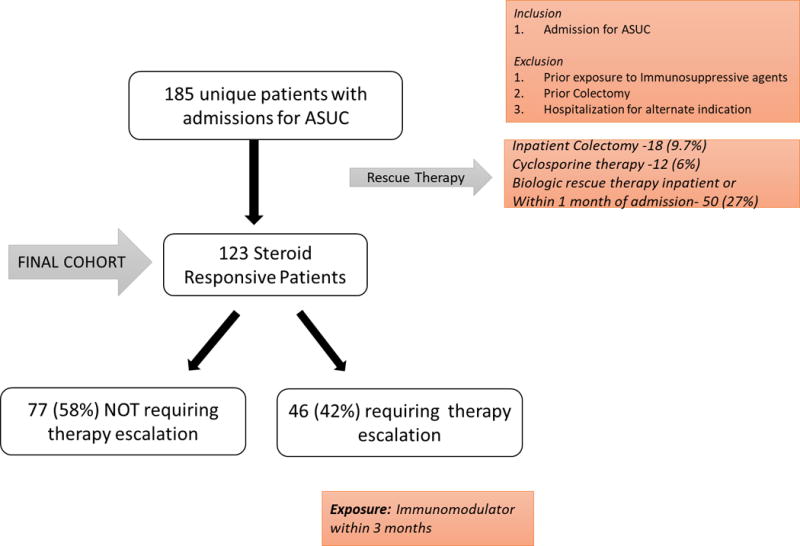
Methods: We identified hospitalized UC patients who were immunosuppression naïve at index hospitalization and responded to intravenous steroids, not requiring medical or surgical rescue therapy. The 'therapy escalated' group comprised of those who were initiated on immunomodulators within 3 months of hospitalization. The need for colectomy at 12 months was compared to the 'not escalated' group who remained on non-immunosuppressive therapy.
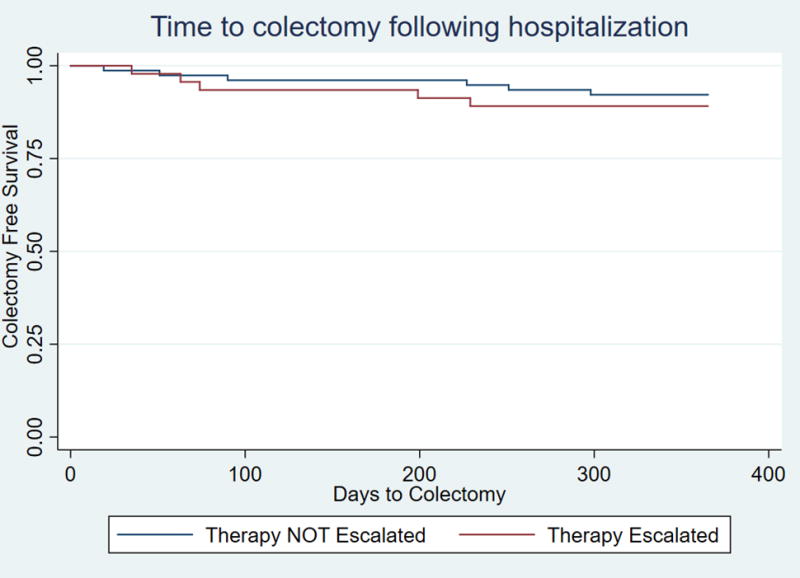
Results: Among 133 immunosuppressive naïve patients hospitalized for ulcerative colitis, 13 (9.8%) who responded to intravenous steroids and did not require rescue therapy underwent colectomy by 1 year. Among 123 patients who escalated to either immunomodulators (n = 46, 37%) or remained on non-immunosuppressive therapy (92% on 5-ASA), there was no difference in the need for colectomy at 1 year (10.8 vs. 7.8%; multivariate OR 1.29, 95% CI 0.35-4.74). There was also no difference in the time to colectomy between the two groups (p = 0.55).
Conclusion: Immunosuppression-naïve ASUC patients who respond to intravenous steroids remain at risk for colectomy. Immunomodulator initiation by 3 months did not reduce risk of colectomy at 1 year. There is an important need for prospective studies identifying thresholds for therapy escalation in UC.
Keywords: Acute severe ulcerative colitis; Colectomy; Hospitalization; Steroids.
Conflict of interest statement
Figures
References
-
- Bernstein CN, Wajda A, Svenson L, et al. The Epidemiology of Inflammatory Bowel Disease in Canada: A Population-Based Study. 2006;101 - PubMed
-
- Dinesen LC, Walsh AJ, Protic MN, et al. The pattern and outcome of acute severe colitis. Journal of Crohn’s and Colitis. 2010;4(4):431–437. - PubMed
-
- Turner D, Walsh CM, Steinhart AH, Griffiths AM. Response to corticosteroids in severe ulcerative colitis: a systematic review of the literature and a meta-regression. Clinical gastroenterology and hepatology: the official clinical practice journal of the American Gastroenterological Association. 2007;5(1):103–110. - PubMed
-
- Aratari A, Papi C, Clemente V, et al. Colectomy rate in acute severe ulcerative colitis in the infliximab era. Dig Liver Dis. 2008;40(10):821–826. - PubMed
Publication types
MeSH terms
Substances
Grants and funding
LinkOut - more resources
Full Text Sources
Other Literature Sources
Medical
