


Which patients with heart failure should receive specialist palliative care?
- PMID: 29952090
- PMCID: PMC6607479
- DOI: 10.1002/ejhf.1240
Which patients with heart failure should receive specialist palliative care?
Abstract
Aims: We investigated which patients with heart failure (HF) should receive specialist palliative care (SPC) by first creating a definition of need for SPC in patients hospitalised with HF using patient-reported outcome measures (PROMs) and then testing this definition using the outcome of days alive and out of hospital (DAOH). We also evaluated which baseline variables predicted need for SPC and whether those with this need received SPC.
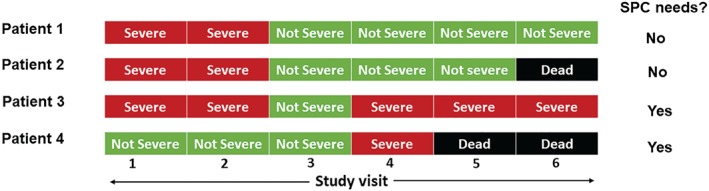
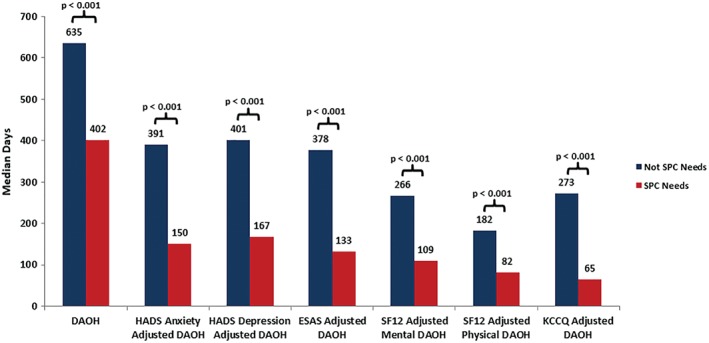
Methods and results: PROMs assessing quality of life (QoL), symptoms, and mood were administered at baseline and every 4 months. SPC need was defined as persistently severe impairment of any PROM without improvement (or severe impairment immediately preceding death). We then tested whether need for SPC, so defined, was reflected in DAOH, a measure which combines length of stay, days of hospital re-admission, and days lost due to death. Of 272 patients recruited, 74 (27%) met the definition of SPC needs. These patients lived one third fewer DAOH than those without SPC need (and less than a quarter of QoL-adjusted DAOH). A Kansas City Cardiomyopathy Questionnaire (KCCQ) summary score of <29 identified patients who subsequently had SPC needs (area under receiver operating characteristic curve 0.78). Twenty-four per cent of patients with SPC needs actually received SPC (n = 18).
Conclusions: A quarter of patients hospitalised with HF had a need for SPC and were identified by a low KCCQ score on admission. Those with SPC need spent many fewer DAOH and their DAOH were of significantly worse quality. Very few patients with SPC needs accessed SPC services.
Keywords: Heart failure; Palliative care.
© 2018 The Authors. European Journal of Heart Failure © 2018 European Society of Cardiology.
Figures
Comment in
-
Talking about palliative care in heart failure.Eur J Heart Fail. 2018 Sep;20(9):1348-1349. doi: 10.1002/ejhf.1239. Epub 2018 Jul 2. Eur J Heart Fail. 2018. PMID: 29963736 No abstract available.
References
-
- Barnes S, Gott M, Payne S, Parker C, Seamark D, Gariballa S, Small N. Prevalence of symptoms in a community‐based sample of heart failure patients. J Pain Symptom Manage 2006;32:208–216. - PubMed
-
- Jhund PS, Macintyre K, Simpson CR, Lewsey JD, Stewart S, Redpath A, Chalmers JW, Capewell S, McMurray JJ. Long‐term trends in first hospitalization for heart failure and subsequent survival between 1986 and 2003: a population study of 5.1 million people. Circulation 2009;119:515–523. - PubMed
-
- World Health Organisation . WHO Definition of Palliative Care http://www.who.int/cancer/palliative/definition/en/ (30 January 2017)
-
- Ponikowski P, Voors AA, Anker SD, Bueno H, Cleland JG, Coats AJ, Falk V, González‐Juanatey JR, Harjola VP, Jankowska EA, Jessup M, Linde C, Nihoyannopoulos P, Parissis JT, Pieske B, Riley JP, Rosano GM, Ruilope LM, Ruschitzka F, Rutten FH, van der Meer P. 2016 ESC Guidelines for the diagnosis and treatment of acute and chronic heart failure: The Task Force for the diagnosis and treatment of acute and chronic heart failure of the European Society of Cardiology (ESC) . Developed with the special contribution of the Heart Failure Association (HFA) of the ESC. Eur J Heart Fail 2016;18:891–975. - PubMed
-
- Yancy CW, Jessup M, Bozkurt B, Butler J, Casey DE, Drazner MH, Fonarow GC, Geraci SA, Horwich T, Januzzi JL, Johnson MR, Kasper EK, Levy WC, Masoudi FA, McBride PE, McMurray JJ, Mitchell JE, Peterson PN, Riegel B, Sam F, Stevenson LW, Tang WH, Tsai EJ, Wilkoff BL. 2013 ACCF/AHA guideline for the management of heart failure: a report of the American College of Cardiology Foundation/American Heart Association Task Force on Practice Guidelines. Circulation 2013;128:e240–327. - PubMed
Publication types
MeSH terms
Grants and funding
LinkOut - more resources
Full Text Sources
Other Literature Sources
Medical
Research Materials
Miscellaneous
