Review
. 2018 Oct 1;315(4):L526-L534.
doi: 10.1152/ajplung.00074.2018. Epub 2018 Jun 28.

Evolution of ARDS biomarkers: Will metabolomics be the answer?

Affiliations
Review

Evolution of ARDS biomarkers: Will metabolomics be the answer?

Sayed Metwaly et al. Am J Physiol Lung Cell Mol Physiol. .

Abstract

To date, there is no clinically agreed-upon diagnostic test for acute respiratory distress syndrome (ARDS): the condition is still diagnosed on the basis of a constellation of clinical findings, laboratory tests, and radiological images. Development of ARDS biomarkers has been in a state of continuous flux during the past four decades. To address ARDS heterogeneity, several studies have recently focused on subphenotyping the disease on the basis of observable clinical characteristics and associated blood biomarkers. However, the strong correlation between identified biomarkers and ARDS subphenotypes has yet to establish etiology; hence, there is a need for the adoption of other methodologies for studying ARDS. In this review, we will shed light on ARDS metabolomics research in the literature and discuss advances and major obstacles encountered in ARDS metabolomics research. Generally, the ARDS metabolomics studies focused on identification of differentiating metabolites for diagnosing ARDS, but they were performed to different standards in terms of sample size, selection of control cohort, type of specimens collected, and measuring technique utilized. Virtually none of these studies have been properly validated to identify true metabolomics biomarkers of ARDS. Though in their infancy, metabolomics studies exhibit promise to unfold the biological processes underlying ARDS and, in our opinion, have great potential for pushing forward our present understanding of ARDS.

Keywords: ARDS; acute respiratory distress syndrome; alveolar epithelial cells; biomarkers; metabolomics; vascular endothelium.


Conflict of interest statement

No conflicts of interest, financial or otherwise, are declared by the authors.

Figures
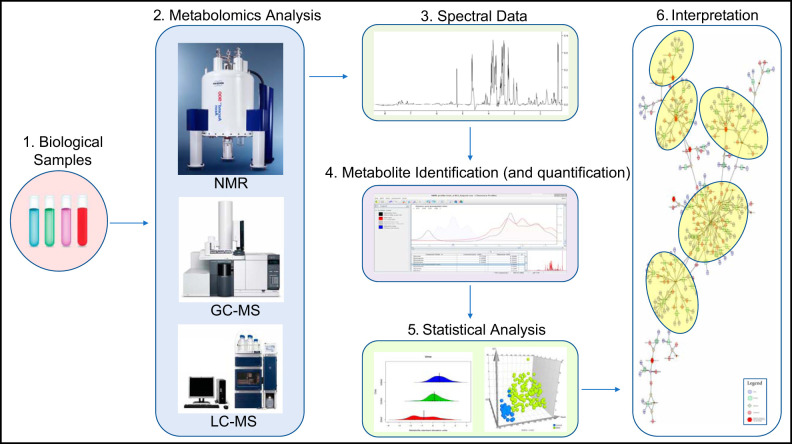
Fig. 1.
Fig. 1.
Typical workflow cycle of a metabolomics study (steps 1–6). 1) Metabolomics studies start with the selection of adequate samples. 2) Commonly used analytical methods include NMR, GC-MS, and/or light chromatography-mass spectrometry (LC-MS). These methods may be employed for either global screening of all possible metabolites (untargeted approach) or selected measurement of specific metabolites (targeted approach). 3) Analysis of resultant spectral data and metabolite selection. 4) Putative metabolite identification using compound libraries. NMR results are quantitative whereas GC-MS/LC-MS results can be quantitative only in targeted approaches. 5) Univariate and multivariate statistical analysis. The most commonly used multivariate analyses include principal component analysis and partial least squares analysis; however, there is a battery of methods that are becoming increasingly reported in literature, e.g., orthogonal partial least squares analysis, random forest analysis, support vector machines analysis, and K-means clustering. 6) Interpretation and, if applicable, identification of relevant pathways involved. Instruments shown in step 2 from top down are as follows: Bruker Ascend 900 Aeon NMR (courtesy of Bruker BioSpin Group), Agilent 7200B GC/Q-TOF (Agilent Technologies, 2014; reproduced with permission, courtesy of Agilent Technologies Incorporated), and Hitachi ChromasterUltra Rs Ultra-High Performance Liquid Chromatograph (courtesy of Hitachi High-Tech Science Corporation).

References

    1. Adamko DJ, Nair P, Mayers I, Tsuyuki RT, Regush S, Rowe BH. Metabolomic profiling of asthma and chronic obstructive pulmonary disease: a pilot study differentiating diseases. J Allergy Clin Immunol 136: 571–580, 2015. doi: 10.1016/j.jaci.2015.05.022. - DOI - PubMed
    1. Banoei MM, Donnelly SJ, Mickiewicz B, Weljie A, Vogel HJ, Winston BW. Metabolomics in critical care medicine: a new approach to biomarker discovery. Clin Invest Med 37: E363–E376, 2014. doi: 10.25011/cim.v37i6.22241. - DOI - PubMed
    1. Barnett N, Ware LB. Biomarkers in acute lung injury: marking forward progress. Crit Care Clin 27: 661–683, 2011. doi: 10.1016/j.ccc.2011.04.001. - DOI - PMC - PubMed
    1. Beckonert O, Keun HC, Ebbels TM, Bundy J, Holmes E, Lindon JC, Nicholson JK. Metabolic profiling, metabolomic and metabonomic procedures for NMR spectroscopy of urine, plasma, serum and tissue extracts. Nat Protoc 2: 2692–2703, 2007. doi: 10.1038/nprot.2007.376. - DOI - PubMed
    1. Bellani G, Laffey JG, Pham T, Fan E, Brochard L, Esteban A, Gattinoni L, van Haren F, Larsson A, McAuley DF, Ranieri M, Rubenfeld G, Thompson BT, Wrigge H, Slutsky AS, Pesenti A; LUNG SAFE Investigators; ESICM Trials Group . Epidemiology, patterns of care, and mortality for patients with acute respiratory distress syndrome in intensive care units in 50 countries. JAMA 315: 788–800, 2016. doi: 10.1001/jama.2016.0291. - DOI - PubMed

Publication types

MeSH terms

LinkOut - more resources