


Outbreaks Associated with Untreated Recreational Water - United States, 2000-2014
- PMID: 29953425
- PMCID: PMC6023190
- DOI: 10.15585/mmwr.mm6725a1
Outbreaks Associated with Untreated Recreational Water - United States, 2000-2014
Abstract
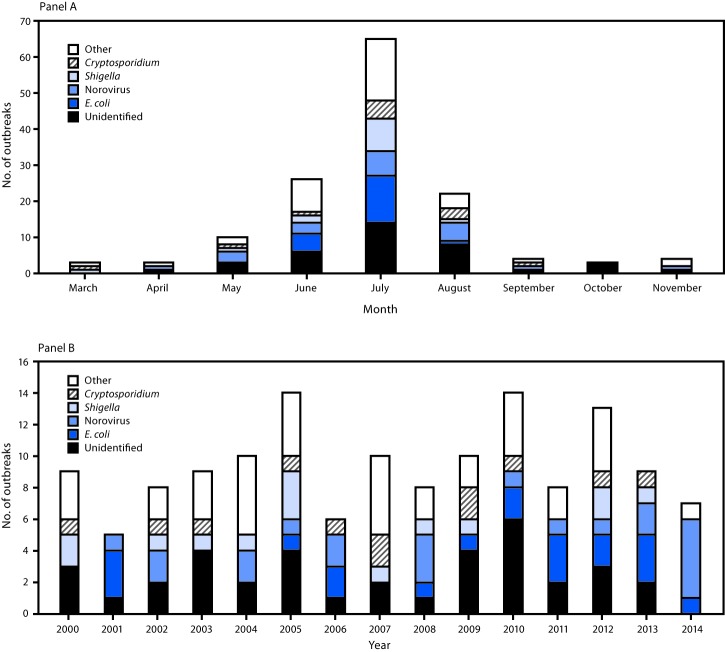
Outbreaks associated with untreated recreational water can be caused by pathogens, toxins, or chemicals in fresh water (e.g., lakes, rivers) or marine water (e.g., ocean). During 2000-2014, public health officials from 35 states and Guam voluntarily reported 140 untreated recreational water-associated outbreaks to CDC. These outbreaks resulted in at least 4,958 cases of disease and two deaths. Among the 95 outbreaks with a confirmed infectious etiology, enteric pathogens caused 80 (84%); 21 (22%) were caused by norovirus, 19 (20%) by Escherichia coli, 14 (15%) by Shigella, and 12 (13%) by Cryptosporidium. Investigations of these 95 outbreaks identified 3,125 cases; 2,704 (87%) were caused by enteric pathogens, including 1,459 (47%) by norovirus, 362 (12%) by Shigella, 314 (10%) by Cryptosporidium, and 155 (5%) by E. coli. Avian schistosomes were identified as the cause in 345 (11%) of the 3,125 cases. The two deaths were in persons affected by a single outbreak (two cases) caused by Naegleria fowleri. Public parks (50 [36%]) and beaches (45 [32%]) were the leading settings associated with the 140 outbreaks. Overall, the majority of outbreaks started during June-August (113 [81%]); 65 (58%) started in July. Swimmers and parents of young swimmers can take steps to minimize the risk for exposure to pathogens, toxins, and chemicals in untreated recreational water by heeding posted advisories closing the beach to swimming; not swimming in discolored, smelly, foamy, or scummy water; not swimming while sick with diarrhea; and limiting water entering the nose when swimming in warm freshwater.
Conflict of interest statement
CDC receives funding from the Great Lakes Restoration Initiative (a program administered by the Environmental Protection Agency) to support public health initiatives focused on the Great Lakes region. The Great Lakes Restoration Initiative had no involvement in the data collection, analysis, drafting, or review of this manuscript. No other conflicts of interest were reported.
Figures
References
-
- CDC. Surveillance reports for recreational water-associated disease & outbreaks. Atlanta, GA: US Department of Health and Human Services, CDC; 2017. https://www.cdc.gov/healthywater/surveillance/rec-water-surveillance-rep...
MeSH terms
LinkOut - more resources
Full Text Sources
Other Literature Sources
Medical
