


Comparison of chikungunya viruses generated using infectious clone or the Infectious Subgenomic Amplicons (ISA) method in Aedes mosquitoes
- PMID: 29953474
- PMCID: PMC6023229
- DOI: 10.1371/journal.pone.0199494
Comparison of chikungunya viruses generated using infectious clone or the Infectious Subgenomic Amplicons (ISA) method in Aedes mosquitoes
Abstract
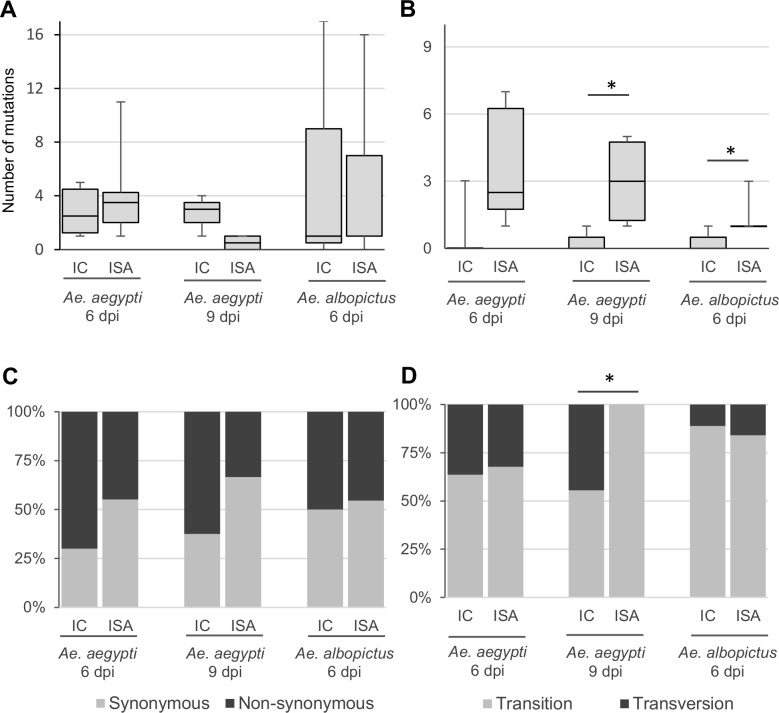
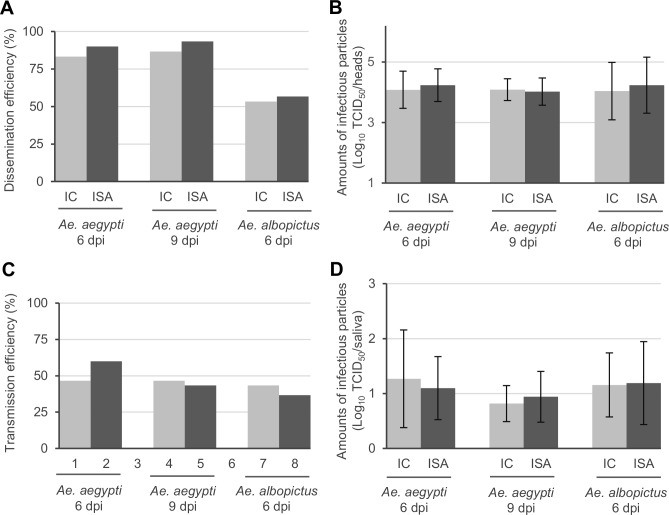
Reverse genetics systems provide the opportunity to manipulate viral genomes and have been widely used to study RNA viruses and to develop new antiviral compounds and vaccine strategies. The recently described method called ISA (Infectious Subgenomic Amplicons) gives the possibility to rescue RNA viruses in days. We demonstrated in cell culture that the use of the ISA method led to a higher genetic diversity of viral populations than that observed using infectious clone technology. However, no replicative fitness difference was observed. In the present study, we used the chikungunya virus as a model to compare in Aedes aegypti and Aedes albopictus mosquitoes the genotypic and phenotypic characteristics of viruses produced either from an infectious clone or using the ISA method. We confirmed the results found in cellulo corroborating that the use of the ISA method was associated with higher genetic diversity of viral populations in mosquitoes but did not affect the vector competence validating its use for in vivo experiments.
Conflict of interest statement
The authors have declared that no competing interests exist.
Figures
References
-
- Aubry F, Nougairede A, Gould EA, de Lamballerie X. Flavivirus reverse genetic systems, construction techniques and applications: a historical perspective. Antiviral research. 2015;114:67–85. Epub 2014/12/17. doi: 10.1016/j.antiviral.2014.12.007 . - DOI - PMC - PubMed
-
- Neumann G, Kawaoka Y. Reverse genetics systems for the generation of segmented negative-sense RNA viruses entirely from cloned cDNA. Curr Top Microbiol Immunol. 2004;283:43–60. Epub 2004/08/10. . - PubMed
-
- Yang CC, Hu HS, Wu RH, Wu SH, Lee SJ, Jiaang WT, et al. A novel dengue virus inhibitor, BP13944, discovered by high-throughput screening with dengue virus replicon cells selects for resistance in the viral NS2B/NS3 protease. Antimicrob Agents Chemother. 2014;58(1):110–9. doi: 10.1128/AAC.01281-13 ; PubMed Central PMCID: PMCPMC3910792. - DOI - PMC - PubMed
-
- Rice CM, Grakoui A, Galler R, Chambers TJ. Transcription of infectious yellow fever RNA from full-length cDNA templates produced by in vitro ligation. New Biol. 1989;1(3):285–96. Epub 1989/12/01. . - PubMed
Publication types
MeSH terms
Substances
LinkOut - more resources
Full Text Sources
Other Literature Sources
Medical
