


Gunn rats with glial activation in the hippocampus show prolonged immobility time in the forced swimming test and tail suspension test
- PMID: 29953737
- PMCID: PMC6085916
- DOI: 10.1002/brb3.1028
Gunn rats with glial activation in the hippocampus show prolonged immobility time in the forced swimming test and tail suspension test
Abstract
Introduction: Recent studies imply that glial activation plays a role in the pathogenesis of psychiatric disorders, such as schizophrenia and major depression. We previously demonstrated that Gunn rats with hyperbilirubinemia show congenital gliosis and schizophrenia-like behavior.
Methods: As it has been suggested that major depression involves glial activation associated with neuroinflammation, we examined whether Gunn rats show depression-like behavior using the forced swimming test (FST) and the tail suspension test (TST). In addition, we quantitatively evaluated both microgliosis and astrogliosis in the hippocampus of Gunn rats using immunohistochemistry analysis of the microglial marker ionized calcium-binding adaptor molecule (Iba) 1 and the astrocytic marker S100B.
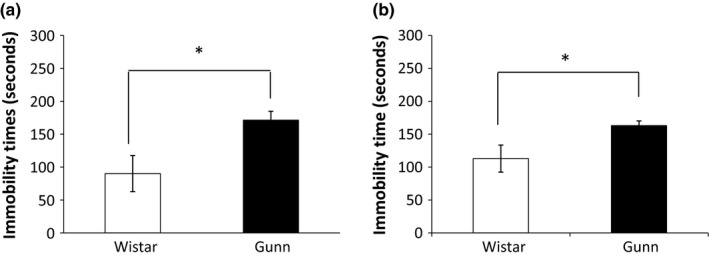
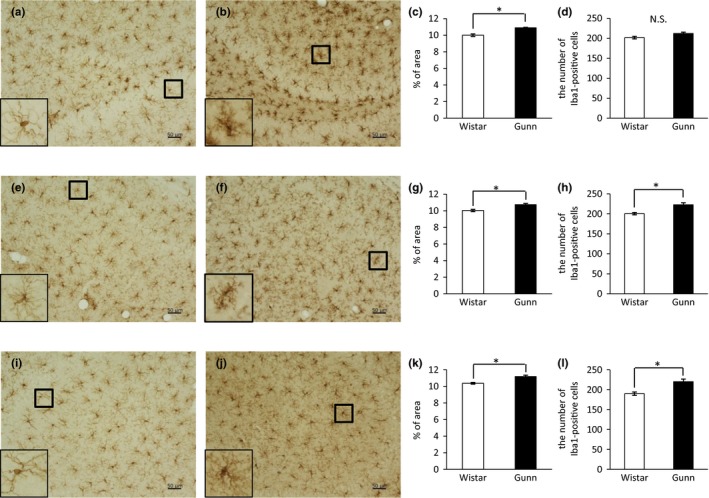
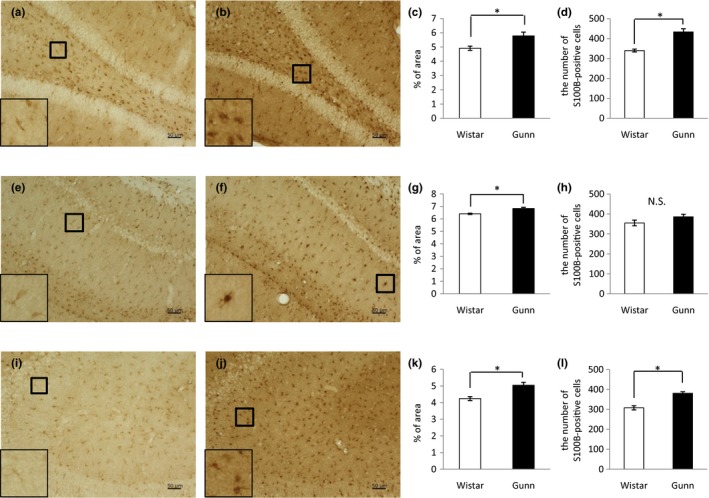
Results: Both the FST and TST showed that immobility time of Gunn rats was significantly longer than that of normal control Wistar rats, indicating that Gunn rats are somewhat helpless, a sign of depression-like behavior. In the quantification of immunohistochemical analysis, Iba1immunoreactivity in the dentate gyrus (DG), cornu ammonis (CA) 1, and CA3 and the number of Iba1-positive cells in the CA1 and CA3 were significantly increased in Gunn rats compared to Wistar rats. S100B immunoreactivity in the DG, CA1, and CA3 and the number of S100B-positive cells in the DG and CA3 were significantly increased in Gunn rats compared to Wistar rats.
Conclusion: Our findings suggest that both microglia and astrocyte are activated in Gunn rats and their learned helplessness could be related to glial activation.
Keywords: Gunn rat; astrocytes; forced swimming test; hippocampus; microglia; tail suspension test.
© 2018 The Authors. Brain and Behavior published by Wiley Periodicals, Inc.
Figures
References
-
- Burke, N. N. , Geoghegan, E. , Kerr, D. M. , Moriarty, O. , Finn, D. P. , & Roche, M. (2013). Altered neuropathic pain behaviour in a rat model of depression is associated with changes in inflammatory gene expression in the amygdala. Genes, Brain and Behavior, 12(7), 705–713. 10.1111/gbb.12080 - DOI - PubMed
Publication types
MeSH terms
LinkOut - more resources
Full Text Sources
Other Literature Sources
Medical
Research Materials
Miscellaneous
