


Role of p53 in the Regulation of the Inflammatory Tumor Microenvironment and Tumor Suppression
- PMID: 29954119
- PMCID: PMC6071291
- DOI: 10.3390/cancers10070219
Role of p53 in the Regulation of the Inflammatory Tumor Microenvironment and Tumor Suppression
Abstract
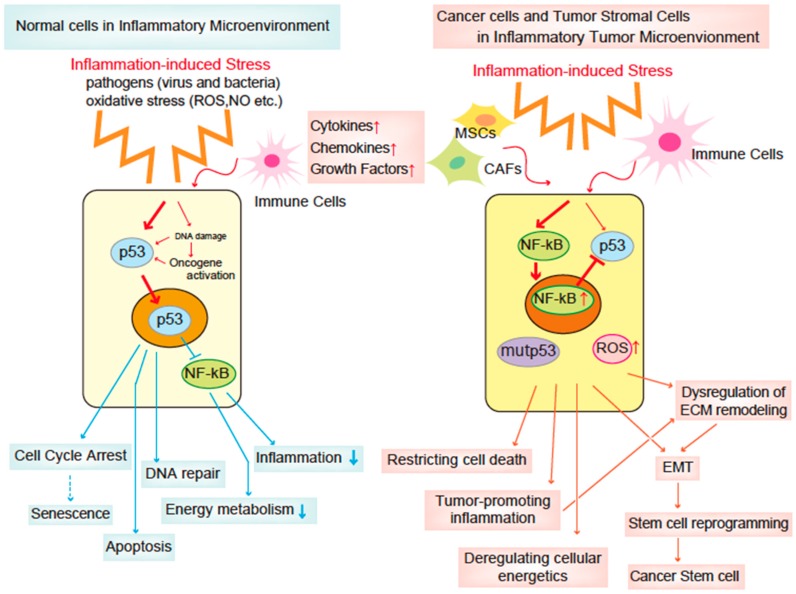
p53 has functional roles in tumor suppression as a guardian of the genome, surveillant of oncogenic cell transformation, and as recently demonstrated, a regulator of intracellular metabolism. Accumulating evidence has shown that the tumor microenvironment, accompanied by inflammation and tissue remodeling, is important for cancer proliferation, metastasis, and maintenance of cancer stem cells (CSCs) that self-renew and generate the diverse cells comprising the tumor. Furthermore, p53 has been demonstrated to inhibit inflammatory responses, and functional loss of p53 causes excessive inflammatory reactions. Moreover, the generation and maintenance of CSCs are supported by the inflammatory tumor microenvironment. Considering that the functions of p53 inhibit reprogramming of somatic cells to stem cells, p53 may have a major role in the inflammatory microenvironment as a tumor suppressor. Here, we review our current understanding of the mechanisms underlying the roles of p53 in regulation of the inflammatory microenvironment, tumor microenvironment, and tumor suppression.
Keywords: cancer metabolism; cancer stem cells; cellular reprograming; inflammation; nuclear factor-κB (NF-κB); oxidative stress; p53; tumor microenvironment.
Conflict of interest statement
The authors declare no conflicts of interest.
Figures
References
Publication types
LinkOut - more resources
Full Text Sources
Other Literature Sources
Research Materials
Miscellaneous
