


Uptake of hepatitis B vaccination and its determinants among health care workers in a tertiary health facility in Enugu, South-East, Nigeria
- PMID: 29954344
- PMCID: PMC6027786
- DOI: 10.1186/s12879-018-3191-9
Uptake of hepatitis B vaccination and its determinants among health care workers in a tertiary health facility in Enugu, South-East, Nigeria
Abstract
Background: Hepatitis B vaccination is the most effective method of prevention for hepatitis B virus infection. It is a major public health problem in Nigeria, and health workers are at increased risk. This study determined the uptake of hepatitis B vaccination and assessed its determinants among health care workers (HCWs).
Methods: A hospital-based cross-sectional study was conducted between July and August, 2016 using self-administered structured questionnaires among 3132 HCWs in University of Nigeria Teaching Hospital, Enugu, South-East, Nigeria. Data was analysed using SPSS version 22. Binary logistic regression analysis was used to identify factors that influenced uptake of vaccination. Ethical clearance was obtained from the Research Ethics Committee of the health facility.
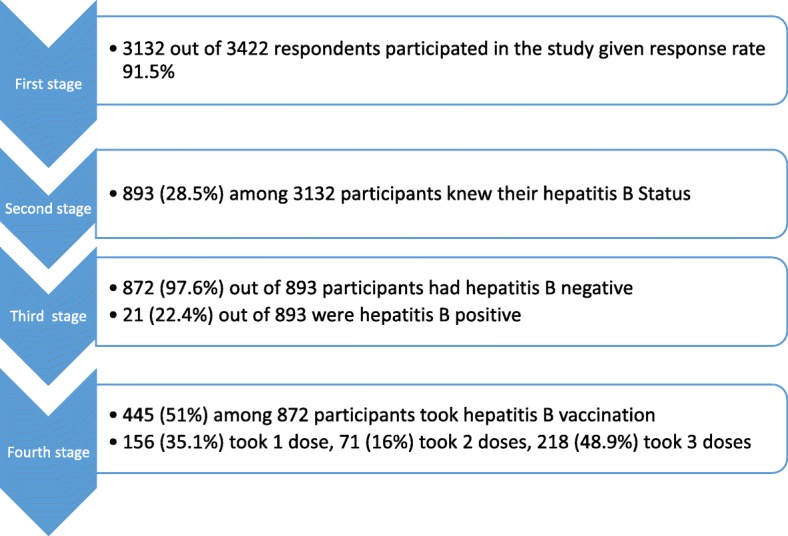
Results: The uptake of hepatitis B vaccination was 14.2% (n = 445). The number of doses received were: 3 doses (218/3132, 48.9%), 2 doses (71/3132, 16.0%), and one dose (156/3132, 35.1%). The reasons for non-uptake of vaccination included: cost of vaccine 48 (10.8%), 'did not believe they could be infected' 28 (6.6%), long vaccination schedule, and lack of time 150 (35.1%). The Odds for uptake of hepatitis B vaccination were 22% lower among nurses compared to doctors (AOR = 0.78, 95% CI = 0.54-0.98, P = 0.037). It increased with increasing age (AOR = 1.30, 95% CI = 1.08-1.59, P < 0.001), increasing duration of work in the hospital (AOR = 1.19, 95% CI = 1.09-1.32, P = 0.032), and was about twice higher among those that had tertiary education than others that had less education (AOR = 1.96, 95 CI = 0.76-5.07, P = 0.164).
Conclusions: The uptake of hepatitis B vaccination was low among HCWs in Enugu, Nigeria. Age, staff category, and duration of work in the hospital, were independently associated with hepatitis B vaccination. Provision of adequate hepatitis B surface antigen screening facilities and vaccination sites where the cost of vaccination is subsidized for all HCWs is recommended.
Keywords: Health care workers; Hepatitis B; Hepatitis B vaccine; Nigeria.
Conflict of interest statement
Ethics approval and consent to participate
Ethical approval was obtained from Health Research Ethics Committees of the University of Nigeria Teaching Hospital, Ituku-Ozalla, Enugu. Informed written consent was obtained from the participants.
Consent for publication
Not applicable
Competing interests
The authors declare that they have no competing interests.
Publisher’s Note
Springer Nature remains neutral with regard to jurisdictional claims in published maps and institutional affiliations.
References
-
- Erhabor O, Ejele OA, Nwauche CA. Epidemiology and management of occupational exposure to blood borne viral infections in a resource poor setting: the case for availability of post exposure prophylaxis. Nig J Clin Pract. 2007;10(2):100–104. - PubMed
-
- Bello AC. Prevalence of hepatitis B virus markers in surgeons in Lagos, Nigeria. East Afr Med J. 2000;77(5):283–285. - PubMed
-
- Fatusi AO, Fatusi OA, Esimai AO, Onayade AA, Ojo OS. Acceptance of hepatitits B vaccine by workers in a Nigerian Teaching Hospital. East Afr Med J. 2000;77:608–612. - PubMed
-
- WHO. Global policy report on the prevention and control of viral hepatitis in WHO member states. World Health organisation; 2013.
MeSH terms
Substances
LinkOut - more resources
Full Text Sources
Other Literature Sources
Medical
