


Host specificity and species diversity of the Ostertagiinae Lopez-Neyra, 1947 in ruminants: a European perspective
- PMID: 29954435
- PMCID: PMC6022717
- DOI: 10.1186/s13071-018-2958-6
Host specificity and species diversity of the Ostertagiinae Lopez-Neyra, 1947 in ruminants: a European perspective
Abstract
Background: Nematodes of the subfamily Ostertagiinae appear to be rather specific to a species or family of hosts, but some are observed in a wide variety of hosts. The nematode Ostertagia leptospicularis draws special attention due to its presence or absence among the same host species in different European countries. Therefore, this paper focuses mainly on the host specificity among nematodes of the subfamily Ostertagiinae. The second aim of this study is to assess the possibility of treating O. leptospicularis as an Ostertagia species complex.
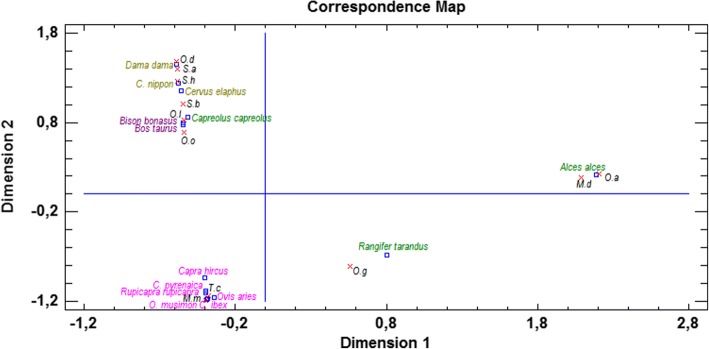
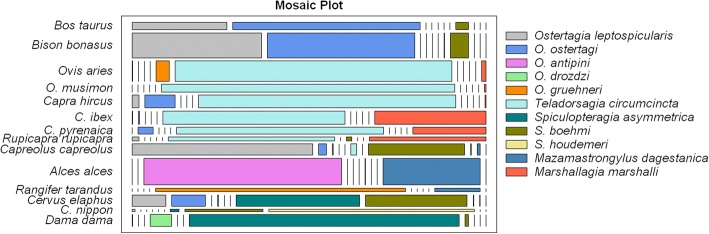
Methods: Data were gathered from post-mortem examinations of domestic and wild ruminants (n = 157), as well as bibliographical references (n = 96), which were pooled and discussed. The research area was limited to European countries, hence the studied ostertagiine species are limited to native ones; likewise, the host species. Special emphasis was placed on the mean abundance values that allowed a typical host or hosts for each nematode species to be specified. Correspondence analysis was performed to confirm the stated host specificity.
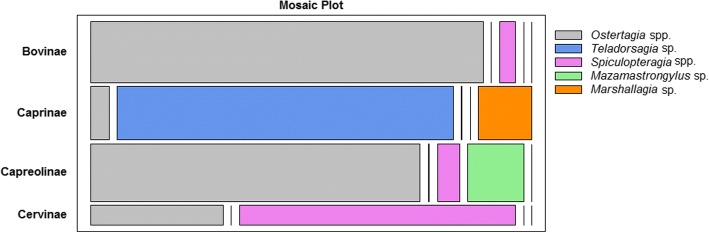
Results: The analysis revealed that nematodes of this subfamily tend to use ruminants from a particular subfamily as their principal host. The results indicate that Ostertagia leptospicularis, similar to Teladorsagia circumcincta, may represent a potential species complex. This nematode, as the sole member of the subfamily Ostertagiinae, occurs in almost all representatives of the Bovidae subfamily, as well as in the Cervidae.
Conclusions: Despite the stated narrow host specificity, the results obtained may suggest that O. leptospicularis is not strongly connected to any host or is comparably associated with a very wide and diverse group of hosts (Cervidae, Bovidae). The Ostertagia complex may have particular cryptic species or strains typical for any individual host or group of hosts. Such a conclusion requires further investigations on a wider scale.
Keywords: Bovidae; Cervidae; Correspondence analysis; Host specificity; Ostertagia leptospicularis; Ostertagiinae.
Conflict of interest statement
Ethics approval and consent to participate
Not applicable.
Consent for publication
Not applicable.
Competing interests
The authors declare that they have no competing interests.
Publisher’s Note
Springer Nature remains neutral with regard to jurisdictional claims in published maps and institutional affiliations.
Figures
References
-
- Holmes JC, Price PW. Parasite communities: the role of phylogeny and ecology. Syst Zool. 1980;29:203–13.
-
- Anderson RC. Nematode parasites of Vertebrates: Their Development and Transmission. 2nd ed. Wallingford: CABI Publishing; 2000.
-
- Hoberg EP, Monsen KJ, Kutz S, Blouin MS. Structure, biodiversity, and historical biogeography of nematode fauna in holarctic ruminants: morphological and molecular diagnoses of Teladorsagia boreoarcticus n. sp. (Nematoda: Ostertaginae), a dimorphic cryptic species in muskoxen (Ovibos moschatus) J Parasitol. 1999;85:910–934. doi: 10.2307/3285831. - DOI - PubMed
-
- Wyrobisz A, Kowal J, Nosal P. Insight into species diversity of the Trichostrongylidae Leiper, 1912 (Nematoda: Strongylida) in ruminants. J Helminthol. 2016;90:639–46. - PubMed
MeSH terms
LinkOut - more resources
Full Text Sources
Other Literature Sources
