


Eosinophilic Esophagitis Is a Late Manifestation of the Allergic March
- PMID: 29954692
- PMCID: PMC6131029
- DOI: 10.1016/j.jaip.2018.05.010
Eosinophilic Esophagitis Is a Late Manifestation of the Allergic March
Abstract
Background: The allergic march describes the natural history of allergic conditions as they develop during childhood. Eosinophilic esophagitis (EoE) is a chronic allergic inflammatory disease that can be triggered by specific foods. Despite its allergic pathophysiology, the epidemiologic relationship between EoE and established members of the allergic march is unknown.
Objective: We sought to determine whether EoE meets epidemiologic criteria for being considered a member of the allergic march.
Methods: Using a primary care birth cohort of 130,435 children, we determined the natural histories of atopic dermatitis (AD), IgE-mediated food allergy (IgE-FA), asthma, EoE, and allergic rhinitis (AR) in individual patients. We then performed case-control analyses to establish the extent that existing allergic conditions influence the rate of subsequent EoE diagnosis.
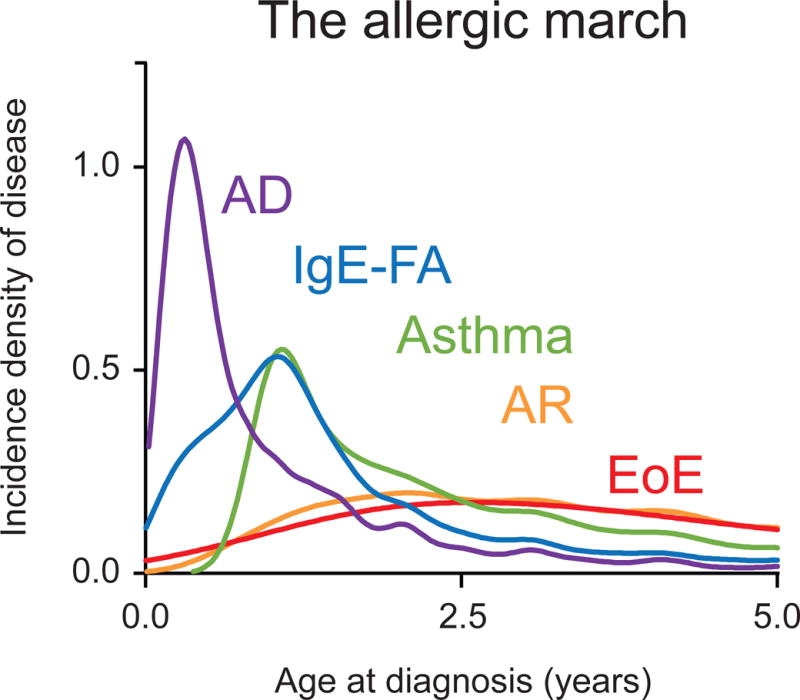
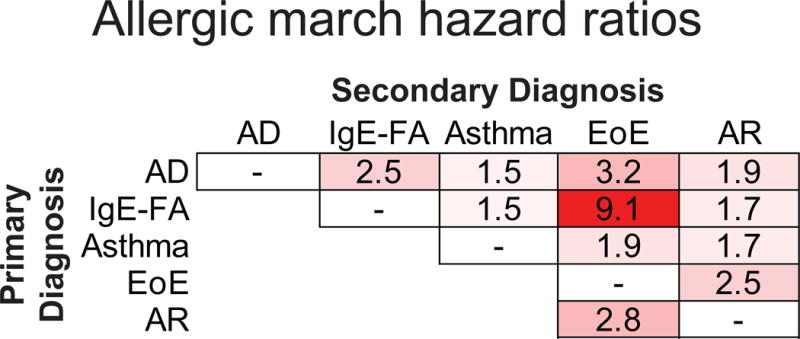
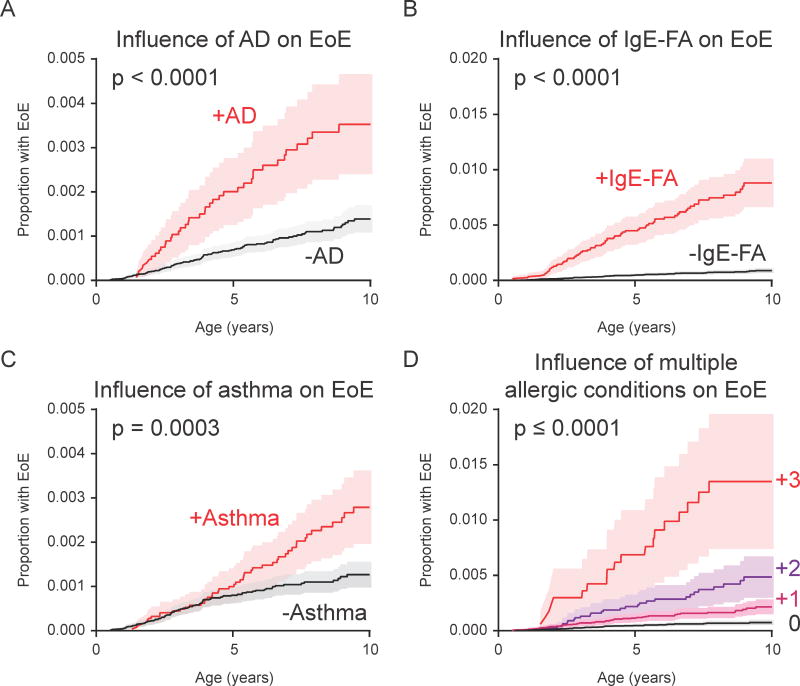
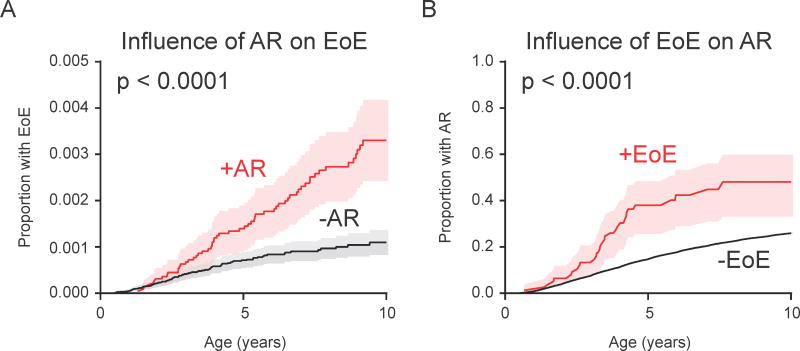
Results: A total of 139 children developed EoE during the observation period (prevalence of 0.11%). The peak age of EoE diagnosis was 2.6 years, as compared with 0.3 years, 1 year, 1.1 years, and 2.1 years for AD, IgE-FA, asthma, and AR, respectively. The presence of AD (hazard ratio [HR] 3.2, 95% confidence interval [CI] 2.2-4.6), IgE-FA (HR 9.1, 95% CI 6.5-12.6), and asthma (HR 1.9, 95% CI 1.3-2.7) was independently and cumulatively associated with subsequent EoE diagnosis. The presence of AR was associated with subsequent EoE diagnosis (HR 2.8, 95% CI 2.0-3.9), and the presence of EoE was associated with subsequent AR diagnosis (HR 2.5, 95% CI 1.7-3.5).
Conclusions: Allergic comorbidities are positively associated with EoE diagnosis. Together, our findings suggest that EoE is a late manifestation of the allergic march.
Keywords: Allergic march; Allergic rhinitis; Asthma; Atopic dermatitis; Eosinophilic esophagitis; Food allergy.
Copyright © 2018 American Academy of Allergy, Asthma & Immunology. Published by Elsevier Inc. All rights reserved.
Conflict of interest statement
Figures
References
-
- Tsakok T, Marrs T, Mohsin M, Baron S, du Toit G, Till S, et al. Does atopic dermatitis cause food allergy? A systematic review. J Allergy Clin Immunol. 2016 Apr;137(4):1071–8. - PubMed
-
- Gustafsson D, Sjoberg O, Foucard T. Development of allergies and asthma in infants and young children with atopic dermatitis–a prospective follow-up to 7 years of age. Allergy. 2000 Mar;55(3):240–5. - PubMed
Publication types
MeSH terms
Substances
Grants and funding
LinkOut - more resources
Full Text Sources
Other Literature Sources
Medical
Research Materials
