


The Participatory Zeitgeist: an explanatory theoretical model of change in an era of coproduction and codesign in healthcare improvement
- PMID: 29954854
- PMCID: PMC6818522
- DOI: 10.1136/medhum-2017-011398
The Participatory Zeitgeist: an explanatory theoretical model of change in an era of coproduction and codesign in healthcare improvement
Abstract
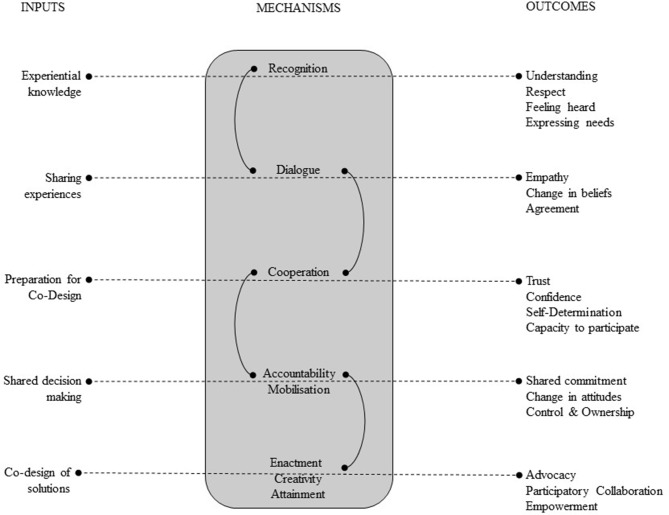
Healthcare systems redesign and service improvement approaches are adopting participatory tools, techniques and mindsets. Participatory methods increasingly used in healthcare improvement coalesce around the concept of coproduction, and related practices of cocreation, codesign and coinnovation. These participatory methods have become the new Zeitgeist-the spirit of our times in quality improvement. The rationale for this new spirit of participation relates to voice and engagement (those with lived experience should be engaged in processes of development, redesign and improvements), empowerment (engagement in codesign and coproduction has positive individual and societal benefits) and advancement (quality of life and other health outcomes and experiences of services for everyone involved should improve as a result). This paper introduces Mental Health Experience Co-design (MH ECO), a peer designed and led adapted form of Experience-based Co-design (EBCD) developed in Australia. MH ECO is said to facilitate empowerment, foster trust, develop autonomy, self-determination and choice for people living with mental illnesses and their carers, including staff at mental health services. Little information exists about the underlying mechanisms of change; the entities, processes and structures that underpin MH ECO and similar EBCD studies. To address this, we identified eight possible mechanisms from an assessment of the activities and outcomes of MH ECO and a review of existing published evaluations. The eight mechanisms, recognition, dialogue, cooperation, accountability, mobilisation, enactment, creativity and attainment, are discussed within an 'explanatory theoretical model of change' that details these and ideal relational transitions that might be observed or not with MH ECO or other EBCD studies. We critically appraise the sociocultural and political movement in coproduction and draw on interdisciplinary theories from the humanities-narrative theory, dialogical ethics, cooperative and empowerment theory. The model advances theoretical thinking in coproduction beyond motivations and towards identifying underlying processes and entities that might impact on process and outcome. TRIAL REGISTRATION NUMBER: The Australian and New Zealand Clinical Trials Registry, ACTRN12614000457640 (results).
Keywords: medical humanities; mental health care; philosophy of medicine/health care; social science.
© Article author(s) (or their employer(s) unless otherwise stated in the text of the article) 2019. All rights reserved. No commercial use is permitted unless otherwise expressly granted.
Conflict of interest statement
Competing interests: None declared.
Figures
References
-
- Alford J. The multiple facets of co-production: building on the work of Elinor Ostrom. Public Manage Rev 2014;16:299–316. 10.1080/14719037.2013.806578 - DOI
-
- Alford J. Engaging public sector clients, from service delivery to coproduction. New York: Pallgrave MacMillan, 2009.
-
- Alford J, Yates S. Co-production of public services in Australia: the roles of government organisations and co-producers. Austral J Pub Admin 2016;75:159–75. 10.1111/1467-8500.12157 - DOI
-
- Wiewiora A, Keast R, Brown K. Opportunities and Challenges in Engaging Citizens in the Co-Production of Infrastructure-Based Public Services in Australia. Public Manage Rev 2016;18:483–507. 10.1080/14719037.2014.999820 - DOI
-
- Barlow R. Engaging patients with digital assistance: engagement, paticipation strategies and tactics reflect mindset shift. Healthcare Purchasing News 2016.
MeSH terms
LinkOut - more resources
Full Text Sources
Other Literature Sources
Medical
