


Development of a Dichotomous Indicator for Population-Level Assessment of Dietary Diversity in Women of Reproductive Age
- PMID: 29955691
- PMCID: PMC5998796
- DOI: 10.3945/cdn.117.001701
Development of a Dichotomous Indicator for Population-Level Assessment of Dietary Diversity in Women of Reproductive Age
Abstract
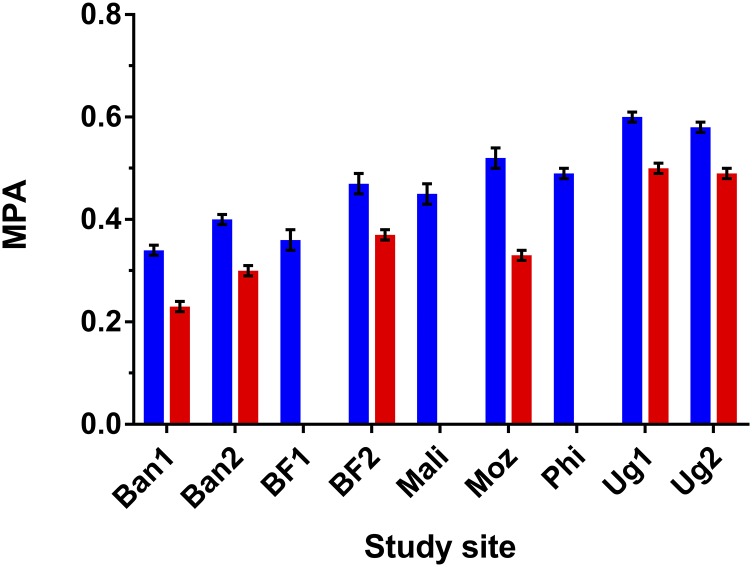
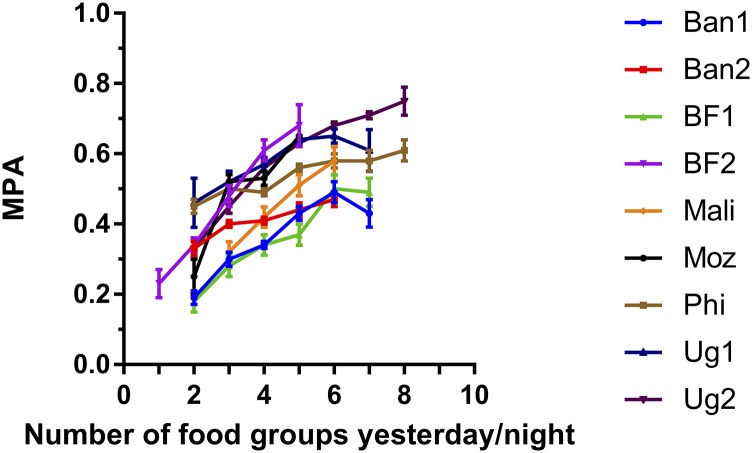
Background: Dietary diversity is a key element of diet quality, but diets of women of reproductive age (WRA; aged 15-49 y) in resource-poor settings are often deficient in a range of micronutrients. Previous work showed associations between simple food-group diversity indicators (FGIs) and micronutrient adequacy among WRA. For operational and advocacy purposes, however, there is strong demand for a dichotomous indicator reflecting an acceptable level of dietary diversity. Objective: The aim of the study was to develop a dichotomous indicator of dietary diversity in WRA. Methods: We performed a secondary analysis of 9 data sets containing quantitative dietary data from WRA in resource-poor settings (total n = 4166). From the raw dietary data, we calculated an individual "mean probability of adequacy" (MPA) across 11 micronutrients. Several candidate FGIs were constructed. Indicator performance in predicting an MPA >0.60 was assessed within each data set by using receiver-operating characteristic analysis and sensitivity and specificity analysis at various FGI cutoffs. The analysis was performed separately for nonpregnant and nonlactating (NPNL) women and for lactating women. Results: We identified 2 "best candidate" dichotomous indicators on the basis of 9- or 10-point food-group scores (FGI-9 and FGI-10) with a cutoff of ≥5 food groups. Both were significantly correlated to MPA in each site (P < 0.001). Areas under the curve were moderate, ranging from 0.62 to 0.82 among NPNL women and from 0.56 to 0.90 among lactating women. Comparisons of results slightly favored FGI-10 for all women. Conclusions: When resource-intensive dietary methods are not feasible, a simple dichotomous indicator based on a cutoff of ≥5 of 10 defined food groups reflects "minimum dietary diversity for women of reproductive age." According to the conclusions of a consensus meeting of experts, this indicator is well suited for population-level assessment, advocacy, and possibly also for tracking of change in dietary diversity across time.
Keywords: developing countries; diet quality; dietary diversity; food groups; indicator; nutrition-sensitive interventions; resource-poor settings; women of reproductive age.
Figures
References
-
- Arimond M, Wiesmann D, Becquey E, Carriquiry A, Daniels MC, Deitchler M, Fanou-Fogny N, Joseph ML, Kennedy G, Martin-Prevel Y, et al. . Simple food group diversity indicators predict micronutrient adequacy of women's diets in 5 diverse, resource-poor settings. J Nutr 2010;140(Suppl):2059S–69S. - PMC - PubMed
-
- Torheim LE, Ferguson EL, Penrose K, Arimond M.. Women in resource-poor settings are at risk of inadequate intakes of multiple micronutrients. J Nutr 2010;140(Suppl):2051S–8S. - PubMed
-
- Black RE, Victora CG, Walker SP, Bhutta ZA, Christian P, de Onis M, Ezzati M, Grantham-McGregor S, Katz J, Martorell R, et al. . Maternal and child undernutrition and overweight in low-income and middle-income countries. Lancet 2013;382:427–51. - PubMed
-
- Branca F, Piwoz E, Schultink W, Sullivan LM.. Nutrition and health in women, children, and adolescent girls. BMJ 2015;351:h4173. - PubMed
LinkOut - more resources
Full Text Sources
Other Literature Sources
