


A Bayesian Approach to Understanding Sex Differences in Tuberculosis Disease Burden
- PMID: 29955827
- PMCID: PMC6211250
- DOI: 10.1093/aje/kwy131
A Bayesian Approach to Understanding Sex Differences in Tuberculosis Disease Burden
Abstract
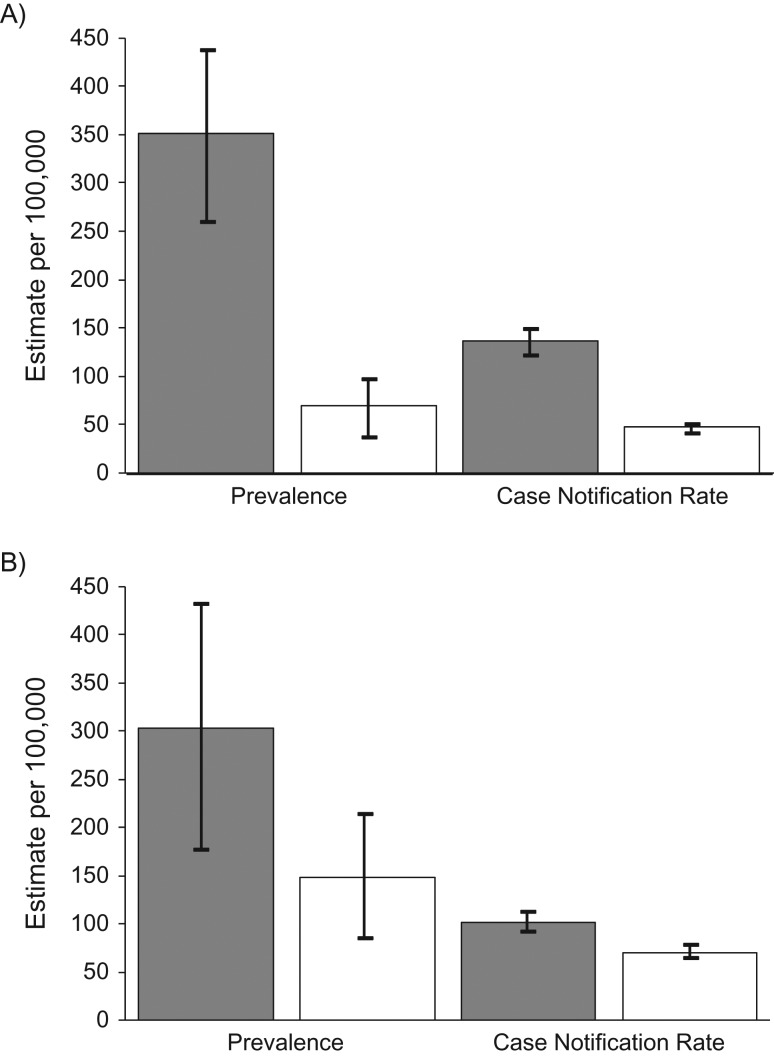
Globally, men have a higher epidemiologic burden of tuberculosis (incidence, prevalence, mortality) than women do, possibly due to differences in disease incidence, treatment initiation, self-cure, and/or untreated-tuberculosis mortality rates. Using a simple, sex-stratified compartmental model, we employed a Bayesian approach to explore which factors most likely explain men's higher burden. We applied the model to smear-positive pulmonary tuberculosis in Vietnam (2006-2007) and Malawi (2013-2014). Posterior estimates were consistent with sex-specific prevalence and notifications in both countries. Results supported higher incidence in men and showed that both sexes faced longer durations of untreated disease than estimated by self-reports. Prior untreated disease durations were revised upward 8- to 24-fold, to 2.2 (95% credible interval: 1.7, 2.9) years for men in Vietnam and 2.8 (1.8, 4.1) years for men in Malawi, approximately a year longer than for women in each country. Results imply that substantial sex differences in tuberculosis burden are almost solely attributable to men's disadvantages in disease incidence and untreated disease duration. The latter, for which self-reports provide a poor proxy, implies inadequate coverage of case-finding strategies. These results highlight an urgent need for better understanding of gender-related barriers faced by men and support the systematic targeting of men for screening.
Figures


References
-
- World Health Organization Case notifications. http://www.who.int/tb/country/data/download/en/. Accessed November 08, 2016.
-
- World Health Organization Global Tuberculosis Report 2017 Geneva, Switzerland: World Health Organization; 2017. http://apps.who.int/iris/bitstream/handle/10665/259366/9789241565516-eng....
-
- Borgdorff MW, Nagelkerke NJ, Dye C, et al. . Gender and tuberculosis: a comparison of prevalence surveys with notification data to explore sex differences in case detection. Int J Tuberc Lung Dis. 2000;4(2):123–132. - PubMed
-
- Onozaki I, Law I, Sismanidis C, et al. . National tuberculosis prevalence surveys in Asia, 1990–2012: an overview of results and lessons learned. Trop Med Int Health. 2015;20(9):1128–1145. - PubMed
Publication types
MeSH terms
Substances
Grants and funding
LinkOut - more resources
Full Text Sources
Other Literature Sources
