. 2018 Sep-Oct;20(5):511-517.
doi: 10.4103/aja.aja_36_18.

The novel long noncoding RNA LOC283070 is involved in the transition of LNCaP cells into androgen-independent cells via its interaction with PHB2

Affiliations

The novel long noncoding RNA LOC283070 is involved in the transition of LNCaP cells into androgen-independent cells via its interaction with PHB2

Ying Zhang et al. Asian J Androl. 2018 Sep-Oct.

Abstract

We sought to investigate the underlying mechanism of action of the long noncoding RNA (lncRNA) LOC283070 in the development of androgen independence in prostate cancer. The interactions between LOC283070 and target proteins were investigated by RNA pull-down and RNA-binding protein immunoprecipitation (RIP) assays. Subcellular fractionation and quantitative reverse transcription-polymerase chain reaction (qRT-PCR) were used to detect the subcellular localization of LOC283070. Western blotting was performed to detect the expression of prohibitin 2 (PHB2). Luciferase activity assays were performed to evaluate the effects of LOC283070 and PHB2 on the androgen receptor (AR) signaling pathway. A methyl thiazolyl tetrazolium (MTT) assay and a growth curve assay were used to test cell viability. Flow cytometry was performed to analyze cell cycles. A transwell assay was employed to test cell migration. We identified PHB2 as an interaction partner of LOC283070 in the pull-down and RIP experiments. Furthermore, we confirmed that the enrichment of LOC283070 with PHB2 in androgen-independent LNCaP (LNCaP-AI) cells was much greater than that in LNCaP cells. Moreover, the expression of PHB2 was not significantly different between the two cell lines, and the expression of LOC283070 in the nuclei of the LNCaP-AI cells was significantly greater than that in the LNCaP cells. In vitro data revealed that PHB2 overexpression significantly inhibited AR activity and cell proliferation and migration and induced accumulation of prostate cancer cells in G0/G1 phase. Moreover, the overexpression of LOC283070 fully abrogated the effects of PHB2 overexpression. In conclusion, we found that LOC283070 can bind to PHB2 located in the nucleus and inhibit its effect, and this is one of the mechanisms by which LOC283070 is involved in the transition of LNCaP cells into androgen-independent cells.

Keywords: LOC283070; androgen-dependent prostate cancer; androgen-independent prostate cancer; long noncoding RNA; prohibitin 2.


Conflict of interest statement

All authors declared no competing interests

Figures
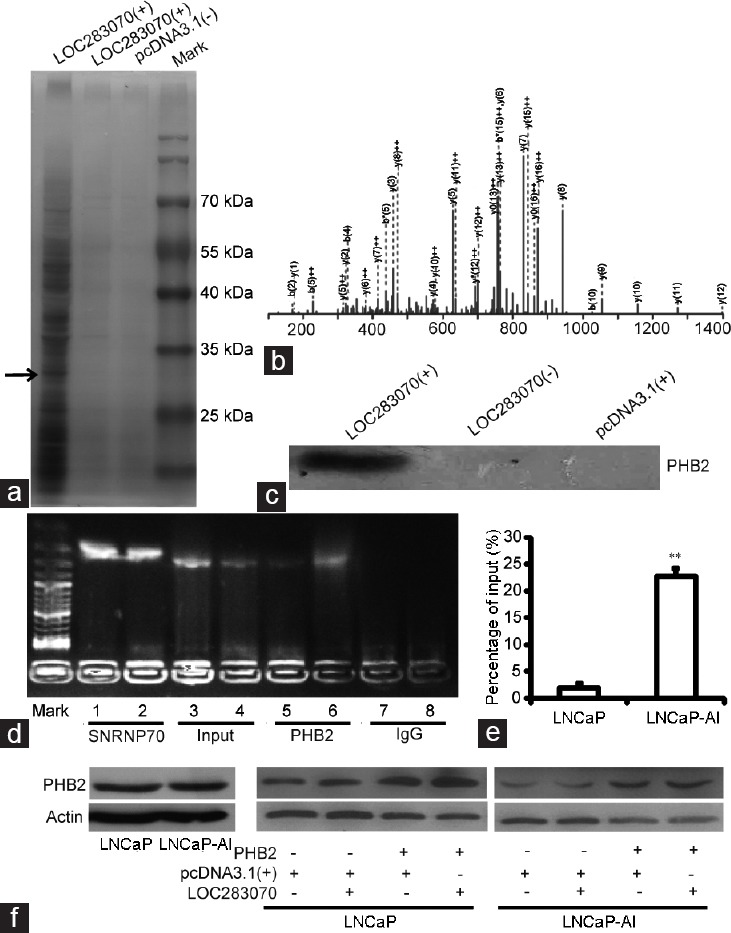
Figure 1
Figure 1
LOC283070 directly interacts with PHB2. (a) RNA pull-down experiment in LNCaP-AI cells. Proteins from LNCaP-AI extracts were pulled down with the biotin-RNAs, subjected to SDS-PAGE, and visualized by silver staining. The band, which was specific to LOC283070 in LNCaP-AI but not in two controls, was pointed out by the arrow and subjected to mass spectrometry. (b) Mass spectrometry identification of target band of PHB2. (c) Proteins pulled down by the biotin-RNAs as in (a) were analyzed by western blotting with PHB2 antibody. (d) RIP assay was performed using PHB2 antibody and was validated by agarose electrophoresis using LOC283070 primers. Lane mark: DNA molecular marker, lane: 1, 3, 5, 7 from LNCaP cells and 2, 4, 6, 8 from LNCaP-AI cells. RNA extracted with SNRP70 antibody and IgG were amplified by PCR experiments using U1 primers (as positive and negative controls, respectively). (e) Fold change enrichment of LOC283070 in LNCaP and LNCaP-AI was calculated comparing with the input in panel in qRT-PCR assay (n = 3, **P < 0.01). (f) PHB2 protein expression measured by western blotting. PHB2: prohibitin 2; qRT-PCR: quantitative reverse transcription-polymerase chain reaction; SDS-PAGE: sodium dodecyl sulfate-polyacrylamide gel electrophoresis; LNCaP-AI: androgen-independent LNCaP; RIP: RNA-binding protein immunoprecipitation.
Figure 2
Figure 2
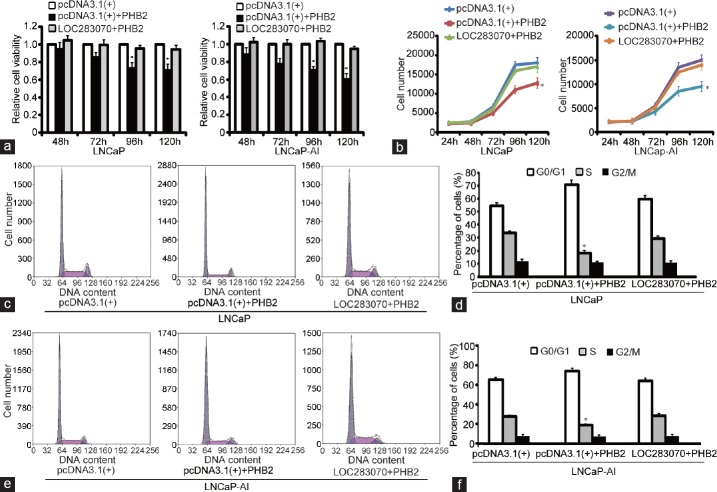
Overexpression of PHB2 inhibits prostate cancer cell proliferation and cell cycle, and LOC283070 overexpression fully abrogates its effect. (a) MTT assay showing the cell viability in LNCaP and LNCaP-AI cells. (b) Cell growth curve analysis showing the proliferative ability in LNCaP and LNCaP-AI cells. (c and d) Cell cycle progression in LNCaP cells. (e and f) Cell cycle progression in LNCaP-AI cells. Data are from one of the three independent experiments and are represented as mean ± s.d.*P < 0.05. PHB2: prohibitin 2; LNCaP-AI: androgen-independent LNCaP; MTT: methyl thiazolyl tetrazolium; s.d.: standard deviation.
Figure 3
Figure 3
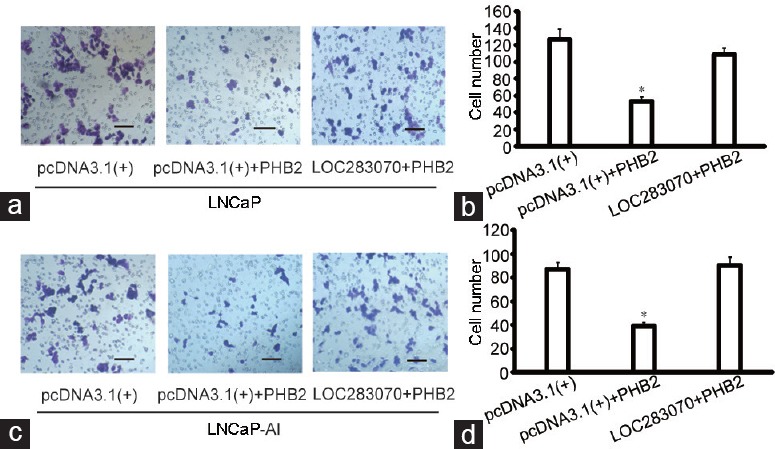
Overexpression of PHB2 inhibits prostate cancer cell migrating, LOC283070 fully abrogates the effect of PHB2. (a) Migration potential of LNCaP cells with the overexpression of LOC283070 and PHB2 or PHB2 (×200). (b) The specific number of migrated cells in a (n = 10, *P < 0.05). (c) Migration potential of LNCaP-AI cells with the overexpression of LOC283070 and PHB2 or PHB2 (×200). (d) The specific number of migrated cells in (c) (n = 10, *P < 0.05). Scale bars=100 μm. PHB2: prohibitin 2.
Figure 4
Figure 4
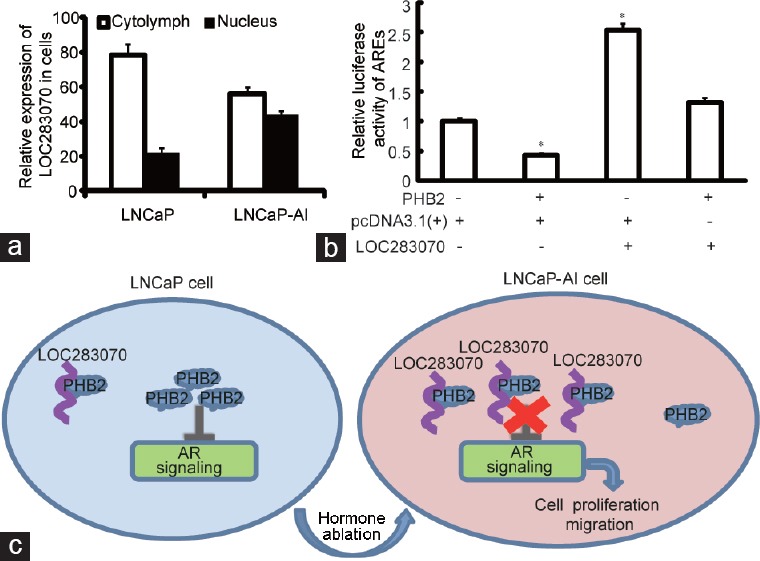
Summary of the mechanism of LOC283070 in the development of CRPC. (a) RNA was extracted from the nucleus and cytoplasm. qRT-PCR detection of the relative expression of LOC283070 in the nucleus and cytoplasm. (b) The activity of AR was detected by luciferase activity assay in LNCaP cells with the overexpression of LOC283070 and PHB2, LOC283070 and pcDNA3.1, and pcDNA3.1 and PHB2 (n = 3, *P < 0.05). (c) Summary of the mechanism of LOC283070 in the transition of LNCaP cells into LNCaP-AI cells. PHB2: prohibitin 2; qRT-PCR: quantitative reverse transcription-polymerase chain reaction; CRPC: castration-resistant prostate cancer; AR: androgen receptor; LNCaP-AI: androgen-independent LNCaP.

References

    1. Siegel RL, Miller KD, Jemal A. Cancer statistics, 2016. CA Cancer J Clin. 2016;66:7–30. - PubMed
    1. Grasso CS, Wu YM, Robinson DR, Cao X, Dhanasekaran SM, et al. The mutational landscape of lethal castration-resistant prostate cancer. Nature. 2012;487:239–43. - PMC - PubMed
    1. Fu W, Yao J, Huang Y, Li Q, Li W, et al. LXR agonist regulates the carcinogenesis of PCa via the SOCS3 pathway. Cell Physiol Biochem. 2014;33:195–204. - PubMed
    1. Wang L, Liu C, Li C, Xue J, Zhao S, et al. Effects of microRNA-221/222 on cell proliferation and apoptosis in prostate cancer cells. Gene. 2015;572:252–8. - PubMed
    1. Liu C, Chen Z, Hu X, Wang L, Li C, et al. MicroRNA-185 downregulates androgen receptor expression in the LNCaP prostate carcinoma cell line. Mol Med Rep. 2015;11:4625–32. - PubMed