


Sex-based differences in antiretroviral therapy initiation, switching and treatment interruptions: global overview from the International Epidemiologic Databases to Evaluate AIDS (IeDEA)
- PMID: 29956882
- PMCID: PMC6024257
- DOI: 10.1002/jia2.25149
Sex-based differences in antiretroviral therapy initiation, switching and treatment interruptions: global overview from the International Epidemiologic Databases to Evaluate AIDS (IeDEA)
Abstract
Introduction: In 2015, the World Health Organization recommended that all HIV-infected individuals consider ART initiation as soon as possible after diagnosis. Sex differences in choice of initial ART regimen, indications for switching, time to switching and choice of second-line regimens have not been well described. The aims of this study were to describe first-line ART and CD4 count at ART initiation by sex, calendar year and region, and to analyse time to change or interruption in first-line ART, according to sex in each region.
Methods: Participating cohorts included: Southern, East and West Africa (IeDEA-Africa), North America (NA-ACCORD), Caribbean, Central/South America (CCASAnet) and Asia-Pacific including Australia (IeDEA Asia-Pacific). The primary outcomes analysed for each region and according to sex were choice of initial ART, time to switching and time to discontinuation of the first-line regimen.
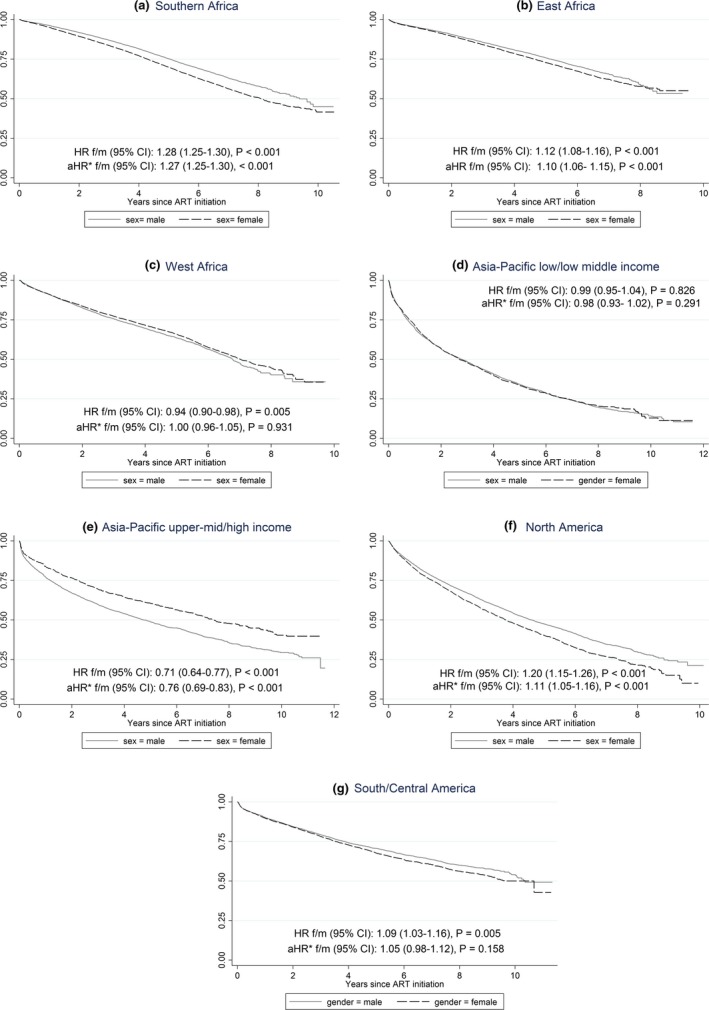
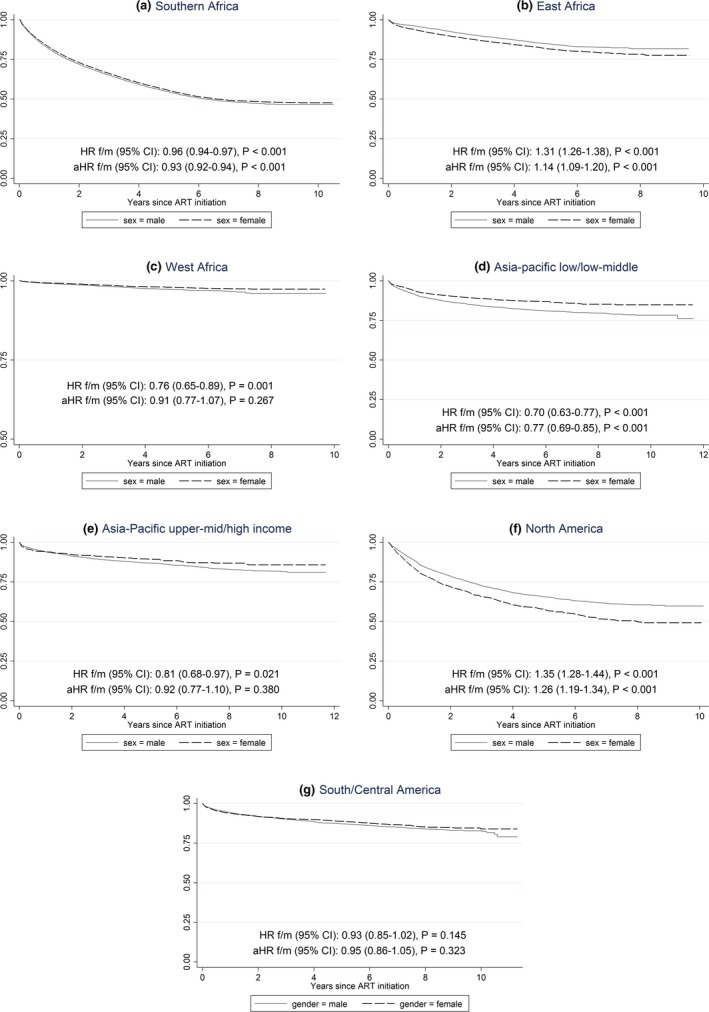
Results and discussion: The combined cohort data set comprised of 715,252 participants across seven regions from low- to high-income settings. The median CD4 count at treatment initiation was lower in men compared with women in nearly all regions and time periods. Women from North America and Southern Africa were more likely to switch ART compared to men (p < 0.001) with approximately 90% of women reporting a major change after 10 years in North America. Overall, after 8 years on ART, >50% of HIV- positive men and women from Southern Africa, East Africa, South and Central America remained on their original regimen. Men were more likely to have a treatment interruption compared with women in low- and middle-income countries from the Asia/Pacific region (p < 0.001) as were men from Southern Africa (p < 0.001). Greater than 75% of men and women did not report a treatment interruption after 10 years on ART from all regions except North America and Southern Africa.
Conclusions: There are regional variations in the ART regimen commenced at baseline and rates of major change and treatment interruption according to sex. Some of this is likely to reflect changes in local and international antiretroviral guideline recommendations but other sex-specific factors such as pregnancy may contribute to these differences.
Keywords: HIV; cohort studies; gender; sex; treatment; women.
© 2018 The Authors. Journal of the International AIDS Society published by John Wiley & sons Ltd on behalf of the International AIDS Society.
Figures
References
-
- World Health Organisation . Consolidated guidelines on general HIV care and the use of antiretroviral drugs for treating and preventing HIV infection: recommendations for a public health approach. June 2013. - PubMed
-
- Joint United Nations Programme on HIV/AIDS . 90‐90‐90: A transformative agenda to leave no one behind. Geneva, Switzerland: Joint United Nations programme on HIV/AIDS. 2014 [cited 2017 Jul 28]. Available at http://www.unaids.org/en/resources/presscentre/unaidsspeeches/2014/20141...
-
- Lecher S, Ellenberger D, Kim AA, Fonjungo PN, Agolory S, Borget MY, et al. Scale‐up of HIV viral load monitoring‐seven sub‐saharan African countries. MMWR. 2015;64:1287–90. - PubMed
Publication types
MeSH terms
Substances
Grants and funding
- Z01 CP010176/ImNIH/Intramural NIH HHS/United States
- P30 AI094189/AI/NIAID NIH HHS/United States
- U01 AI038855/AI/NIAID NIH HHS/United States
- U01 AI069923/AI/NIAID NIH HHS/United States
- UL1 RR024131/RR/NCRR NIH HHS/United States
- U01 AA020790/AA/NIAAA NIH HHS/United States
- P30 AI027757/AI/NIAID NIH HHS/United States
- R01 DA012568/DA/NIDA NIH HHS/United States
- R01 AA016893/AA/NIAAA NIH HHS/United States
- P30 AI027767/AI/NIAID NIH HHS/United States
- U01 AI035042/AI/NIAID NIH HHS/United States
- P30 MH062246/MH/NIMH NIH HHS/United States
- U01 AI069434/AI/NIAID NIH HHS/United States
- U01 AI037984/AI/NIAID NIH HHS/United States
- U01 AI103397/AI/NIAID NIH HHS/United States
- K23 EY013707/EY/NEI NIH HHS/United States
- R01 CA165937/CA/NCI NIH HHS/United States
- Z01 CP010176/CP/NCI NIH HHS/United States
- U01 AI031834/AI/NIAID NIH HHS/United States
- N02CP55504/CP/NCI NIH HHS/United States
- U01 AI035004/AI/NIAID NIH HHS/United States
- G12 MD007583/MD/NIMHD NIH HHS/United States
- K24 DA000432/DA/NIDA NIH HHS/United States
- U01 DA036935/DA/NIDA NIH HHS/United States
- U54 MD007587/MD/NIMHD NIH HHS/United States
- R01 DA004334/DA/NIDA NIH HHS/United States
- R01 DA011602/DA/NIDA NIH HHS/United States
- U01 AI037613/AI/NIAID NIH HHS/United States
- U01 AI035041/AI/NIAID NIH HHS/United States
- R24 AI067039/AI/NIAID NIH HHS/United States
- U01 AI034989/AI/NIAID NIH HHS/United States
- UM1 AI035043/AI/NIAID NIH HHS/United States
- U01 AI069432/AI/NIAID NIH HHS/United States
- U01 AI038858/AI/NIAID NIH HHS/United States
- U10 EY008057/EY/NEI NIH HHS/United States
- U01 AI068636/AI/NIAID NIH HHS/United States
- U01 AI034994/AI/NIAID NIH HHS/United States
- M01 RR000052/RR/NCRR NIH HHS/United States
- UL1 TR000454/TR/NCATS NIH HHS/United States
- U01 AI069911/AI/NIAID NIH HHS/United States
- UL1 TR000083/TR/NCATS NIH HHS/United States
- U10 EY008052/EY/NEI NIH HHS/United States
- UL1 TR002378/TR/NCATS NIH HHS/United States
- P30 AI110527/AI/NIAID NIH HHS/United States
- P30 AI027763/AI/NIAID NIH HHS/United States
- U01 AI069919/AI/NIAID NIH HHS/United States
- K01 AI093197/AI/NIAID NIH HHS/United States
- U01 AI069918/AI/NIAID NIH HHS/United States
- K24 AI065298/AI/NIAID NIH HHS/United States
- U01 AI069907/AI/NIAID NIH HHS/United States
- U01 AI103401/AI/NIAID NIH HHS/United States
- U01 AA013566/AA/NIAAA NIH HHS/United States
- N02 CP055504/CP/NCI NIH HHS/United States
- KL2 TR000421/TR/NCATS NIH HHS/United States
- U01 AI035040/AI/NIAID NIH HHS/United States
- U01 AI103390/AI/NIAID NIH HHS/United States
- U01 AI034993/AI/NIAID NIH HHS/United States
- U01 AI103408/AI/NIAID NIH HHS/United States
- F31 DA037788/DA/NIDA NIH HHS/United States
- U01 AI035039/AI/NIAID NIH HHS/United States
- UL1 TR000004/TR/NCATS NIH HHS/United States
- U10 EY008067/EY/NEI NIH HHS/United States
- P30 AI036219/AI/NIAID NIH HHS/United States
- U01 AI069924/AI/NIAID NIH HHS/United States
- U24 AA020794/AA/NIAAA NIH HHS/United States
- U01 AI068634/AI/NIAID NIH HHS/United States
- P30 AI050410/AI/NIAID NIH HHS/United States
- U01 HD032632/HD/NICHD NIH HHS/United States
- U01 AI042590/AI/NIAID NIH HHS/United States
LinkOut - more resources
Full Text Sources
Other Literature Sources
Medical
Research Materials
