


A heterozygous variant in the SLC22A12 gene in a Sri Lanka family associated with mild renal hypouricemia
- PMID: 29958533
- PMCID: PMC6025733
- DOI: 10.1186/s12887-018-1185-9
A heterozygous variant in the SLC22A12 gene in a Sri Lanka family associated with mild renal hypouricemia
Abstract
Background: Renal hypouricemia is a rare heterogeneous inherited disorder characterized by impaired tubular uric acid transport, reabsorption insufficiency and /or acceleration of secretion. The affected individuals are predisposed to nephrolithiasis and recurrent episodes of exercise-induced acute kidney injury. Type 1 is caused by dysfunctional variants in the SLC22A12 gene (URAT1), while type 2 is caused by defects in the SLC2A9 gene (GLUT9). To date, more than 150 patients with the loss-of-function mutations for the SLC22A12 gene have been found (compound heterozygotes and/or homozygotes), most of whom are Japanese and Koreans.
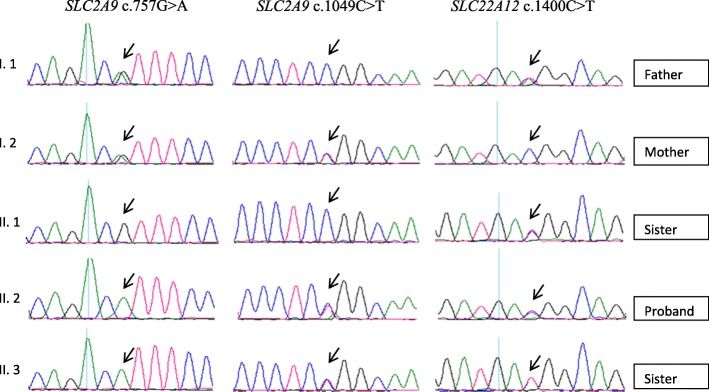
Case presentation: Herein, we report a nine year old Sri Lankan boy with renal hypouricemia (serum uric acid 97 μmol/L, fractional excretion of uric acid 33%).The sequencing analysis of SLC22A12 revealed a potentially deleterious missense variant c.1400C > T (p.T467 M, rs200104135) in heterozygous state. This variant has been previously identified in homozygous and/or compound heterozygous state with other causative SLC22A12 variant c.1245_1253del (p.L415_G417del) in Roma population.
Conclusions: This is the first identification of a family with mild renal hypouricemia1 associated to the p.T467 M variant. Detailed investigations of urate blood and urine concentrations in patients with unexplained hypouricemia are needed and renal hypouricemia should also be considered in patients other than those from Japan and/or Korea. Our finding confirms an uneven geographical and ethnic distribution of Romany prevalent SLC22A12 variant that need to be considered in Asian patients (population data Genome Aggregation Database: allele frequency in South Asia 0.007055, in East Asia 0.001330).
Keywords: Renal hypouricemia; SLC22A12; URAT1; Uric acid transporters.
Conflict of interest statement
Consent for publication
Written informed consent was obtained from the parent of the patient for publication of this case report. A copy of the written consent is available for review by the editor of this journal.
Competing interests
The authors declare that they have no competing interests.
Publisher’s Note
Springer Nature remains neutral with regard to jurisdictional claims in published maps and institutional affiliations.
Figures
References
Publication types
MeSH terms
Substances
Supplementary concepts
LinkOut - more resources
Full Text Sources
Other Literature Sources
