


Web-Based Intervention for Family Carers of Persons with Dementia and Multiple Chronic Conditions (My Tools 4 Care): Pragmatic Randomized Controlled Trial
- PMID: 29959111
- PMCID: PMC6045794
- DOI: 10.2196/10484
Web-Based Intervention for Family Carers of Persons with Dementia and Multiple Chronic Conditions (My Tools 4 Care): Pragmatic Randomized Controlled Trial
Abstract
Background: My Tools 4 Care (MT4C) is a Web-based intervention that was developed based on the transitions theory. It is an interactive, self-administered, and portable toolkit containing six main sections intended to support carers of community-living persons with Alzheimer's disease and related dementia and multiple chronic conditions through their transition experiences.
Objective: The objective of our study was to evaluate the effectiveness of MT4C with respect to increasing hope, self-efficacy, and health-related quality of life in carers of community-living older persons with Alzheimer's disease and related dementia and multiple chronic conditions.
Methods: A multisite, pragmatic, mixed methods, longitudinal, repeated-measures, randomized controlled trial was conducted between June 2015 and April 2017. Eligible participants were randomized into either treatment (MT4C) or educational control groups. Following baseline measures, carers in the treatment group received 3 months of password-protected access to MT4C. Trained research assistants collected data from participants via phone on hope (Herth Hope Index [HHI]), self-efficacy (General Self-Efficacy Scale), and health-related quality of life (Short Form-12 item [version 2] health survey; SF-12v2) at baseline, 1, 3, and 6 months. The use and cost of health and social services (Health and Social Services Utilization Inventory) among participants were measured at baseline, 3, and 6 months. Analysis of covariance was used to identify group differences at 3 months, and generalized estimating equations were used to identify group differences over time.
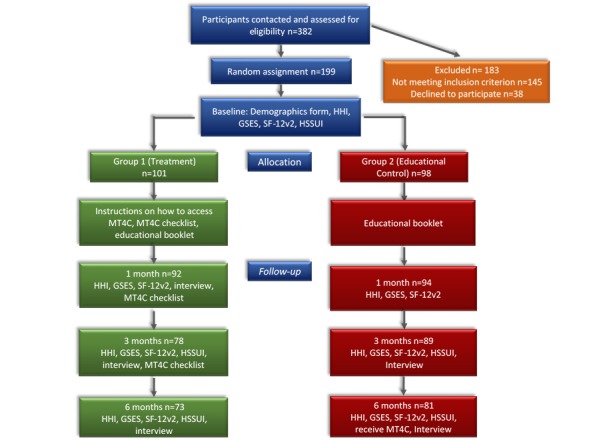
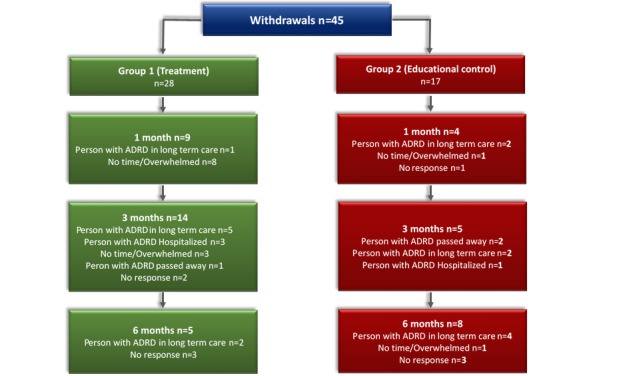
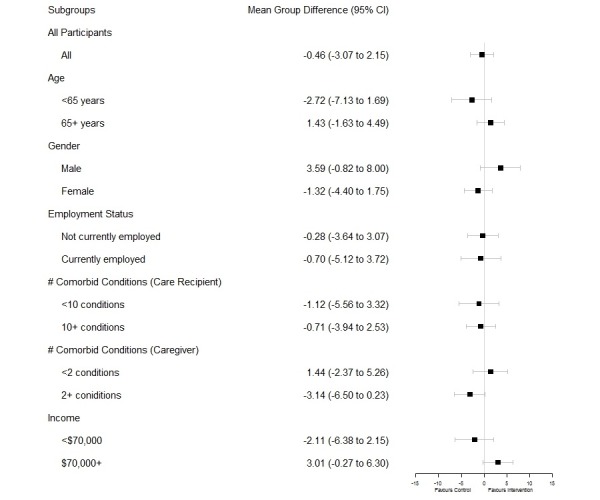
Results: A total of 199 carers participated in this study, with 101 participants in the treatment group and 98 in the educational control group. Of all, 23% (45/199) participants withdrew during the study for various reasons, including institutionalization or death of the person with dementia and lack of time from the carer. In the treatment group, 73% (74/101) carers used MT4C at least once over the 3-month period. No significant differences in the primary outcome measure (mental component summary score from the SF-12v2) by group or time were noted at 3 months; however, significant differences were evident for HHI-factor 2 (P=.01), with higher hope scores in the treatment group than in the control group. General estimating equations showed no statistically significant group differences in terms of mental component summary score at all time points. Attrition and the fact that not all carers in the treatment group used MT4C may explain the absence of statistically significant results for the main outcome variable.
Conclusions: Despite no significant differences between groups in terms of the primary outcome variable (mental component score), the significant differences in terms of one of the hope factors suggest that MT4C had a positive influence on the lives of participants.
Trial registration: ClinicalTrials.gov NCT02428387; https://clinicaltrials.gov/ct2/show/NCT02428387 (Archived by Webcite at http://www.webcitation.org/708oFCR8h).
Keywords: carers; dementia; internet; treatment.
©Wendy Duggleby, Jenny Ploeg, Carrie McAiney, Shelley Peacock, Kathryn Fisher, Sunita Ghosh, Maureen Markle-Reid, Jennifer Swindle, Allison Williams, Jean AC Triscott, Dorothy Forbes, Kathya Jovel Ruiz. Originally published in the Journal of Medical Internet Research (http://www.jmir.org), 29.06.2018.
Conflict of interest statement
Conflicts of Interest: None declared.
Figures
References
-
- Ploeg J, Markle-Reid M, Valaitis R, McAiney C, Duggleby W, Bartholomew A, Sherifali D. Web-based interventions to improve mental health, general caregiving outcomes, and general health for informal caregivers of adults with chronic conditions living in the community: rapid evidence review. J Med Internet Res. 2017 Jul 28;19(7):e263. doi: 10.2196/jmir.7564. http://www.jmir.org/2017/7/e263/ v19i7e263 - DOI - PMC - PubMed
-
- Prince M, Wimo A, Guerchet M, Ali GC, Wu YT, Prina M. Alzheimer's Disease International. [2018-05-14]. World Alzheimer report: The global impact of dementia, an analysis of the prevalence, incidence, costs & trends https://www.alz.co.uk/research/WorldAlzheimerReport2015.pdf .
-
- Ploeg J, Matthew-Maich N, Fraser K, Dufour S, McAiney C, Kaasalainen S, Markle-Reid M, Upshur R, Cleghorn L, Emili A. Managing multiple chronic conditions in the community: a Canadian qualitative study of the experiences of older adults, family caregivers and healthcare providers. BMC Geriatr. 2017 Jan 31;17(1):40. doi: 10.1186/s12877-017-0431-6. https://bmcgeriatr.biomedcentral.com/articles/10.1186/s12877-017-0431-6 10.1186/s12877-017-0431-6 - DOI - DOI - PMC - PubMed
-
- Duggleby WD, Swindle J, Peacock S, Ghosh S. A mixed methods study of hope, transitions, and quality of life in family caregivers of persons with Alzheimer's disease. BMC Geriatr. 2011 Dec 22;11:88. doi: 10.1186/1471-2318-11-88. https://bmcgeriatr.biomedcentral.com/articles/10.1186/1471-2318-11-88 1471-2318-11-88 - DOI - DOI - PMC - PubMed
Publication types
MeSH terms
Associated data
LinkOut - more resources
Full Text Sources
Other Literature Sources
Medical
Miscellaneous
