


Misleading Claims About Tobacco Products in YouTube Videos: Experimental Effects of Misinformation on Unhealthy Attitudes
- PMID: 29959113
- PMCID: PMC6045787
- DOI: 10.2196/jmir.9959
Misleading Claims About Tobacco Products in YouTube Videos: Experimental Effects of Misinformation on Unhealthy Attitudes
Abstract
Background: Recent content analyses of YouTube postings reveal a proliferation of user generated videos with misleading statements about the health consequences of various types of nontraditional tobacco use (eg, electronic cigarettes; e-cigarettes).
Objective: This research was aimed at obtaining evidence about the potential effects of YouTube postings about tobacco products on viewers' attitudes toward these products.
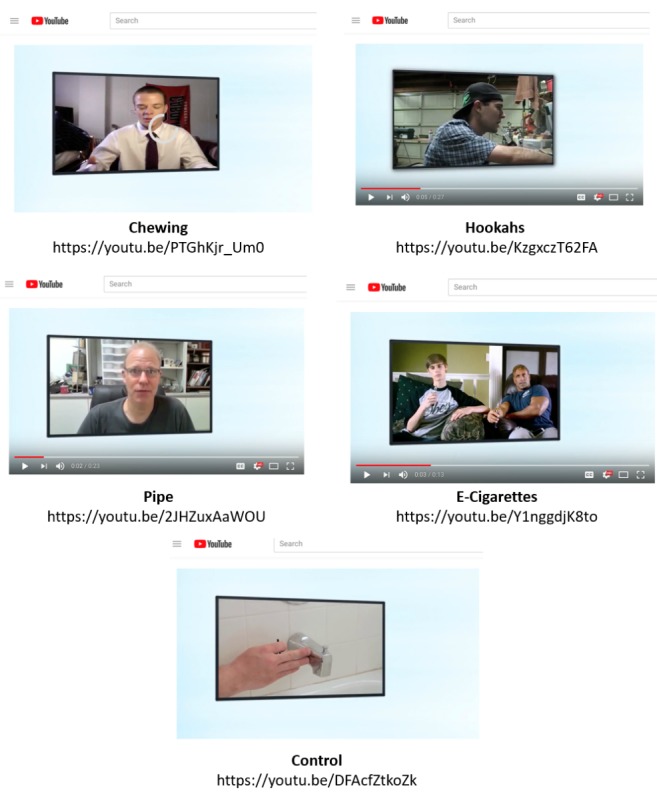
Methods: A sample of young adults recruited online (N=350) viewed one of four highly viewed YouTube videos containing misleading health statements about chewing tobacco, e-cigarettes, hookahs, and pipe smoking, as well as a control YouTube video unrelated to tobacco products.
Results: The videos about e-cigarettes and hookahs led to more positive attitudes toward the featured products than did control videos. However, these effects did not fully translate into attitudes toward combustive cigarette smoking, although the pipe video led to more positive attitudes toward combustive smoking than did the chewing and the hookah videos, and the e-cigarette video led to more positive attitudes toward combustive cigarette smoking than did the chewing video.
Conclusions: This research revealed young people's reactions to misleading claims about tobacco products featured in popular YouTube videos. Policy implications are discussed.
Keywords: health communication; tobacco.
©Dolores Albarracin, Daniel Romer, Christopher Jones, Kathleen Hall Jamieson, Patrick Jamieson. Originally published in the Journal of Medical Internet Research (http://www.jmir.org), 29.06.2018.
Conflict of interest statement
Conflicts of Interest: None declared.
References
-
- National Cancer Institute The role of the media in promoting and reducing tobacco use. Executive summary. New Directions for Youth Development. 2010 Jul 20;2010(126):7–12. doi: 10.1002/yd.346. - DOI
MeSH terms
LinkOut - more resources
Full Text Sources
Other Literature Sources
Medical
