


UVC LED Irradiation Effectively Inactivates Aerosolized Viruses, Bacteria, and Fungi in a Chamber-Type Air Disinfection System
- PMID: 29959245
- PMCID: PMC6102977
- DOI: 10.1128/AEM.00944-18
UVC LED Irradiation Effectively Inactivates Aerosolized Viruses, Bacteria, and Fungi in a Chamber-Type Air Disinfection System
Abstract
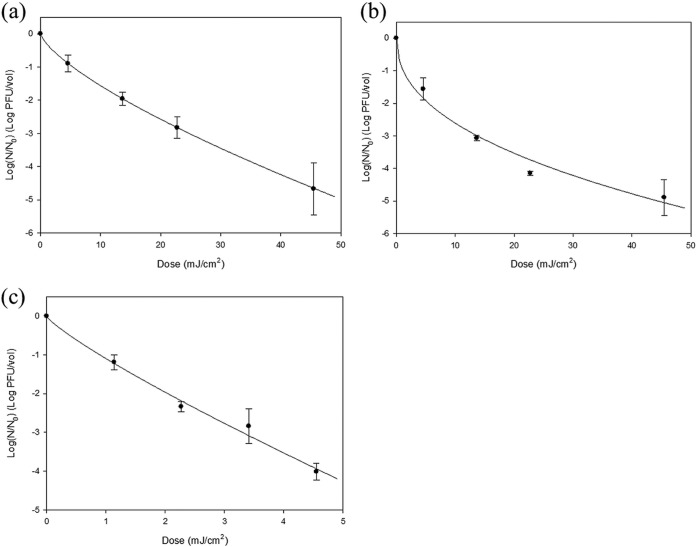
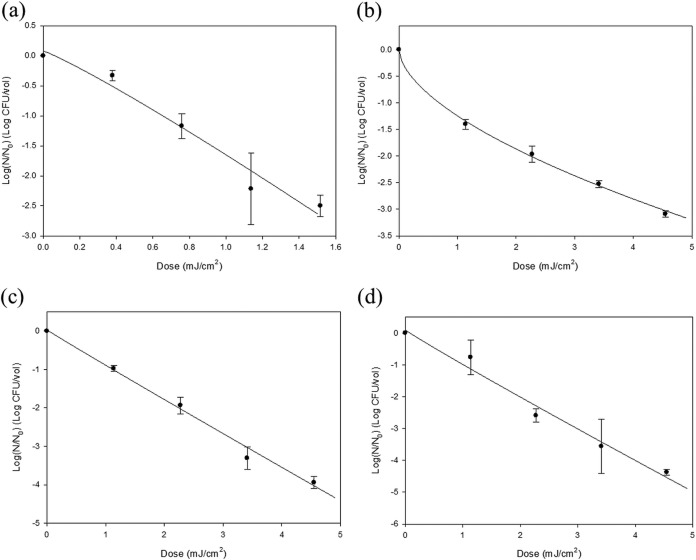
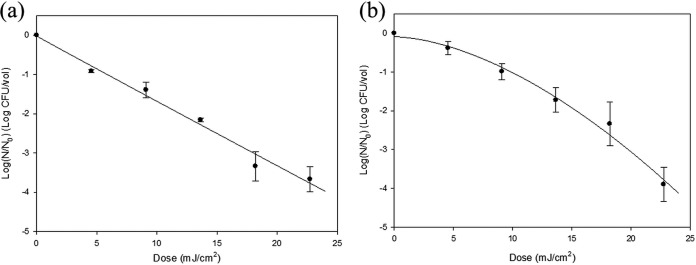
In this study, the possibility of inactivating viral, bacterial, and fungal aerosols in a chamber-type air disinfection system by using a UVC light-emitting-diode (LED) array was investigated and inactivation rate constants of each microorganism were calculated in fitting curves of surviving populations. UVC LED array treatment effectively inactivated viral infectivity, achieving 5-log reductions within 45 mJ/cm2 for MS2, Qβ, and ϕX174 viruses. UVC LED array effectiveness in inactivating Escherichia coli O157:H7, Salmonella enterica serovar Typhimurium, Listeria monocytogenes, and Staphylococcus aureus aerosols achieved 2.5- to 4-log reductions within 1.5 to 4.6 mJ/cm2 Also, 4-log reductions of Aspergillus flavus and Alternaria japonica were achieved at a dosage of 23 mJ/cm2 using UVC LED array irradiation. The highest UV susceptibility, represented by the inactivation rate constant, was calculated for bacteria, followed by fungi and viruses. UVC LED, an innovative technology, can effectively inactivate microorganisms regardless of taxonomic classification and can sufficiently substitute for conventional mercury UV lamps.IMPORTANCE The United Nations Environment Programme (UNEP) convened the Minamata Convention on Mercury in 2013 to ban mercury-containing products in order to ensure human and environmental health. It will be effectuated in 2020 to discontinue use of low-pressure mercury lamps and new UV-emitting sources have to replace this conventional technology. However, the UV germicidal irradiation (UVGI) system still uses conventional UV lamps, and no research has been conducted for air disinfection using UVC LEDs. The research reported here investigated the inactivation effect of aerosolized microorganisms, including viruses, bacteria, and fungi, with an UVC LED module. The results can be utilized as a primary database to replace conventional UV lamps with UVC LEDs, a novel type of UV emitter. Implementation of UVC LED technology is truly expected to significantly reduce the extent of global mercury contamination, and this study provides important baseline data to help ensure a healthier environment and increased health for humanity.
Keywords: UVC LED; aerosolized microorganism; air disinfection; fungi; inactivation rate constant; nebulizing; pathogens; viruses.
Copyright © 2018 American Society for Microbiology.
Figures
References
-
- Perdelli F, Cristina M, Sartini M, Spagnolo A, Dallera M, Ottria G, Lombardi R, Grimaldi M, Orlando P. 2006. Fungal contamination in hospital environments. Infect Control Hosp Epidemiol 27:44–47. - PubMed
Publication types
MeSH terms
LinkOut - more resources
Full Text Sources
Other Literature Sources
Medical
Molecular Biology Databases
