Review
. 2018 Oct;23(10):1162-1170.
doi: 10.1634/theoncologist.2017-0654. Epub 2018 Jun 29.

Developing a Roadmap for Interventional Oncology

Affiliations
Review

Developing a Roadmap for Interventional Oncology

Stefan O Schoenberg et al. Oncologist. 2018 Oct.

Abstract

Interventional oncology uses image-guided procedures to enhance cancer care. Today, this specialty plays an increasingly critical role in cancer diagnosis (e.g., biopsy), cancer therapy (e.g., ablation or embolization), and cancer symptom palliation (e.g., nephrostomies or biliary drainages). Although the number of procedures and technical capabilities has improved over the last few years, challenges remain. In this article we discuss the need to advance existing procedures, develop new ones, and focus on several operational aspects that will dictate future interventional techniques to enhance cancer care, particularly by accelerating drug development and improving patient outcomes.

Implications for practice: Interventional oncology is vital for cancer diagnosis, therapy, and symptom palliation. This report focuses on current interventional procedures and techniques with a look toward future improvements that will improve cancer care and patient outcomes.

Keywords: Cancer; Imaging; Intervention; Minimally invasive intervention.


Conflict of interest statement

Disclosures of potential conflicts of interest may be found at the end of this article.

Figures
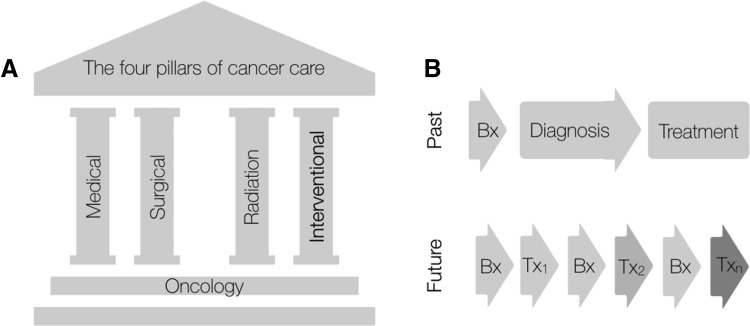
Figure 1.
Figure 1.
Interventional oncology plays a key role in integrated cancer care. (A): The four pillars of cancer care: medical oncology, surgical oncology, radiation oncology, and interventional oncology. (B): The old approach to intervention was largely linear (biopsy → diagnosis → treatment). The emerging promise of IO is one of multiple rebiopsies to optimize therapeutic approaches including interventions. Abbreviations: Bx, Biopsy; Tx, Treatment.
Figure 2.
Figure 2.
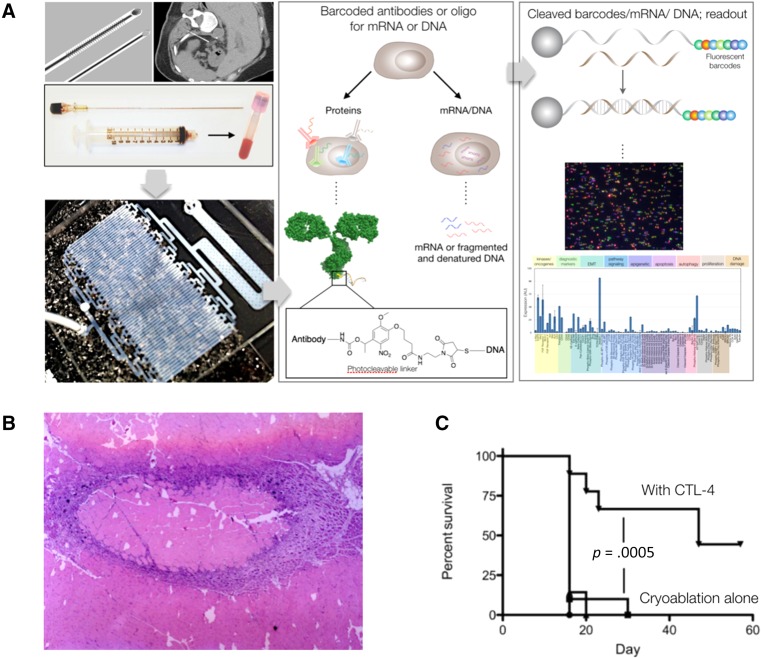
Example of emerging interventional procedures. (A): Novel diagnostics developed for fine needle aspirate sampling under image guidance. Using a 21 G needle alone it is now possible to quickly obtain thousands of single cells for protein, mRNA, and DNA analysis. This has the potential to replace cutting biopsies and reduce complications while improving information content. Reprinted with permission from [9]. (B): Combination of local therapy, drug delivery, and systemic immunotherapy potentiates therapeutic efficacy. Hematoxylin and eosin staining of a 7‐day‐old ablation lesion created with high intensity focused ultrasound in a rabbit muscle. The image demonstrates the intense inflammatory response surrounding the ablation zone and the opportunity for antigen presentation. This type of response suggests the possibility for combining ablation therapy with immunotherapy treatments. Reprinted with permission from [48]. (C): The graph demonstrates the synergy between cryoablation and anti‐CTLA‐4 combination therapy to mediate rejection of a second tumor challenge. Reprinted with permission from AACR [31].
Figure 3.
Figure 3.
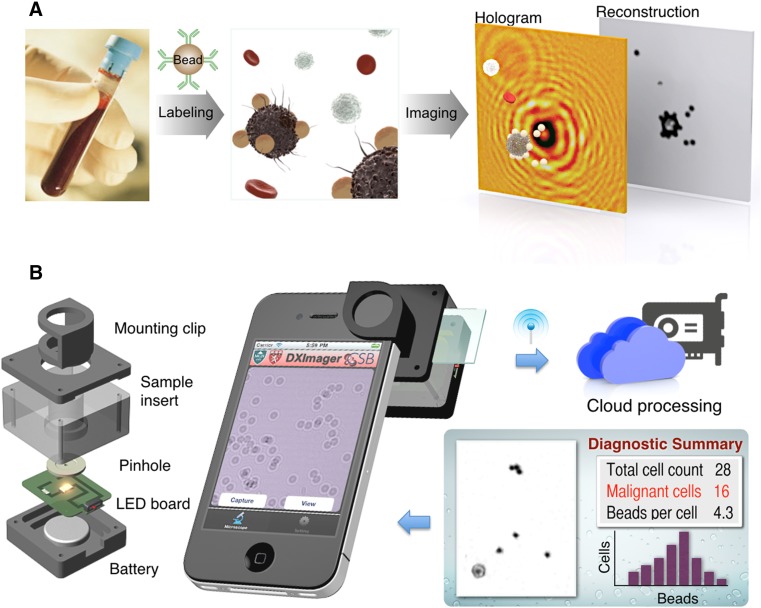
Digital diffraction diagnosis (D3) platform for rapid diagnosis of biopsy material in resource‐limited settings. (A): Assay schematic for cellular detection. Target cells in patient samples (e.g., blood or biopsy) are immunolabeled with microbeads, and their diffraction patterns are recorded. The diffraction images are then digitally reconstructed into object images wherein bead‐labeled target cells are identified. (B): The snap‐on module for a smartphone consists of a light‐emitting diode powered by a coin battery, a pinhole for uniform illumination with partial coherence, and a sample mount. (C): The D3‐mounted smartphone's embedded phone camera is used to record the diffraction images of the specimen. The recorded images are transferred to a server via the cloud service for real‐time image reconstruction and analyses, which can be returned to the smartphone in less than 2 minutes. Reprinted with permission from PNAS [17].

References

    1. Taghizadeh N, Fortin M, Tremblay A. US hospitalizations for malignant pleural effusions: Data from the 2012 National Inpatient Sample. Chest 2017;151:845–854. - PubMed
    1. Lo CM, Ngan H, Tso WK et al. Randomized controlled trial of transarterial lipiodol chemoembolization for unresectable hepatocellular carcinoma. Hepatology 2002;35:1164–1171. - PubMed
    1. Llovet JM, Bruix J. Systematic review of randomized trials for unresectable hepatocellular carcinoma: Chemoembolization improves survival. Hepatology 2003;37:429–442. - PubMed
    1. Shiina S, Tateishi R, Arano T et al. Radiofrequency ablation for hepatocellular carcinoma: 10‐year outcome and prognostic factors. Am J Gastroenterol 2012;107:569–577. - PMC - PubMed
    1. Benson AB 3rd, D'Angelica MI, Abbott DE et al. NCCN Guidelines Insights: Hepatobiliary Cancers, Version 1.2017. J Natl Compr Canc Netw 2017;15:563–573. - PMC - PubMed

LinkOut - more resources