. 2018 Jun 29;8(1):9817.
doi: 10.1038/s41598-018-27985-y.

Increased nuclear DNA damage precedes mitochondrial dysfunction in peripheral blood mononuclear cells from Huntington's disease patients

Affiliations

Increased nuclear DNA damage precedes mitochondrial dysfunction in peripheral blood mononuclear cells from Huntington's disease patients

Georgina Askeland et al. Sci Rep. .

Abstract

Huntington's disease (HD) is a progressive neurodegenerative disorder primarily affecting the basal ganglia and is caused by expanded CAG repeats in the huntingtin gene. Except for CAG sizing, mitochondrial and nuclear DNA (mtDNA and nDNA) parameters have not yet proven to be representative biomarkers for disease and future therapy. Here, we identified a general suppression of genes associated with aerobic metabolism in peripheral blood mononuclear cells (PBMCs) from HD patients compared to controls. In HD, the complex II subunit SDHB was lowered although not sufficiently to affect complex II activity. Nevertheless, we found decreased level of factors associated with mitochondrial biogenesis and an associated dampening of the mitochondrial DNA damage frequency in HD, implying an early defect in mitochondrial activity. In contrast to mtDNA, nDNA from HD patients was four-fold more modified than controls and demonstrated that nDNA integrity is severely reduced in HD. Interestingly, the level of nDNA damage correlated inversely with the total functional capacity (TFC) score; an established functional score of HD. Our data show that PBMCs are a promising source to monitor HD progression and highlights nDNA damage and diverging mitochondrial and nuclear genome responses representing early cellular impairments in HD.


Conflict of interest statement

The authors declare no competing interests.

Figures
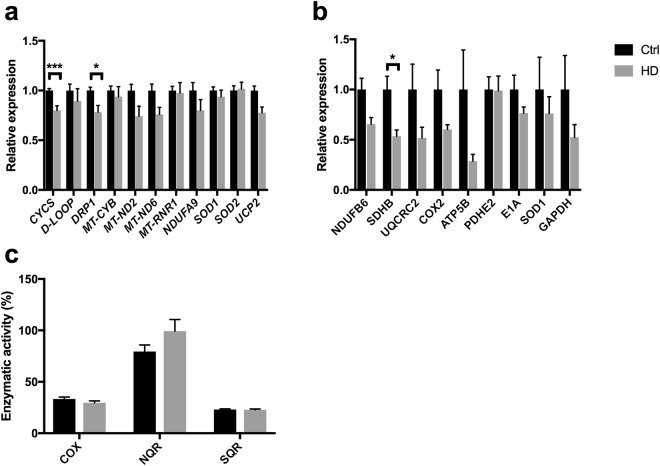
Figure 1
Figure 1
Early mitochondrial alterations in HD PBMCs. (a) Expression of mitochondria-related genes in HD (n = 12–18) relative to controls (n = 32–44). (b) Expression of proteins associated with mitochondrial function in HD (n = 17) and controls (n = 5). (c) Biochemical ETC complex activity in HD (n = 17) and control (n = 34) PBMCs. Data represent mean with error bars representing standard error mean. *P < 0.05., ***P < 0.001.
Figure 2
Figure 2
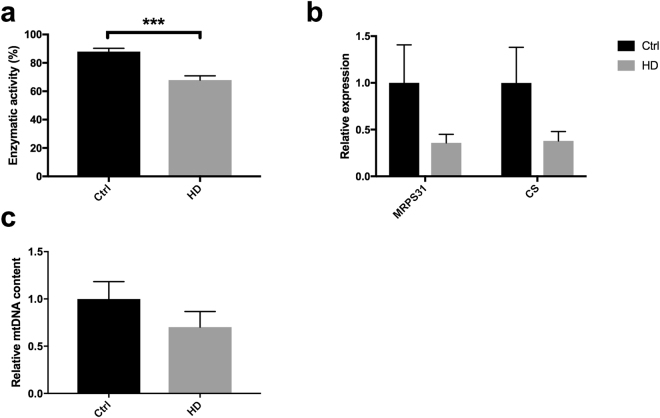
Mitochondrial biomarkers indicate reduced mitochondrial activity in HD. (a) Activity of citrate synthase in HD PBMCs (n = 17) relative to controls (n = 32). (b) Levels of ribosomal subunit MRPS31 and citrate synthase in HD (n = 17) and control (n = 5) PBMCs. (c) mtDNA copy number in HD and control PBMCs. ***P < 0.001.
Figure 3
Figure 3
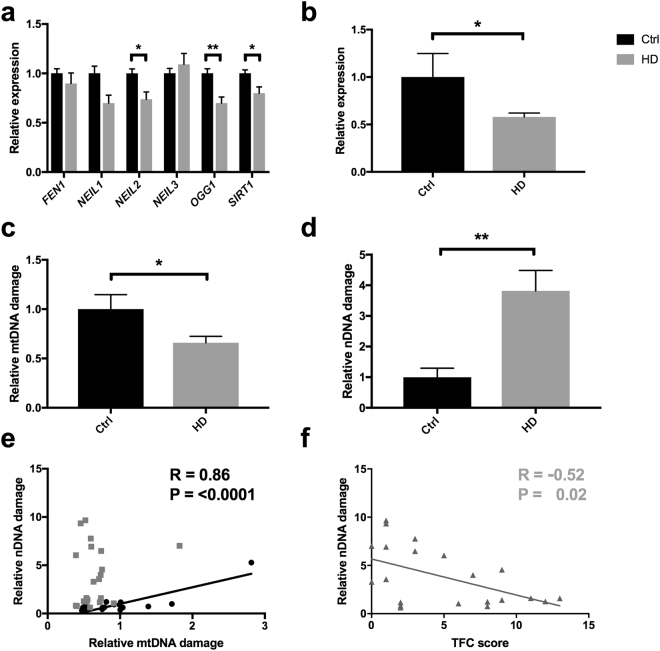
DNA integrity is impaired in HD PBMCs. (a) Expression of genes associated to base excision repair, in HD (n = 18) relative to controls (n = 44). (b) Expression of p53 protein level in HD (n = 17) and controls (n = 5). (c) mtDNA integrity and (d) nDNA integrity in HD (n = 21) and control (n = 16) PBMCs. (e) Correlation analyses between nDNA damage and mtDNA damage in HD and control PBMCs (n = 16). (f) Correlation analyses between nuclear DNA damage in PBMCs and TFC score in HD patients (n = 21) *P < 0.05; **P < 0.01. Pearson correlation with 95% confidence interval.

References

    1. Adegbuyiro A, Sedighi F, Pilkington AWT, Groover S, Legleiter J. Proteins Containing Expanded Polyglutamine Tracts and Neurodegenerative Disease. Biochemistry. 2017;56:1199–1217. doi: 10.1021/acs.biochem.6b00936. - DOI - PMC - PubMed
    1. Duyao MP, et al. Inactivation of the mouse Huntington’s disease gene homolog Hdh. Science. 1995;269:407–410. doi: 10.1126/science.7618107. - DOI - PubMed
    1. Nasir J, et al. Targeted disruption of the Huntington’s disease gene results in embryonic lethality and behavioral and morphological changes in heterozygotes. Cell. 1995;81:811–823. doi: 10.1016/0092-8674(95)90542-1. - DOI - PubMed
    1. Zeitlin S, Liu JP, Chapman DL, Papaioannou VE, Efstratiadis A. Increased apoptosis and early embryonic lethality in mice nullizygous for the Huntington’s disease gene homologue. Nat Genet. 1995;11:155–163. doi: 10.1038/ng1095-155. - DOI - PubMed
    1. Unified Huntington’s Disease Rating Scale: reliability and consistency. Huntington Study Group. Mov Disord11, 136–142, 10.1002/mds.870110204 (1996). - PubMed

Publication types

Substances