


Positive mental health among cancer survivors: overlap in psychological well-being, personal meaning, and posttraumatic growth
- PMID: 29959577
- PMCID: PMC6326009
- DOI: 10.1007/s00520-018-4325-8
Positive mental health among cancer survivors: overlap in psychological well-being, personal meaning, and posttraumatic growth
Abstract
Purpose: Positive mental health involves theoretical constructs like psychological well-being, personal meaning, and posttraumatic growth. This study aims to provide empirical insight into possible overlap between these constructs in cancer survivors.
Methods: Within the context of a randomized controlled trial, 170 cancer survivors completed the patient-reported outcome measures (PROMs) Ryff's Scales of Psychological Well-Being (SPWB), Personal Meaning Profile (PMP), and Posttraumatic Growth Inventory (PTGI). Exploratory factor analysis (EFA) on the subscales of these PROMs, as well as structural equation modeling (SEM), was used to explore overlap in these three constructs.
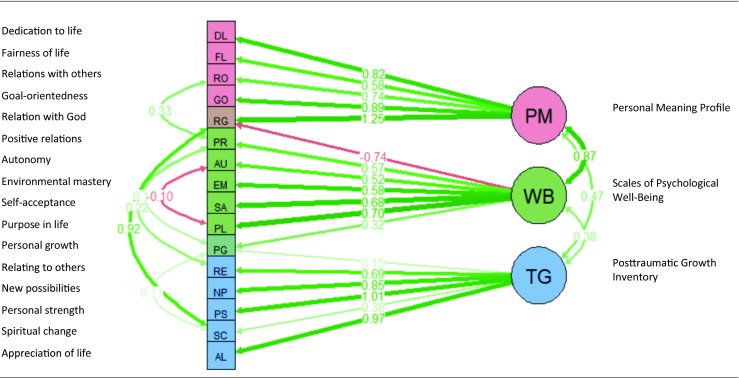
Results: The EFA resulted in a three-factor solution with an insufficient model fit. SEM led to a model with a high estimated correlation (0.87) between SPWB and PMP and lower estimated correlations with PTGI (respectively 0.38 and 0.47). Furthermore, the estimated correlation between the subscales relation with God (PMP) and spiritual change (PTGI) was high (0.92). This model had adequate fit indices (χ2(93) = 144, p = .001, RMSEA = 0.059, CFI = 0.965, TLI = 0.955, SRMR = 0.061).
Conclusions: The constructs psychological well-being and personal meaning overlap to a large extent in cancer survivors. Posttraumatic growth can be seen as a separate construct, as well as religiosity. These findings facilitate researchers to select the appropriate PROM(s) when testing the effect of a psychosocial intervention on positive mental health in cancer survivors.
Relevance: An increasing number of psychosocial intervention trials for cancer survivors use positive mental health outcomes. These constructs are often multifaceted and overlapping. Knowledge of this overlap is important in designing trials, in order to avoid the pitfalls of multiple testing and finding artificially strengthened associations.
Netherlands trial register: NTR3571.
Keywords: Cancer; Meaning; Mental health; Oncology; Patient-reported outcome measures; Survivors.
Conflict of interest statement
Conflict of interest
The authors declare that they have no conflict of interest.
Ethical approval
All procedures performed in studies involving human participants were in accordance with the ethical standards of the institutional and/or national research committee and with the 1964 Helsinki declaration and its later amendments or comparable ethical standards.
This article does not contain any studies with animals performed by any of the authors.
Figures
References
-
- Trompetter HR, Lamers SMA, Westerhof GJ, Fledderus M, Bohlmeijer ET. Both positive mental health and psychopathology should be monitored in psychotherapy: confirmation for the dual-factor model in acceptance and commitment therapy. Behav Res Ther. 2017;91:58–63. doi: 10.1016/j.brat.2017.01.008. - DOI - PubMed
-
- Ryff CD, Singer B. The contours of positive human health. Psychol Inq. 1998;9(1):1–28. doi: 10.1207/s15327965pli0901_1. - DOI
MeSH terms
Grants and funding
LinkOut - more resources
Full Text Sources
Other Literature Sources
Medical
Miscellaneous
