


Neurocognitive and Health Correlates of Overweight and Obesity among Ten-Year-Old Children Born Extremely Preterm
- PMID: 29960765
- PMCID: PMC6109604
- DOI: 10.1016/j.jpeds.2018.05.011
Neurocognitive and Health Correlates of Overweight and Obesity among Ten-Year-Old Children Born Extremely Preterm
Abstract
Objective: To assess the relationship between overweight (body mass index [BMI] percentile ≥85 and <95) and obesity (BMI ≥95 percentile) and developmental and health outcomes at 10 years of age in a cohort of individuals born extremely preterm.
Study design: This was an observational cohort study of children born extremely preterm and then assessed at age 10 years for neurocognitive function and parent-reported behavior and health outcomes. Participants included 871 children aged 10 years. To describe the strength of association between overweight or obesity and outcomes, we used logistic regression models adjusting for confounders. Neurocognitive function, academic achievement, parent-reported health outcome surveys, and height and weight were measured.
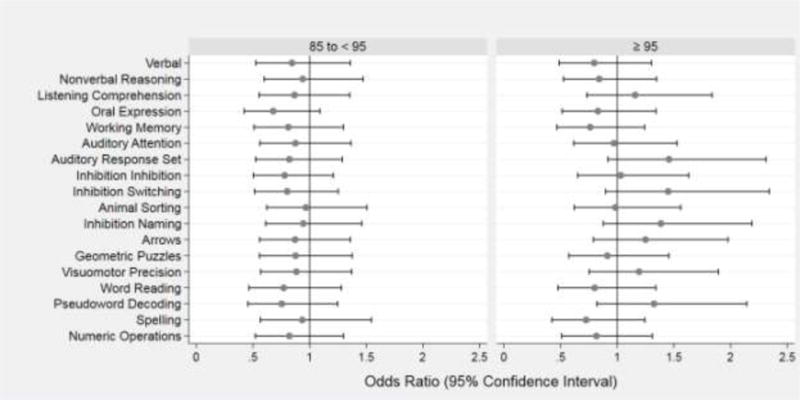
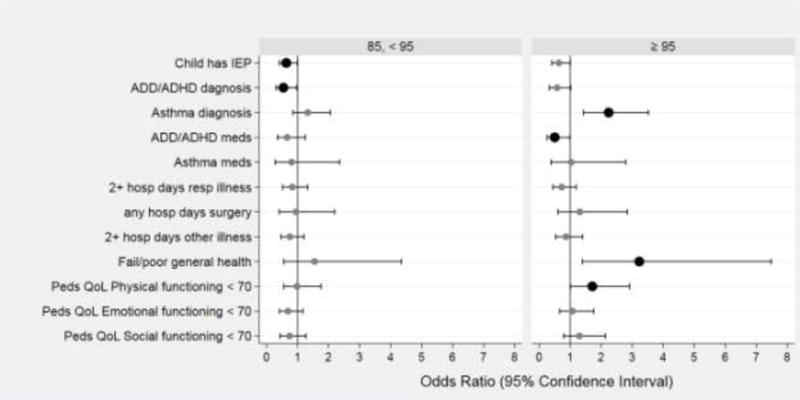
Results: BMI category at 10 years of age was not associated with differences in intelligence, language, or academic achievement. Parents of children with obesity were more likely to report their child had asthma (OR 2.2; 95% CI 1.4-3.5), fair/poor general health (OR 3.2; 95% CI 1.4-7.5), and decreased physical function (OR 1.7; 95% CI 1.1-2.9) but less likely to have physician diagnosed attention-deficit/hyperactivity disorder (OR 0.5; 95% CI 0.3-0.97) or an individualized education plan (OR 0.6; 95% CI 0.4-0.99).
Conclusion: Among children born extremely preterm, an elevated BMI, compared with normal or low BMI, is not associated with a difference in neurocognitive function. However, asthma, fair/poor general health, and decreased physical function were more prevalent among study participants with obesity, and attention-deficit/hyperactivity disorder and individualized education plan were less prevalent.
Keywords: asthma; extremely preterm; neurocognitive outcomes; obesity; overweight.
Copyright © 2018 Elsevier Inc. All rights reserved.
Conflict of interest statement
The authors declare no conflicts of interest.
Figures
References
-
- Clark RH, Thomas P, Peabody J. Extrauterine growth restriction remains a serious problem in prematurely born neonates. Pediatrics. 2003;111:986–90. - PubMed
-
- Farooqi A, Hagglof B, Sedin G, Gothefors L, Serenius F. Growth in 10- to 12- year-old children born at 23 to 25 weeks’ gestation in the 1990s: a Swedish national prospective follow-up study. Pediatrics. 2006;118:e1452–65. - PubMed
-
- Saigal S, Stoskopf B, Streiner D, Paneth N, Pinelli J, Boyle M. Growth trajectories of extremely low birth weight infants from birth to young adulthood: a longitudinal, population-based study. Pediatr Res. 2006;60:751–8. - PubMed
Publication types
MeSH terms
Grants and funding
LinkOut - more resources
Full Text Sources
Other Literature Sources
Medical
