


Psychometric evaluation of an interview-administered version of the Kessler 10-item questionnaire (K10) for measuring psychological distress in rural Bangladesh
- PMID: 29961041
- PMCID: PMC6042570
- DOI: 10.1136/bmjopen-2018-022967
Psychometric evaluation of an interview-administered version of the Kessler 10-item questionnaire (K10) for measuring psychological distress in rural Bangladesh
Abstract
Objective: The aim of this study was to translate, adapt and validate the Kessler 10-item questionnaire (K10) for measuring psychological distress in rural Bangladesh.
Design: Cohort study.
Setting: Narail district, Bangladesh.
Participants: A random sample of 2425 adults of age 18-90 years was recruited.
Outcome measure: Validation of the K10 was the major outcome. Sociodemographic factors were measured to assess if the K10 needed adjustment for factors such as age or gender. The Rasch measurement model was used for the validation, and RUMM 2030 and SPSS V.24 software were used for analyses.
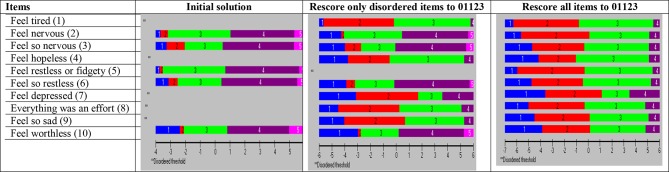
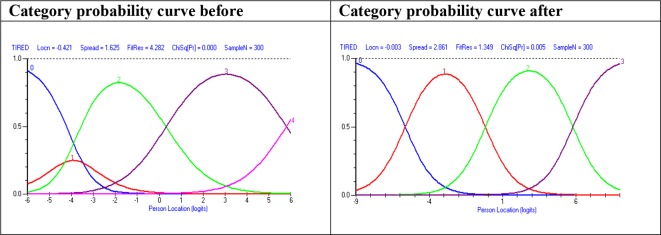
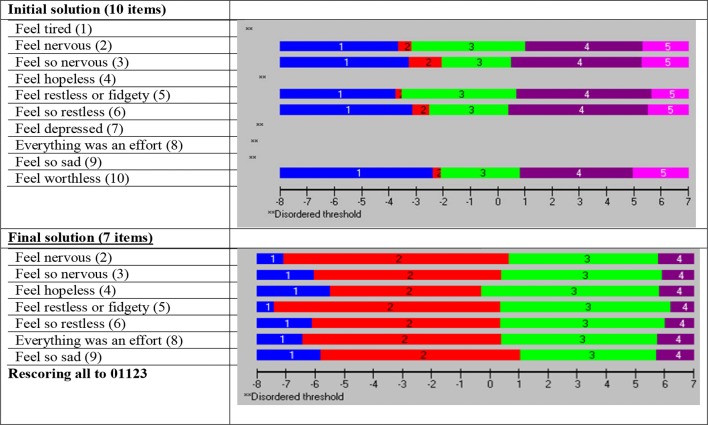
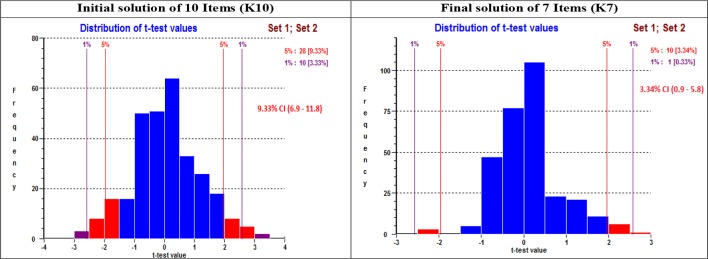
Results: Initial inspection of the total sample showed poor overall fit. A sample size of 300, which is more satiated for Rasch analysis, also showed poor overall fit, as indicated by a significant item-trait interaction (χ2= 262.27, df=40, p<0.001) and item fit residual values (mean=-0.25, SD=2.49). Of 10 items, five items were disordered thresholds, and seven items showed misfit, suggesting problems with the response format and items. After removing three items ('feel tired', 'depressed' and 'worthless') and changing the Likert scale categories from five to four categories, the remaining seven items showed ordered threshold. A revised seven-item scale has shown adequate internal consistency, with no evidence of multidimensionality, no differential item functioning on age and gender, and no signs of local dependency.
Conclusions: Analysis of the psychometric validity of K10 using the Rasch model showed that 10 items are not appropriate for measuring psychological distress in rural Bangladesh. A modified version of seven items (K7) with four response categories would provide a psychometrically more robust scale than the original K10. The study findings suggest repeating the K7 version in other remote areas for further validation can substantiate an efficient screening tool for measuring psychological distress among the general Bangladeshi population.
Keywords: item response theory; kessler psychological distress scale; phychological distress; rasch analysis; rural Bangladesh; validation.
© Article author(s) (or their employer(s) unless otherwise stated in the text of the article) 2018. All rights reserved. No commercial use is permitted unless otherwise expressly granted.
Conflict of interest statement
Competing interests: None declared.
Figures
References
-
- Sunderland M, Mahoney A, Andrews G. Investigating the factor structure of the kessler psychological distress scale in community and clinical samples of the Australian Population. J Psychopathol Behav Assess 2012;34:253–9. 10.1007/s10862-012-9276-7 - DOI
Publication types
MeSH terms
LinkOut - more resources
Full Text Sources
Other Literature Sources
Medical
Research Materials
Miscellaneous
