Relationship Between Swallowing Function and Maximum Phonation Time in Patients With Parkinsonism
- PMID: 29961740
- PMCID: PMC6058589
- DOI: 10.5535/arm.2018.42.3.425
Relationship Between Swallowing Function and Maximum Phonation Time in Patients With Parkinsonism
Abstract
Objective: To identify the relationship between maximum phonation time (MPT) and swallowing function, as well as the elements of swallowing, in order to provide a rationale for speech therapy in patients with Parkinsonism manifesting dysphagia.
Methods: Thirty patients with Parkinsonism who underwent speech evaluation and videofluoroscopic swallowing study (VFSS) were recruited. The MPT, the longest periods of sustained pronunciation of /aa/, was evaluated. The VFSS was evaluated using Penetration Aspiration Scale (PAS), National Institutes of Health-Swallowing Safety Scale (NIH-SSS), and Videofluoroscopic Dysphagia Scale (VDS). The relationship between dysphagia scales and MPT was analyzed using Pearson correlation. The difference in VDS variables between subgroups (Parkinson disease or Parkinsonian syndrome, independent or dependent ambulation, and normal or abnormal MPT) and the difference in MPT between subgroups based on the VDS variables were analyzed using the independent t-test.
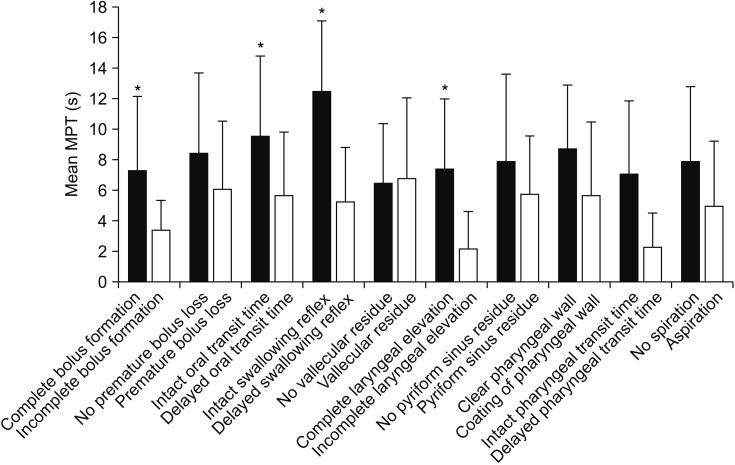
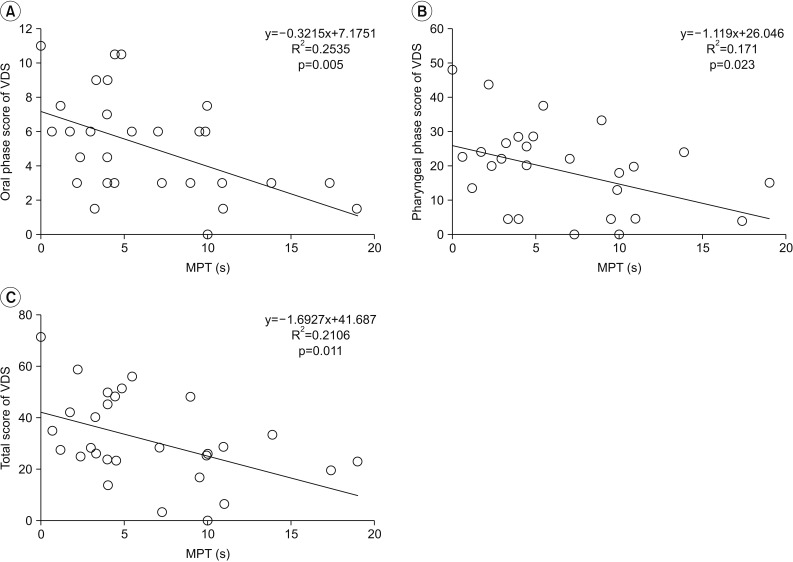
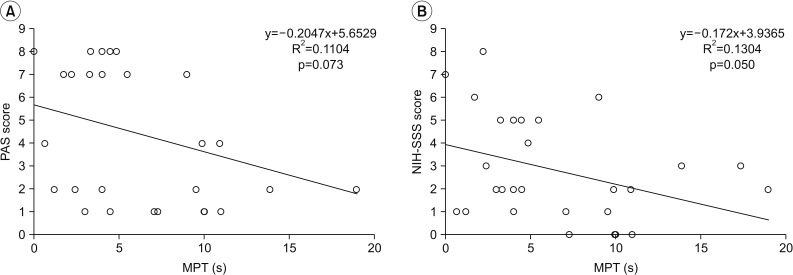
Results: Bolus formation and laryngeal elevation functions were significantly higher in the normal MPT group compared with the impaired group. In the VDS variables, patients with intact bolus formation, oral transit time, pharyngeal swallow triggering, and laryngeal elevation showed significantly longer MPTs compared with the impaired groups. In addition, MPT was significantly correlated with the VDS and modestly correlated with the NIH-SSS, but not the PAS, suggesting that phonatory function is related to the oropharyngeal swallowing function, but not directly to the aspiration itself.
Conclusion: The correlation between MPT and several swallowing-related elements was identified, indicating an interactive correlation between swallowing and phonation. This result justifies voice therapy as a treatment for dysphagia in patients with Parkinsonism.
Keywords: Deglutition disorders; Parkinson disease; Parkinsonian disorders; Phonation.
Figures
References
-
- Kalia LV, Lang AE. Parkinson’s disease. Lancet. 2015;386:896–912. - PubMed
-
- Potulska A, Friedman A, Krolicki L, Spychala A. Swallowing disorders in Parkinson’s disease. Parkinsonism Relat Disord. 2003;9:349–53. - PubMed
-
- van Hooren MR, Baijens LW, Voskuilen S, Oosterloo M, Kremer B. Treatment effects for dysphagia in Parkinson’s disease: a systematic review. Parkinsonism Relat Disord. 2014;20:800–7. - PubMed
-
- Suttrup I, Warnecke T. Dysphagia in Parkinson’s disease. Dysphagia. 2016;31:24–32. - PubMed
LinkOut - more resources
Full Text Sources
Other Literature Sources