Reactive Oxygen Species as Intracellular Signaling Molecules in the Cardiovascular System
- PMID: 29962348
- PMCID: PMC6300799
- DOI: 10.2174/1573403X14666180702152436
Reactive Oxygen Species as Intracellular Signaling Molecules in the Cardiovascular System
Abstract
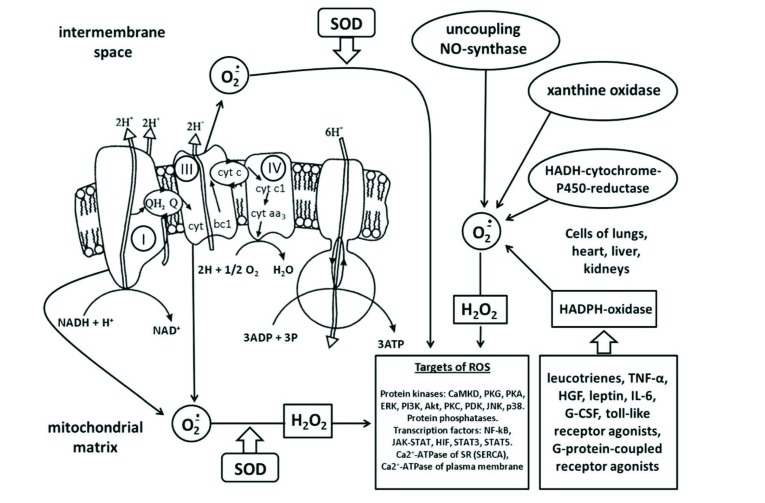
Background: Redox signaling plays an important role in the lives of cells. This signaling not only becomes apparent in pathologies but is also thought to be involved in maintaining physiological homeostasis. Reactive Oxygen Species (ROS) can activate protein kinases: CaMKII, PKG, PKA, ERK, PI3K, Akt, PKC, PDK, JNK, p38. It is unclear whether it is a direct interaction of ROS with these kinases or whether their activation is a consequence of inhibition of phosphatases. ROS have a biphasic effect on the transport of Ca2+ in the cell: on one hand, they activate the sarcoplasmic reticulum Ca2+-ATPase, which can reduce the level of Ca2+ in the cell, and on the other hand, they can inactivate Ca2+-ATPase of the plasma membrane and open the cation channels TRPM2, which promote Ca2+-loading and subsequent apoptosis. ROS inhibit the enzyme PHD2, which leads to the stabilization of HIF-α and the formation of the active transcription factor HIF.
Conclusion: Activation of STAT3 and STAT5, induced by cytokines or growth factors, may include activation of NADPH oxidase and enhancement of ROS production. Normal physiological production of ROS under the action of cytokines activates the JAK/STAT while excessive ROS production leads to their inhibition. ROS cause the activation of the transcription factor NF-κB. Physiological levels of ROS control cell proliferation and angiogenesis. ROS signaling is also involved in beneficial adaptations to survive ischemia and hypoxia, while further increases in ROS can trigger programmed cell death by the mechanism of apoptosis or autophagy. ROS formation in the myocardium can be reduced by moderate exercise.
Keywords: Reactive oxygen species; autophagy; cardiovascular system; exercise; heart; intracellular signaling molecules..
Copyright© Bentham Science Publishers; For any queries, please email at epub@benthamscience.org.
Figures
References
-
- Jacobson M.D. Reactive oxygen species and programmed cell death. Trends Biochem. Sci. 1996;21(3):83–86. - PubMed
-
- Kuroda S., Siesjö B.K. Reperfusion damage following focal ischemia: pathophysiology and therapeutic windows. Clin. Neurosci. 1997;4(4):199–212. - PubMed
-
- Markesbery W.R. Oxidative stress hypothesis in Alzheimer’s disease. Free Radic. Biol. Med. 1997;23(1):137–147. - PubMed
-
- Meerson F.Z., Belkina L.M., Sazontova T.G., Saltykova V.A., Arkhipenko YuV. The role of lipid peroxidation in pathogenesis of arrhythmias and prevention of cardiac fibrillation with antioxidants. Basic Res. Cardiol. 1987;82(2):123–137. - PubMed
-
- Yu B.P. Cellular defenses against damage from reactive oxygen species. Physiol. Rev. 1994;74(1):139–162. - PubMed
Publication types
MeSH terms
Substances
LinkOut - more resources
Full Text Sources
Other Literature Sources
Research Materials
Miscellaneous