


Correlation between model observers in uniform background and human observers in patient liver background for a low-contrast detection task in CT
- PMID: 29962647
- PMCID: PMC6023415
- DOI: 10.1117/12.2294955
Correlation between model observers in uniform background and human observers in patient liver background for a low-contrast detection task in CT
Abstract
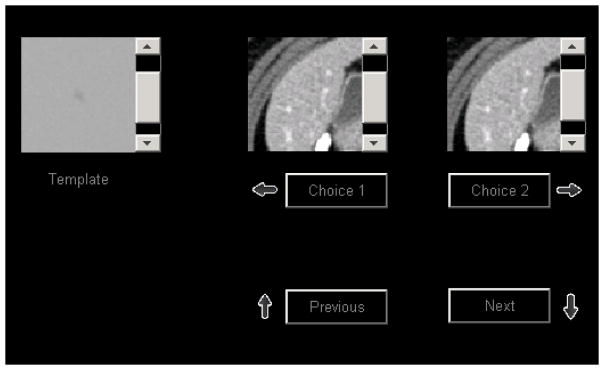
Channelized Hotelling observer (CHO) has demonstrated strong correlation with human observer (HO) in both single-slice viewing mode and multi-slice viewing mode in low-contrast detection tasks with uniform background. However, it remains unknown if the simplest single-slice CHO in uniform background can be used to predict human observer performance in more realistic tasks that involve patient anatomical background and multi-slice viewing mode. In this study, we aim to investigate the correlation between CHO in a uniform water background and human observer performance at a multi-slice viewing mode on patient liver background for a low-contrast lesion detection task. The human observer study was performed on CT images from 7 abdominal CT exams. A noise insertion tool was employed to synthesize CT scans at two additional dose levels. A validated lesion insertion tool was used to numerically insert metastatic liver lesions of various sizes and contrasts into both phantom and patient images. We selected 12 conditions out of 72 possible experimental conditions to evaluate the correlation at various radiation doses, lesion sizes, lesion contrasts and reconstruction algorithms. CHO with both single and multi-slice viewing modes were strongly correlated with HO. The corresponding Pearson's correlation coefficient was 0.982 (with 95% confidence interval (CI) [0.936, 0.995]) and 0.989 (with 95% CI of [0.960, 0.997]) in multi-slice and single-slice viewing modes, respectively. Therefore, this study demonstrated the potential to use the simplest single-slice CHO to assess image quality for more realistic clinically relevant CT detection tasks.
Keywords: Channelized Hotelling observer; Computed tomography (CT); Model observer; Multi-slice viewing; Observer study.
Figures




References
-
- Verdun FR, Racine D, Ott JG, Tapiovaara MJ, Toroi P, Bochud FO, et al. Image quality in CT: From physical measurements to model observers. Physica Medica: European Journal of Medical Physics. 31:823–843. - PubMed
-
- Richard S, Li X, Yadava G, Samei E. Predictive models for observer performance in CT: applications in protocol optimization. SPIE Medical Imaging. 2011:6.
-
- Wilson JM, Christianson OI, Richard S, Samei E. A methodology for image quality evaluation of advanced CT systems. Med Phys. 2013 Mar;40:031908. - PubMed
-
- Fessler JA, Rogers WL. Spatial resolution properties of penalized-likelihood image reconstruction: space-invariant tomographs. IEEE Trans Image Process. 1996;5:1346–58. - PubMed
Grants and funding
LinkOut - more resources
Full Text Sources
Other Literature Sources