Review
. 2018 Jun 29;11(7):1116.
doi: 10.3390/ma11071116.

Biomaterials in Tendon and Skeletal Muscle Tissue Engineering: Current Trends and Challenges

Affiliations
Review

Biomaterials in Tendon and Skeletal Muscle Tissue Engineering: Current Trends and Challenges

Megane Beldjilali-Labro et al. Materials (Basel). .

Abstract

Tissue engineering is a promising approach to repair tendon and muscle when natural healing fails. Biohybrid constructs obtained after cells’ seeding and culture in dedicated scaffolds have indeed been considered as relevant tools for mimicking native tissue, leading to a better integration in vivo. They can also be employed to perform advanced in vitro studies to model the cell differentiation or regeneration processes. In this review, we report and analyze the different solutions proposed in literature, for the reconstruction of tendon, muscle, and the myotendinous junction. They classically rely on the three pillars of tissue engineering, i.e., cells, biomaterials and environment (both chemical and physical stimuli). We have chosen to present biomimetic or bioinspired strategies based on understanding of the native tissue structure/functions/properties of the tissue of interest. For each tissue, we sorted the relevant publications according to an increasing degree of complexity in the materials’ shape or manufacture. We present their biological and mechanical performances, observed in vitro and in vivo when available. Although there is no consensus for a gold standard technique to reconstruct these musculo-skeletal tissues, the reader can find different ways to progress in the field and to understand the recent history in the choice of materials, from collagen to polymer-based matrices.

Keywords: collagen; elastic modulus; electrospinning; sponge; stem cells; stretching.


Conflict of interest statement

The authors declare no conflicts of interest.

Figures

Figure 1
Figure 1
The three pillars of tendon/muscle tissue engineering: cells are cultured on a scaffold where they can attach, proliferate, or differentiate, giving them a phenotype relevant for the renewal of tissue functions. The mechanical and biochemical environments are of prime importance for triggering specific responses.
Figure 2
Figure 2
Overview of the bone-tendon-muscle continuum in the human musculo-skeletal system (a). Multi-scale description of a skeletal muscle (b) and a tendon (c).
Figure 3
Figure 3
Typical tendon response to stretching at fixed strain rate: stress-strain curve illustrating the various deformations of the collagen fibrils.
Figure 4
Figure 4
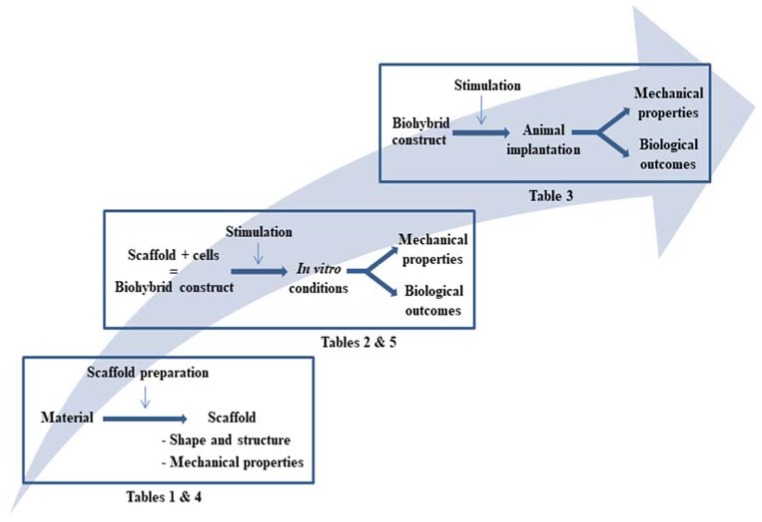
Rationale for the choice of studies and contents reported in the tables, for tendon, and muscle tissue engineering, respectively.
Figure 5
Figure 5
Schematic representation of skeletal muscle cell mechanotransduction: chemical signals are initiated by growth factors such as insulin-like growth factor (IGF), Hepatocyte growth factor (HGF), and fibroblast growth factor (FGF) binding to their respective receptors to trigger RAS, phosphatidylinositol-3-kinase (PI3K), and McKusick-Kaufman syndrome (MKKs) signaling cascades and activate Extracellular signal-regulated kinases (ERK), mitogen-activated protein kinases (p38), and c-Jun NH2-terminal kinases (JNK) pathways, respectively [233,234,235]. Electrical stimulation induces calcium release from the endoplasmic reticulum [236]. Calcium can act by activating either ERK [237] or calp, camk and calc [238,239,240]. Mechanical stretching signals involve the transmembrane protein integrin and the calcium ion channel [241]. Activating integrin triggers the FAK signaling pathway. Electrical and mechanical stimulations are also likely to activate the JNK and p38 pathways. Other pathways may be involved, such as wnt/frizzled and notch. All these signaling pathways up-regulate the expression of some of the genes responsible for skeletal muscle progenitor development.

References

    1. Yang J., Zhang Y.S., Yue K., Khademhosseini A. Cell-laden hydrogels for osteochondral and cartilage tissue engineering. Acta Biomater. 2017;57:1–25. doi: 10.1016/j.actbio.2017.01.036. - DOI - PMC - PubMed
    1. Huang B.J., Hu J.C., Athanasiou K.A. Cell-based tissue engineering strategies used in the clinical repair of articular cartilage. Biomaterials. 2016;98:1–22. doi: 10.1016/j.biomaterials.2016.04.018. - DOI - PMC - PubMed
    1. Henkel J., Woodruff M.A., Epari D.R., Steck R., Glatt V., Dickinson I.C., Choong P.F.M., Schuetz M.A., Hutmacher D.W. Bone Regeneration Based on Tissue Engineering Conceptions-A 21st Century Perspective. Bone Res. 2013;1:216–248. doi: 10.4248/BR201303002. - DOI - PMC - PubMed
    1. Font Tellado S., Balmayor E.R., Van Griensven M. Strategies to engineer tendon/ligament-to-bone interface: Biomaterials, cells and growth factors. Adv. Drug Deliv. Rev. 2015;94:126–140. doi: 10.1016/j.addr.2015.03.004. - DOI - PubMed
    1. Kirkendall D.T., Garrett W.E. Function and biomechanics of tendons. Scand. J. Med. Sci. Sports. 2007;7:62–66. doi: 10.1111/j.1600-0838.1997.tb00120.x. - DOI - PubMed