Review
. 2018 Jul 2;16(1):121.
doi: 10.1186/s12957-018-1428-0.

Genomic characterization of colitis-associated colorectal cancer

Affiliations
Review

Genomic characterization of colitis-associated colorectal cancer

Hitoshi Kameyama et al. World J Surg Oncol. .

Abstract

Background: Inflammatory bowel disease (IBD), which includes ulcerative colitis (UC) and Crohn's disease (CD), is a chronic, idiopathic, repeated inflammatory disease. Colorectal cancer (CRC) that develops in patients with IBD is known as colitis-associated colorectal cancer (CAC), but the underlying carcinogenic mechanism remains unclear. Genomic analysis of sporadic CRC has been well described based on next-generation sequencing (NGS) data. Using NGS, we compared all exons of 415 cancer-associated genes in patients in Japan and the USA who had CRC and found similar genomic alteration patterns among the two populations. However, genomic analysis of CAC has not been thoroughly investigated.

Main body: The molecular pathogenesis of CAC shares many features with sporadic CRC, but there are distinct variations in the time and frequency of some alterations. Gene alterations in CAC are gradually being elucidated using genomic sequencing analyses. Some studies have shown that gene alteration patterns differ between UC and CD. The carcinogenesis of CAC depends on unique environmental, genetic, and immunological factors.

Conclusions: In this review, we have discussed the differences in genomic alterations between sporadic CRC and CAC. NGS in patients with IBD has the potential to detect early CAC and to suggest therapeutic targets.

Keywords: Colitis-associated cancer; Colorectal cancer; Genomic characterization; Next-generation sequencing.


Conflict of interest statement

Ethics approval and consent to participate

Not applicable.

Consent for publication

Not applicable.

Competing interests

The authors declare that they have no competing interests.

Publisher’s Note

Springer Nature remains neutral with regard to jurisdictional claims in published maps and institutional affiliations.

Figures
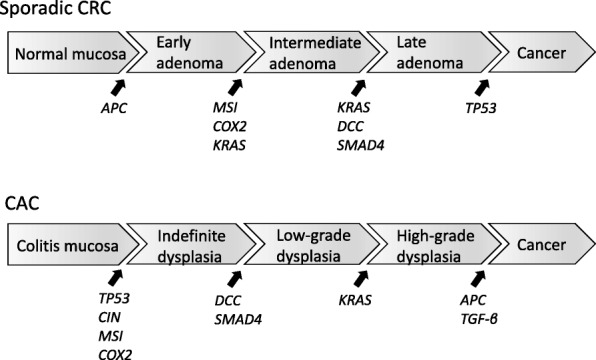
Fig. 1
Fig. 1
Differences in molecular pathogenesis of sporadic CRC and CAC. The loss of APC occurs early in the development of sporadic CRC, whereas it is usually a late event in CAC. TP53 mutations appear early in CAC, even prior to the development of dysplasia, but late in sporadic CRC. CRC colorectal cancer, CAC colitis-associated cancer, APC adenomatous polyposis coli, MSI microsatellite instability, COX2 cyclooxygenase 2, KRAS Kirsten rat sarcoma viral oncogene homolog, DCC deleted in colorectal carcinoma, SMAD4 SMAD family member 4, CIN chromosomal instability, TGF-β transforming growth factor-β
Fig. 2
Fig. 2
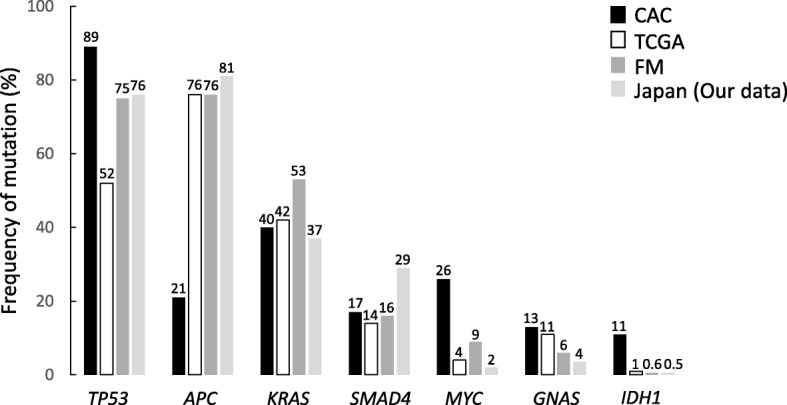
Comparison of the frequency of genetic alterations in CAC and sporadic CRC. TP53 mutations are the most commonly occurring mutations in CAC. However, the mutations in APC are less frequent in CAC than in sporadic CRC. Genomic alteration patterns in Japanese and American patients are similar. CAC colitis-associated cancer, TCGA The Cancer Genome Atlas, FM Foundation Medicine, APC adenomatous polyposis coli, KRAS Kirsten rat sarcoma viral oncogene homolog, SMAD4 SMAD family member 4, IDH1 isocitrate dehydrogenase
Fig. 3
Fig. 3
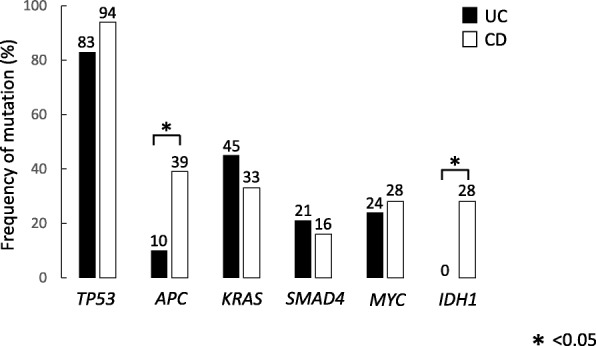
Comparison of the frequency of genetic alterations in UC and CD. The frequency of genetic alterations shares many features between UC and CD, but there are also some differences between the two. TP53 mutations are the most commonly occurring mutations in UC and CD. APC and IDH alterations are significantly more frequent in CD than in UC. UC ulcerative colitis, CD Crohn’s disease, APC adenomatous polyposis coli, KRAS Kirsten rat sarcoma viral oncogene homolog, SMAD4 SMAD family member 4

References

    1. Ungaro R, Meandrous S, Allen PB, Peyrin-Biroulet L, Colombel JF. Ulcerative colitis. Lancet. 2017;389:1756–1770. doi: 10.1016/S0140-6736(16)32126-2. - DOI - PMC - PubMed
    1. Kinugasa T, Akagi Y. Status of colitis-associated cancer in ulcerative colitis. World J Gastrointest Oncol. 2016;8:351–357. doi: 10.4251/wjgo.v8.i4.351. - DOI - PMC - PubMed
    1. Ng WK, Wong SH, Ng SC. Changing epidemiological trends of inflammatory bowel disease in Asia. Intest Res. 2016;14:111–119. doi: 10.5217/ir.2016.14.2.111. - DOI - PMC - PubMed
    1. Peyrin-Biroulet L, Sandborn W, Sands BE, Reinisch W, Bemelman W, Bryant RV, et al. Selecting therapeutic targets in inflammatory bowel disease (STRIDE): determining therapeutic goals for treat-to-target. Am J Gastroenterol. 2015;110:1324–1338. doi: 10.1038/ajg.2015.233. - DOI - PubMed
    1. Baumgart DC, Sandborn WJ. Crohn’s disease. Lancet. 2012;380:1590–1605. doi: 10.1016/S0140-6736(12)60026-9. - DOI - PubMed

Grants and funding