


Distinct neural processes for the perception of familiar versus unfamiliar faces along the visual hierarchy revealed by EEG
- PMID: 29966716
- PMCID: PMC6139062
- DOI: 10.1016/j.neuroimage.2018.06.080
Distinct neural processes for the perception of familiar versus unfamiliar faces along the visual hierarchy revealed by EEG
Abstract
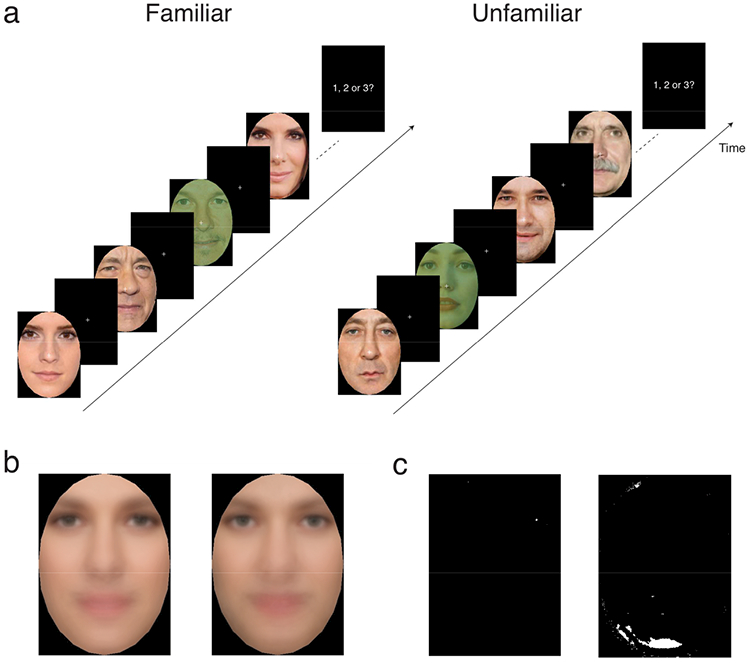
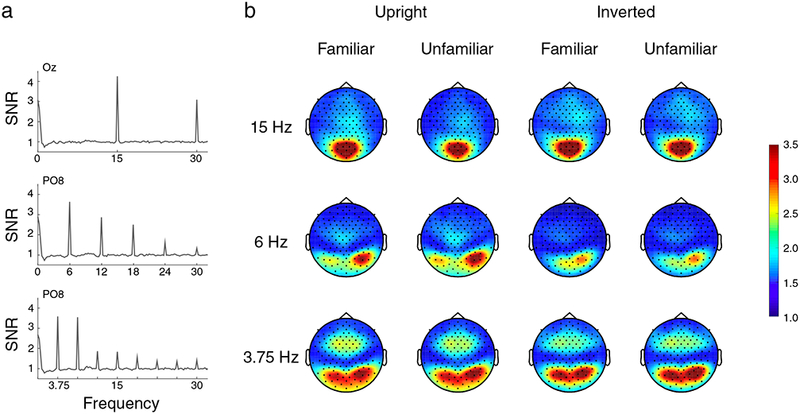
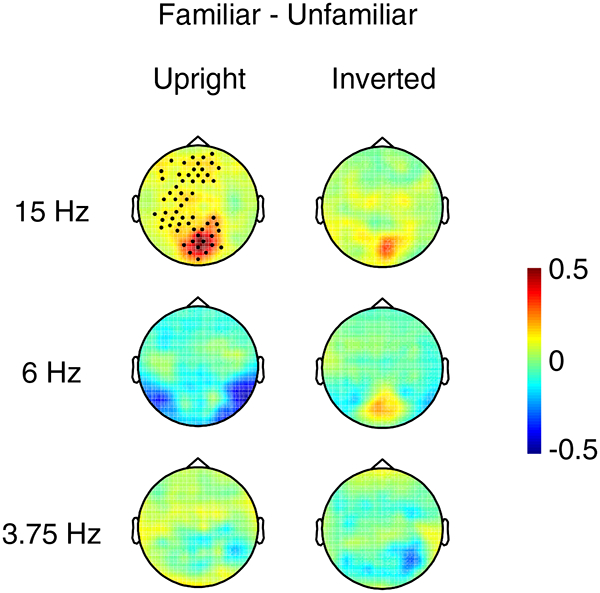
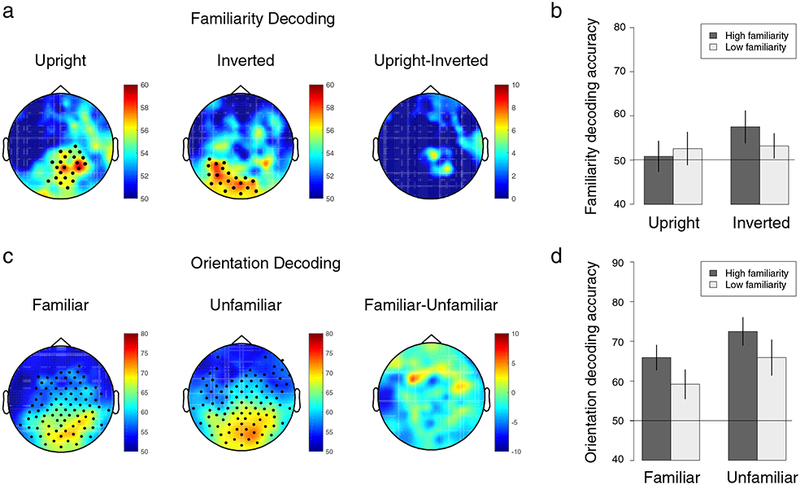
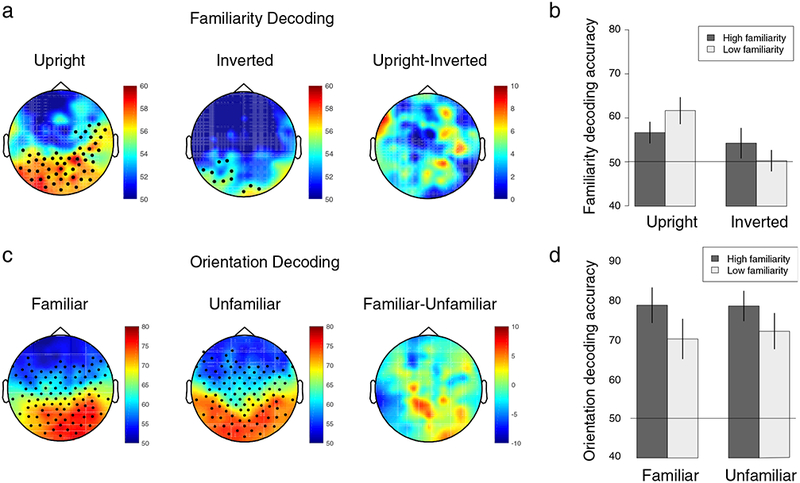
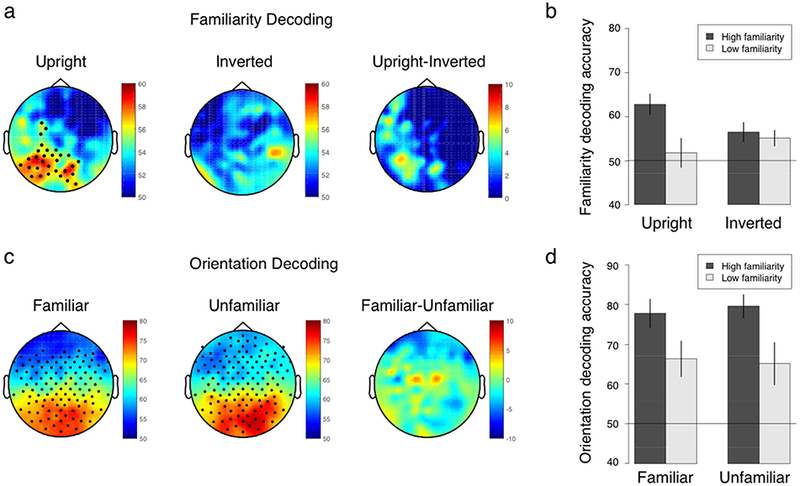
Humans recognize faces with ease, despite the complexity of the task and of the visual system which underlies it. Different spatial regions, including both the core and extended face processing networks, and distinct temporal stages of processing have been implicated in face recognition, but there is ongoing controversy regarding the extent to which the mechanisms for recognizing a familiar face differ from those for an unfamiliar face. Here, we used electroencephalogram (EEG) and flicker SSVEP, a high signal-to-noise approach, and searchlight decoding methods to elucidate the mechanisms mediating the processing of familiar and unfamiliar faces in the time domain. Familiar and unfamiliar faces were presented periodically at 15 Hz, 6 Hz and 3.75 Hz either upright or inverted in separate blocks, with the rationale that faster frequencies require shorter processing times per image and tap into fundamentally different levels of visual processing. The 15 Hz trials, likely to reflect early visual processing, exhibited enhanced neural responses for familiar over unfamiliar face trials, but only when the faces were upright. In contrast, decoding methods revealed similar classification accuracies for upright and inverted faces for both familiar and unfamiliar faces. For the 6 Hz frequency, familiar faces had lower amplitude responses than unfamiliar faces, and decoding familiarity was more accurate for upright compared with inverted faces. Finally, the 3.75 Hz frequency revealed no main effects of familiarity, but decoding showed significant correlations with behavioral ratings of face familiarity, suggesting that activity evoked by this slow presentation frequency reflected higher-level, cognitive aspects of familiarity processing. This three-way dissociation between frequencies reveals that fundamentally different stages of the visual hierarchy are modulated by face familiarity. The combination of experimental and analytical approaches used here represent a novel method for elucidating spatio-temporal characteristics within the visual system.
Keywords: EEG; FPVS; Face processing; Face recognition; Famous faces; Frequency tagging.
Copyright © 2018 Elsevier Inc. All rights reserved.
Figures
References
-
- Alonso-Prieto E, Van Belle G, Liu-Shuang J, Norcia AM, & Rossion B (2013). The 6Hz fundamental stimulation frequency rate for individual face discrimination in the right occipito-temporal cortex. Neuropsychologia, 51(13), 2863–2875. - PubMed
-
- Althoff RR, & Cohen NJ (1999). Eye-movement-based memory effect: a reprocessing effect in face perception. J Exp Psychol Learn Mem Cogn, 25(4), 997–1010. - PubMed
-
- Barton JJS, Radcliffe N, Cherkasova MV, Edelman J, & Intriligator JM (2006). Information processing during face recognition: the effects of familiarity, inversion, and morphing on scanning fixations. Perception, 35(8), 1089–1105. - PubMed
-
- Bruce V, Henderson Z, Newman C, & Burton AM (2001). Matching identities of familiar and unfamiliar faces caught on CCTV images. J Exp Psychol Appl, 7(3), 207–218. - PubMed
Publication types
MeSH terms
Grants and funding
LinkOut - more resources
Full Text Sources
Other Literature Sources
Miscellaneous
