


Gene-Centric Analysis of Preeclampsia Identifies Maternal Association at PLEKHG1
- PMID: 29967039
- PMCID: PMC6043396
- DOI: 10.1161/HYPERTENSIONAHA.117.10688
Gene-Centric Analysis of Preeclampsia Identifies Maternal Association at PLEKHG1
Abstract
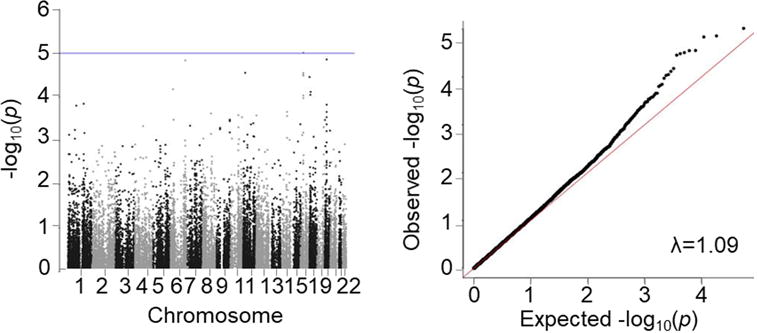
The genetic susceptibility to preeclampsia, a pregnancy-specific complication with significant maternal and fetal morbidity, has been poorly characterized. To identify maternal genes associated with preeclampsia risk, we assembled 498 cases and 1864 controls of European ancestry from preeclampsia case-control collections in 5 different US sites (with additional matched population controls), genotyped samples on a cardiovascular gene-centric array composed of variants from ≈2000 genes selected based on prior genetic studies of cardiovascular and metabolic diseases and performed case-control genetic association analysis on 27 429 variants passing quality control. In silico replication testing of 9 lead signals with P<10-4 was performed in independent European samples from the SOPHIA (Study of Pregnancy Hypertension in Iowa) and Inova cohorts (212 cases, 456 controls). Multiethnic assessment of lead signals was then performed in samples of black (26 cases, 136 controls), Hispanic (132 cases, 468 controls), and East Asian (9 cases, 80 controls) ancestry. Multiethnic meta-analysis (877 cases, 3004 controls) revealed a study-wide statistically significant association of the rs9478812 variant in the pleiotropic PLEKHG1 gene (odds ratio, 1.40 [1.23-1.60]; Pmeta=5.90×10⁻⁷). The rs9478812 effect was even stronger in the subset of European cases with known early-onset preeclampsia (236 cases diagnosed <37 weeks, 1864 controls; odds ratio, 1.59 [1.27-1.98]; P=4.01×10⁻⁵). PLEKHG1 variants have previously been implicated in genome-wide association studies of blood pressure, body weight, and neurological disorders. Although larger studies are required to further define maternal preeclampsia heritability, this study identifies a novel maternal risk locus for further investigation.
Keywords: genetic association studies; hypertension; population control; preeclampsia; pregnancy.
© 2018 American Heart Association, Inc.
Conflict of interest statement
Figures
Comment in
-
Genes for Preeclampsia: An Opportunity for Blood Pressure Genomics.Hypertension. 2018 Aug;72(2):285-286. doi: 10.1161/HYPERTENSIONAHA.118.10840. Epub 2018 Jul 2. Hypertension. 2018. PMID: 29967038 Free PMC article. No abstract available.
References
-
- Mol BWJ, Roberts CT, Thangaratinam S, Magee LA, de Groot CJM, Hofmeyr GJ. Pre-eclampsia. Lancet. 2016;387(10022):999–1011. - PubMed
-
- Smith GC, Pell JP, Walsh D. Pregnancy complications and maternal risk of ischaemic heart disease: a retrospective cohort study of 129,290 births. Lancet. 2001;357(9273):2002–2006. - PubMed
-
- Wikström A-K, Haglund B, Olovsson M, Lindeberg SN. The risk of maternal ischaemic heart disease after gestational hypertensive disease. BJOG. 2005;112(11):1486–1491. - PubMed
-
- Pell JP, Smith GCS, Walsh D. Pregnancy complications and subsequent maternal cerebrovascular events: a retrospective cohort study of 119,668 births. Am J Epidemiol. 2004;159(4):336–342. - PubMed
-
- Kestenbaum B, Seliger SL, Easterling TR, Gillen DL, Critchlow CW, Stehman-Breen CO, Schwartz SM. Cardiovascular and thromboembolic events following hypertensive pregnancy. Am J Kidney Dis. 2003;42(5):982–989. - PubMed
Publication types
MeSH terms
Substances
Grants and funding
LinkOut - more resources
Full Text Sources
Other Literature Sources
Molecular Biology Databases
