Stop fRETting the Target: Next-Generation RET Inhibitors Have Arrived
- PMID: 29967074
- PMCID: PMC6345252
- DOI: 10.1158/2159-8290.CD-18-0489
Stop fRETting the Target: Next-Generation RET Inhibitors Have Arrived
Abstract
BLU-667 is a next-generation RET inhibitor that maximizes on-target and minimizes off-target effects. It is an exemplar of genotype-driven drug development followed by multi-histology basket trial validation that is becoming a paradigm for precision oncology. Cancer Discov; 8(7); 797-9. ©2018 AACRSee related article by Subbiah et al., p. 836.
©2018 American Association for Cancer Research.
Conflict of interest statement
Disclosure of Potential Conflicts of Interest
C.M. Lovly reports receiving commercial research support from Novartis, Xcovery, and AstraZeneca and is a consultant/advisory board member for Cepheid, Foundation Medicine, Takeda, Pfizer. Ariad, AstraZeneca, Novartis, Clovis, and Genoptix. No potential conflicts of interest were disclosed by the other author.
Figures
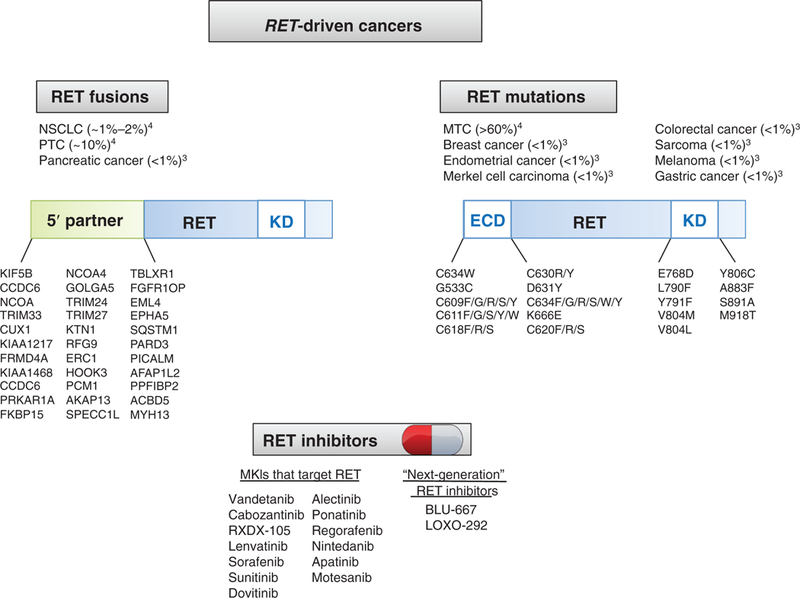
Comment on
-
Precision Targeted Therapy with BLU-667 for RET-Driven Cancers.Cancer Discov. 2018 Jul;8(7):836-849. doi: 10.1158/2159-8290.CD-18-0338. Epub 2018 Apr 15. Cancer Discov. 2018. PMID: 29657135
References
-
- Soria JC, Ohe Y, Vansteenkiste J, Reungwetwattana T, Chewaskulyong B, Lee KH, et al. Osimertinib in untreated EGFR-mutated advanced non-small-cell lung cancer. N Engl J Med 2018;378:113–25. - PubMed
-
- Peters S, Camidge DR, Shaw AT, Gadgeel S, Ahn JS, Kim DW, et al. Alectinib versus crizotinib in untreated ALK-positive non-small-cell lung cancer. N Engl J Med 2017;377:829–38. - PubMed
-
- Subbiah V, Gainor JF, Rahal R, Brubaker JD, Kim JL, Maynard M, et al. Precision targeted therapy with BLU-667 for RET-driven cancers. Cancer Discov 2018;8:836–49. - PubMed
-
- Kato S, Subbiah V, Marchlik E, Elkin SK, Carter JL, Kurzrock R RET aberrations in diverse cancers: next-generation sequencing of 4,871 patients. Clin Cancer Res 2017;23:1988–97. - PubMed
-
- Yoh K, Seto T, Satouchi M, Nishio M, Yamamoto N, Murakami H, et al. Vandetanib in patients with previously treated RET-rearranged advanced non-small-cell lung cancer (LURET): an open-label, multicentre phase 2 trial. Lancet Respir Med 2017;5:42–50. - PubMed
Publication types
MeSH terms
Substances
Grants and funding
LinkOut - more resources
Full Text Sources
Other Literature Sources
Miscellaneous