. 2018 Jul 17;115(29):E6956-E6963.
doi: 10.1073/pnas.1722202115. Epub 2018 Jul 2.

Human impact on the diversity and virulence of the ubiquitous zoonotic parasite Toxoplasma gondii

Affiliations

Human impact on the diversity and virulence of the ubiquitous zoonotic parasite Toxoplasma gondii

E Keats Shwab et al. Proc Natl Acad Sci U S A. .

Abstract

A majority of emerging infectious diseases in humans are zoonoses. Understanding factors that influence the emergence and transmission of zoonoses is pivotal for their prevention and control. Toxoplasma gondii is one of the most widespread zoonotic pathogens known today. Whereas only a few genotypes of T. gondii dominate in the Northern Hemisphere, many genotypes coexist in South America. Furthermore, T. gondii strains from South America are more likely to be virulent than those from the Northern Hemisphere. However, it is not clear what factor(s) shaped modern-day genetic diversity and virulence of T. gondii Here, our analysis suggests that the rise and expansion of farming in the past 11,000 years established the domestic cat/mouse transmission cycle for T. gondii, which has undoubtedly played a significant role in the selection of certain linages of T. gondii Our mathematical simulations showed that within the domestic transmission cycle, intermediately mouse-virulent T. gondii genotypes have an adaptive advantage and eventually become dominant due to a balance between lower host mortality and the ability to superinfect mice previously infected with a less virulent T. gondii strain. Our analysis of the global type II lineage of T. gondii suggests its Old World origin but recent expansion in North America, which is likely the consequence of global human migration and trading. These results have significant implications concerning transmission and evolution of zoonotic pathogens in the rapidly expanding anthropized environment demanded by rapid growth of the human population and intensive international trading at present and in the future.

Keywords: Toxoplasma gondii; evolution; mathematical modeling; population genetics; virulence.


Conflict of interest statement

The authors declare no conflict of interest.

Figures
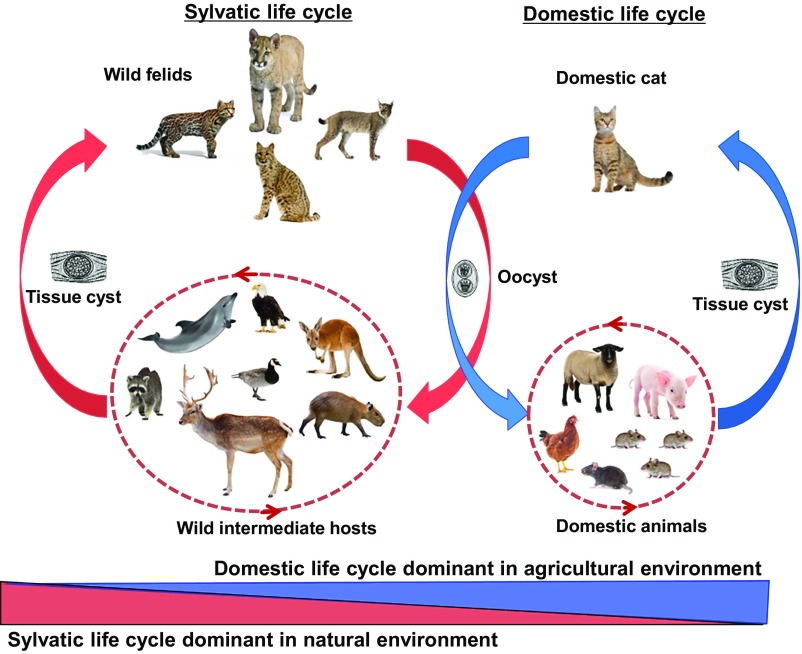
Fig. 1.
Fig. 1.
Life cycle of T. gondii. Parasites are shed by definitive feline hosts in the form of oocysts, which may then be ingested by intermediate hosts. Transmission back to definitive hosts may occur by ingestion of infected intermediate host tissue containing parasites in tissue cysts. The sylvatic cycle includes many definitive wild feline host species and varied mammalian and avian intermediate host species, whereas the domestic cycle includes the domestic cat as a definitive host and the house mouse as an important intermediate host. Transmission may also occur through scavenging among the intermediate hosts.
Fig. 2.
Fig. 2.
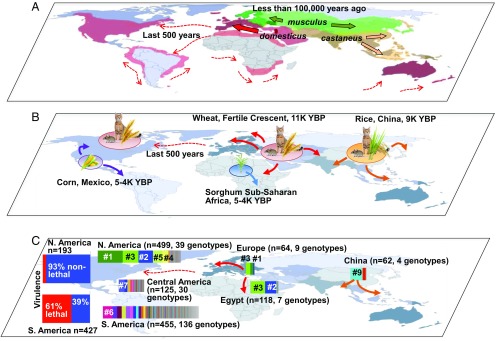
Association of global expansion and distribution of house mice, human agriculture, and population structure of T. gondii. (A) Global distribution of the three major house mouse subspecies, M. m. domesticus (red), M. m. musculus (green), and M. m. castaneus (brown). Colored arrows indicate directions of mouse subspecies expansion over the indicated time frames. (B) Origins and expansion of agriculture and association with domestic cats and house mice. Indicated are cultivation of wheat in the Middle East, rice in Southeast Asia (both associated with domestic cats and house mice), corn in South and Central America, and sorghum in Africa. Arrows indicate directions of outward agricultural expansion, including migration of European settlers to North America and concomitant exportation of domestic cats, house mice, and livestock. (C) Overall population structure and mouse virulence of T. gondii. Charts indicate proportions of color-coded T. gondii PCR restriction fragment length polymorphism (RFLP) genotypes present on corresponding continents. Populations in the Northern Hemisphere are largely clonal in structure, with small numbers of highly dominant lineages, whereas the South American population is much more diverse, without notably dominant individual genotypes. Most isolates from North (N.) America were nonvirulent to mice, whereas the opposite was true for South (S.) America. The numbers following the number sign (#) are PCR-RFLP genotype numbers.
Fig. 3.
Fig. 3.
T. gondii transmission dynamics in the domestic and sylvatic cycles. (A) Simulation of domestic life cycles with superinfection for 25 y. The IV type becomes fixed, while the HV and NV types disappear. (B) Simulation of sylvatic life cycles with superinfection for 25 y. The HV type becomes fixed, while the NV and IV types disappear. (C) Domestic cycle with superinfection. There were significant differences in the frequencies of fixation among the three populations, with IV > NV > HV types (P < 0.001). (D) Domestic cycle without superinfection. The IV and NV types were significantly higher than the HV type (P < 0.001). There was no difference between the IV and NV types (P > 0.01). (E) Sylvatic cycle with superinfection. The HV type was significantly higher than the IV and NV types (P < 0.001). The IV type was also significantly higher than the NV type (P < 0.01). (F) Sylvatic cycle without superinfection. There was no difference among the three populations (P > 0.01). ANOVA was performed using SAS (9.4) proc glimmix. *P < 0.01; **P < 0.001; #P > 0.01.

References

    1. Jones KE, et al. Global trends in emerging infectious diseases. Nature. 2008;451:990–993. - PMC - PubMed
    1. Gebreyes WA, et al. The global one health paradigm: Challenges and opportunities for tackling infectious diseases at the human, animal, and environment interface in low-resource settings. PLoS Negl Trop Dis. 2014;8:e3257. - PMC - PubMed
    1. Dubey JP. Toxoplasmosis of Animals and Humans. 2nd Ed CRC Press; Boca Raton, FL: 2010.
    1. Montoya JG, Liesenfeld O. Toxoplasmosis. Lancet. 2004;363:1965–1976. - PubMed
    1. Howe DK, Sibley LD. Toxoplasma gondii comprises three clonal lineages: Correlation of parasite genotype with human disease. J Infect Dis. 1995;172:1561–1566. - PubMed

Publication types

LinkOut - more resources