


Opposite outcomes of coinfection at individual and population scales
- PMID: 29967175
- PMCID: PMC6055155
- DOI: 10.1073/pnas.1801095115
Opposite outcomes of coinfection at individual and population scales
Abstract
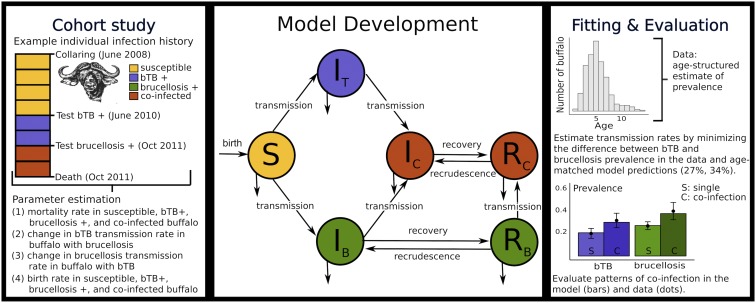
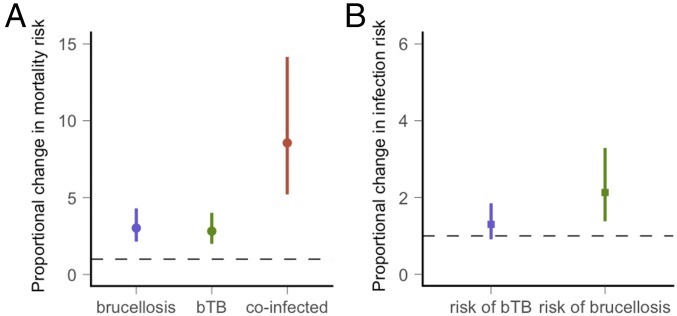
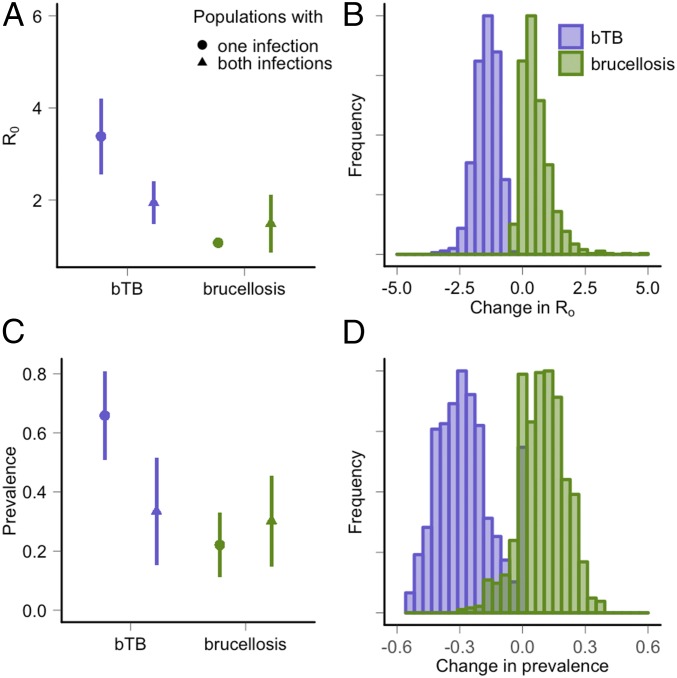
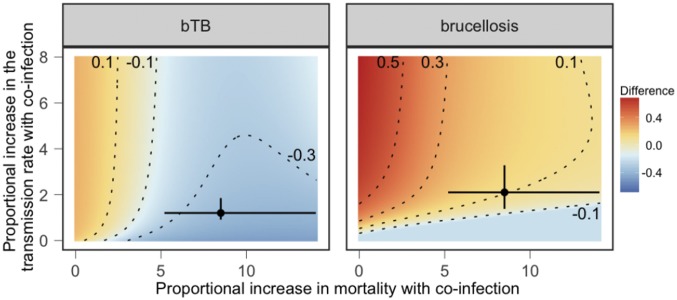
Coinfecting parasites and pathogens remain a leading challenge for global public health due to their consequences for individual-level infection risk and disease progression. However, a clear understanding of the population-level consequences of coinfection is lacking. Here, we constructed a model that includes three individual-level effects of coinfection: mortality, fecundity, and transmission. We used the model to investigate how these individual-level consequences of coinfection scale up to produce population-level infection patterns. To parameterize this model, we conducted a 4-y cohort study in African buffalo to estimate the individual-level effects of coinfection with two bacterial pathogens, bovine tuberculosis (bTB) and brucellosis, across a range of demographic and environmental contexts. At the individual level, our empirical results identified bTB as a risk factor for acquiring brucellosis, but we found no association between brucellosis and the risk of acquiring bTB. Both infections were associated with reductions in survival and neither infection was associated with reductions in fecundity. The model reproduced coinfection patterns in the data and predicted opposite impacts of coinfection at individual and population scales: Whereas bTB facilitated brucellosis infection at the individual level, our model predicted the presence of brucellosis to have a strong negative impact on bTB at the population level. In modeled populations where brucellosis was present, the endemic prevalence and basic reproduction number ([Formula: see text]) of bTB were lower than in populations without brucellosis. Therefore, these results provide a data-driven example of competition between coinfecting pathogens that occurs when one pathogen facilitates secondary infections at the individual level.
Keywords: African buffalo; brucellosis; coinfection; competition; tuberculosis.
Conflict of interest statement
The authors declare no conflict of interest.
Figures
References
-
- Gandhi NR, et al. Extensively drug-resistant tuberculosis as a cause of death in patients co-infected with tuberculosis and HIV in a rural area of South Africa. Lancet. 2006;368:1575–1580. - PubMed
-
- Alter MJ. Epidemiology of viral hepatitis and HIV co-infection. J Hepatol. 2006;44:S6–S9. - PubMed
-
- Graham AL, Lamb TJ, Read AF, Allen JE. Malaria-filaria coinfection in mice makes malarial disease more severe unless filarial infection achieves patency. J Infect Dis. 2005;191:410–421. - PubMed
Publication types
MeSH terms
LinkOut - more resources
Full Text Sources
Other Literature Sources
