. 2018 Jul 2;8(1):9979.
doi: 10.1038/s41598-018-28019-3.

Cluster-assembled zirconia substrates promote long-term differentiation and functioning of human islets of Langerhans

Affiliations

Cluster-assembled zirconia substrates promote long-term differentiation and functioning of human islets of Langerhans

Alessandra Galli et al. Sci Rep. .

Erratum in

Abstract

Ex vivo expansion and differentiation of human pancreatic β-cell are enabling steps of paramount importance for accelerating the development of therapies for diabetes. The success of regenerative strategies depends on their ability to reproduce the chemical and biophysical properties of the microenvironment in which β-cells develop, proliferate and function. In this paper we focus on the biophysical properties of the extracellular environment and exploit the cluster-assembled zirconia substrates with tailored roughness to mimic the nanotopography of the extracellular matrix. We demonstrate that β-cells can perceive nanoscale features of the substrate and can convert these stimuli into mechanotransductive processes which promote long-term in vitro human islet culture, thus preserving β-cell differentiation and function. Proteomic and quantitative immunofluorescence analyses demonstrate that the process is driven by nanoscale topography, via remodelling of the actin cytoskeleton and nuclear architecture. These modifications activate a transcriptional program which stimulates an adaptive metabolic glucose response. Engineered cluster-assembled substrates coupled with proteomic approaches may provide a useful strategy for identifying novel molecular targets for treating diabetes mellitus and for enhancing tissue engineering in order to improve the efficacy of islet cell transplantation therapies.


Conflict of interest statement

The authors declare no competing interests.

Figures

Figure 1
Figure 1
Nanostructured zirconia substrates promote long term β-cell survival. (A) Three-dimensional views of AFM topographic maps of substrates. Representative topographic profiles are superimposed over maps (white lines) in gelatin, flat-ZrO2 and cluster-assembled ns-ZrOx (rms 15 nm). (B) Representative confocal images of human islets grown on different substrates for 5, 10 or 25 days. The cells were triple stained with anti-insulin (red), anti-chromogranin A (green) antibodies or DAPI (blue). The yellow-orange staining indicates colocalization between chromogranin A and insulin. Bar: 20 μm. (C) Quantification of endocrine cells density. Chromogranin A-positive endocrine cells are expressed as percentage of total DAPI-positive cells and are the mean ± SE of five independent experiments, performed in duplicate. The black bar reports the percentage of endocrine cells in freshly isolated islets. Quantification of β-cell density. Insulin-positive β-cells are expressed as percentage of total endocrine cells (chromogranin A-positive cells) and are the mean ± SE of five independent experiments, performed in duplicate. The black bar reports the percentage of β-cells in freshly isolated islets. (*p < 0.05, ns-ZrOx vs gelatin).
Figure 2
Figure 2
Bioinformatic analysis of proteins increased or exclusively expressed in cells grown on ns-ZrOx in comparison to gelatin. (A) The proteins listed in Table S1 were classified in different biological processes according to the Gene Ontology classification system: GO-biological process (GOBP), GO-cellular component (GOCC) and GO-molecular function (GOMF) (GO) using Panther software. Functional grouping was based on p value ≤ 0.05. The numbers in the bars indicate the genes number for each category. (B) Reactome analysis. Only categories with confidence level Very High (K value 0.75–1) (Dark Purple) and High (K value 0.5–0.75) (Purple) are reported. (C) Network interactions of the same proteins data set were analyzed by String. Active interactions: text mining, experiments, databases; edges thickness indicates “confidence”. The proteins are indicated by the official gene symbol.
Figure 3
Figure 3
Bioinformatic analysis of the proteins increased or exclusively expressed in cells grown on ns-ZrOx in comparison to flat-ZrO2. (A) The proteins listed in Table S3 were classified into different biological processes according to the Gene Ontology classification system GO-biological process (GOBP), GO-cellular component (GOCC) and GO-molecular function (GOMF) using Panther software. Functional grouping was based on p value ≤ 0.05. The numbers in the bars indicate the number of genes for each category. (B) Reactome analysis. Only categories with confidence level: Very High (K value 0.75–1) (Dark Purple) and High (K value 0.5–0.75) (Purple) are reported. (C) Network interactions in the same proteins data set were analyzed by String. Active interactions: text mining, experiments, databases; edges thickness indicates “confidence”. The proteins are indicated by the official gene symbol.
Figure 4
Figure 4
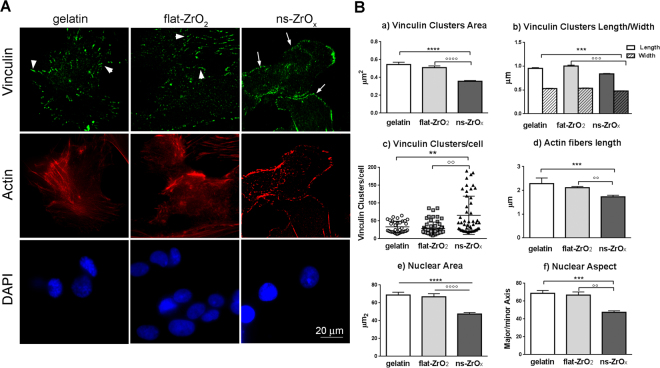
Nanostructured zirconia substrates promote the activation of a mechanotransduction pathway. (A) Cells, grown on different substrates for 15 days, were triple stained with anti-vinculin antibody (green), phalloidin (actin, red) and DAPI (blue). Representative epifluorescence (actin and DAPI) and TIRFM (vinculin) images are shown. Bar: 20 μm. Arrows indicate focal complexes, arrowheads indicate focal adhesion. (B) Quantitative analyses of adhesive complexes, actin fibers organization and nuclear architecture of cells grown on different substrates. (a,b) Vinculin-positive clusters area, length and width; (c) number of vinculin clusters per cell; (d) cytoskeletal actin fibers length; (e,f) nuclear area and aspect (major/minor axis). Bars illustrate the average responses ± SE (N = 40–100 cells for each substrate) in two different islet preparations. (***p < 0.005, ns-ZrOx vs gelatin; °°p < 0.01, °°°p < 0.005, ns-ZrOx vs flat-ZrO2).
Figure 5
Figure 5
Nanostructured Zirconia substrates prevent β-cells death through modulation of hypoxia and NF-κB pathways. (A) Representative immunofluorescence images of islets triple stained with TUNEL (green), anti-insulin antibody (red) and DAPI (blue). Bar = 30 μm. (B) Quantification of β-cell apoptosis by TUNEL assay in human islets grown on different substrates for 2, 10 and 20 days. β-cell apoptosis represents the percentage of TUNEL- and insulin-double positive cells over total insulin-positive cells; non β-cell apoptosis represents the percentage of TUNEL-positive cells over total DAPI-positive and insulin-negative cells. The experiment was performed in triplicate, with three different islet preparations. A minimum of 100 cells for islet preparation was counted (*p < 0.05 vs gelatin; °p < 0.05 vs flat-ZrO2). (C) Western-blotting analysis of hypoxia and NF-κB pathways selected proteins in islets grown on the indicated substrates for 20 days (15 μg protein/sample). On the right, the proteins molecular weight in kDa is reported. (D) Quantitative analysis of protein expression shows that flat-ZrO2 and ns-ZrOx substrates downregulate the hypoxia and NF-κB pathways. Data (mean values ± S.E.; n = 5 independent experiments) are expressed as fold change over gelatin (dashed line). (*p < 0.05, **p < 0.01, ***p < 0.005, ns-ZrOx vs gelatin. °p < 0.05, °°p < 0.01, ns-ZrOx vs flat-ZrO2).
Figure 6
Figure 6
Nanostructured substrates preserve β-cell function in long term cultures. (A) Insulin granules density and distribution were evaluated by double immunofluorescence stainings with anti-insulin (red) and anti-chromogranin A (green) antibodies. The yellow-orange staining indicates colocalization between the two markers. Representative confocal images are shown. Bar = 5 μm. (B) The insulin content was evaluated in human islets cultured for 20 days on the indicated substrates or in freshly-isolated intact islets (three days old islets) (islets, black bars). Data (mean ± SD) are expressed as μUi of insulin per mg of protein (n = 3, in duplicate) (*p < 0.05; vs gelatin). (C) The insulin secretory response in basal (3.3 mM glucose) and stimulated (16.7 mM glucose) conditions was evaluated in human islets cultured for 20 days on the indicated substrates or in freshly isolated intact islets. Data (mean ± SD) are expressed as % of insulin content (n = 3, in duplicate). (*p < 0.05, vs gelatin; °p < 0.05, vs flat-ZrO2; ##p < 0.001 stimulated vs relative basal). (D) The cells were loaded with the Ca2+ indicator Fluo3 and Calcium imaging was performed under basal (NG, 3.3 mM glucose) (dotted lines) and stimulated (HG, 20 mM glucose) (continue lines) conditions. The time course of changes in fluorescence signals (F/F0) induced by glucose application (bars over traces) were recorded from islets grown on gelatin (black), flat-ZrO2 (blue) and ns-ZrOx (red). The curves illustrate average responses ± S.E. from four different islet isolations (N = 20 cells for each experiment) (p < 0.005 ns-ZrOx vs gelatin; P < 0.0001 ns-ZrOx vs flat-ZrO2). (E) Area Under the Curves (AUC) of experiments reported in D (*p < 0.05 ns-ZrOx vs gelatin; °°°p < 0.001 ns-ZrOx vs flat-ZrO2).
Figure 7
Figure 7
β-cells relay on nanotopography features to regulate their differentiation and survival. Modification of β-cell shape and insulin expression in cells grown on flat-ZrO2 or ns-ZrOx during the in vitro culture. Ins: insulin, ChrA: chromogranin A, −/+ insulin or chromogranin A expression. Only β-cells grown on ns-ZrOx maintain their circularity and activate a survival and pro-differentiation program. The process is supported by a mechanotransduction pathway, driven by the nanostructured topology, via remodeling of the actin cytoskeleton, nuclear architecture and activation of a transcriptional program that promotes β-cell survival and differentiation. Examples of genes involved in the different processes are reported (the complete list of genes is reported in Supplementary Tables).

References

    1. Guariguata L, et al. Global estimates of diabetes prevalence for 2013 and projections for 2035. Diabetes Res. Clin. Pract. 2014;103:137–149. doi: 10.1016/j.diabres.2013.11.002. - DOI - PubMed
    1. Shapiro AMJ, Pokrywczynska M, Ricordi C. Clinical pancreatic islet transplantation. Nat. Rev. Endocrinol. 2016;13:268–277. doi: 10.1038/nrendo.2016.178. - DOI - PubMed
    1. Juhl K, Bonner-Weir S, Sharma A. Regenerating pancreatic β-cells: plasticity of adult pancreatic cells and the feasibility of in-vivo neogenesis. Curr. Opin. Organ Transplant. 2010;15:79–85. doi: 10.1097/MOT.0b013e3283344932. - DOI - PMC - PubMed
    1. Pagliuca FW, Melton DA. How to make a functional -cell. Development. 2013;140:2472–2483. doi: 10.1242/dev.093187. - DOI - PMC - PubMed
    1. Carlessi R, Keane KN, Mamotte C, Newsholme P. Nutrient regulation of β-cell function: what do islet cell/animal studies tell us? Eur. J. Clin. Nutr. 2017;71:890–895. doi: 10.1038/ejcn.2017.49. - DOI - PubMed

Publication types

MeSH terms