. 2019 Mar;40(3):365-373.
doi: 10.1038/s41401-018-0059-x. Epub 2018 Jul 2.

Cannabinoid CB1 receptor neutral antagonist AM4113 inhibits heroin self-administration without depressive side effects in rats

Affiliations

Cannabinoid CB1 receptor neutral antagonist AM4113 inhibits heroin self-administration without depressive side effects in rats

Xiang-Hu He et al. Acta Pharmacol Sin. 2019 Mar.

Abstract

Cannabinoid CB1 receptors (CB1Rs) have been shown to be a promising target in medication development for the treatment of addiction. However, clinical trials with SR141716A (rimonabant, a selective CB1R antagonist/inverse agonist) for the treatment of obesity and smoking cessation failed due to unwanted side effects, such as depression, anxiety, and suicidal tendencies. Recent preclinical studies suggest that the neutral CB1R antagonist AM4113 may retain the therapeutic anti-addictive effects of SR141716A in nicotine self-administration models and possibly has fewer unwanted side effects. However, little is known about whether AM4113 is also effective for other drugs of abuse, such as opioids and psychostimulants, and whether it produces depressive side effects similar to SR141716A in experimental animals. In this study, we demonstrated that systemic administration of AM4113 (3 and 10 mg/kg) dose-dependently inhibited the self-administration of intravenous heroin but not cocaine or methamphetamine, whereas SR141716A (3 and 10 mg/kg) dose-dependently inhibited the self-administration of heroin and methamphetamine but not cocaine. In the electrical brain-stimulation reward (BSR) paradigm, SR141716A (3 and 10 mg/kg) dose-dependently increased the BSR stimulation threshold (i.e., decreased the stimulation reward), but AM4113 had no effect on BSR at the same doses, suggesting that SR141716A may produce aversive effects while AM4113 may not. Together, these findings show that neutral CB1R antagonists such as AM4113 deserve further research as a new class of CB1R-based medications for the treatment of opioid addiction without SR141716A-like aversive effects.

Keywords: AM4113; CB1 inverse agonist; CB1 neutral antagonist; CB1 receptors; SR141716A; aversion; brain-stimulation reward; depression; drug reward; self-administration.


Conflict of interest statement

The authors declare no competing interests.

Figures
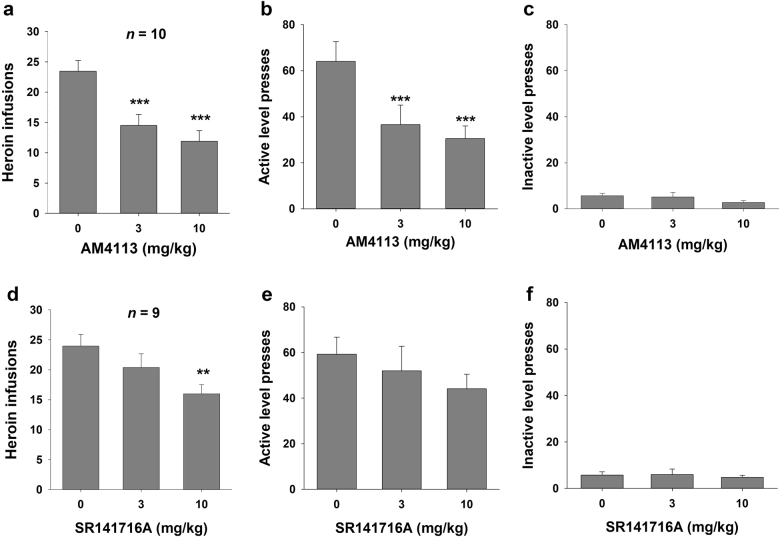
Fig. 1
Fig. 1
Effects of AM4113 or SR141716A on heroin self-administration under a fixed-ratio 2 (FR2) reinforcement schedule. Administration of AM4113 (3 and 10 mg/kg, i.p.) significantly decreased the number of heroin infusions (a) and active lever presses (b), but had no effect on inactive lever presses (c). Administration of SR141716A (3 and 10 mg/kg, i.p.) dose-dependently decreased the number of heroin infusions (d), but did not alter active lever presses (e) or inactive lever presses (f). Data are presented as the mean ± SEM. **P < 0.01 and ***P < 0.001 vs. vehicle (0 mg/kg, i.p.)
Fig. 2
Fig. 2
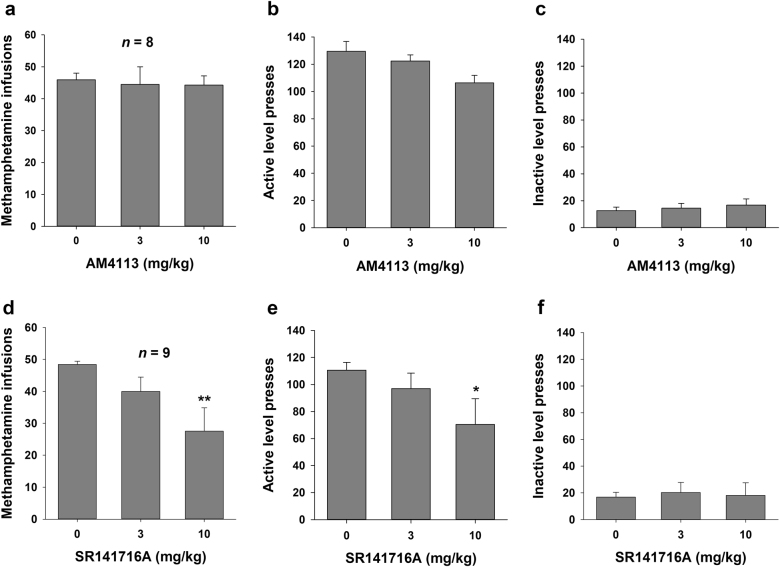
Effects of AM4113 or SR141716A on methamphetamine self-administration under a FR2 reinforcement schedule. Administration of AM4113 did not alter the number of methamphetamine infusions (a), active lever presses (b), or inactive lever presses (c). Administration of SR141716A (10 mg/kg, i.p.) significantly decreased the number of methamphetamine infusions (d) and active lever presses (e), but had no effect on inactive lever presses (f). Data are presented as the mean ± SEM. *P < 0.05 and **P < 0.01 vs. vehicle (0 mg/kg, i.p.)
Fig. 3
Fig. 3
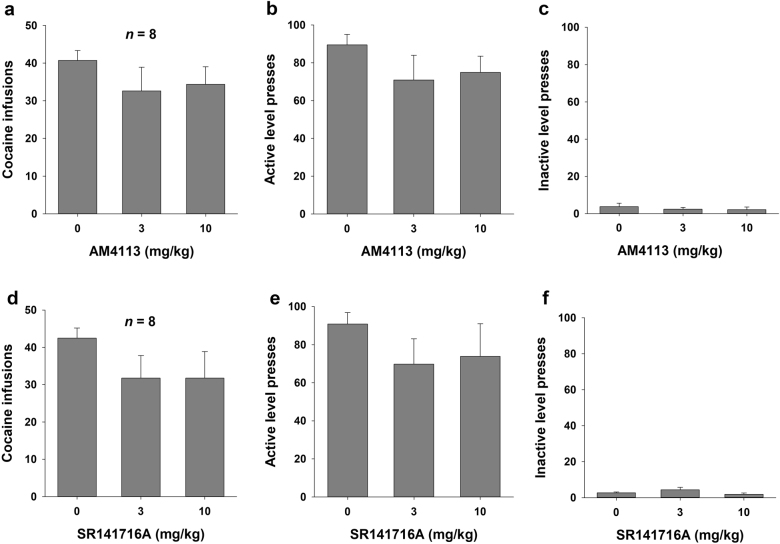
Effects of AM4113 or SR141716A on cocaine self-administration under a FR2 reinforcement schedule. Administration of AM4113 did not alter the number of cocaine infusions (a), active lever presses (b), or inactive lever presses (c). Administration of SR141716A did not alter the number of cocaine infusions (d), active lever presses (e), or inactive lever presses (f). Data are presented as the mean ± SEM
Fig. 4
Fig. 4
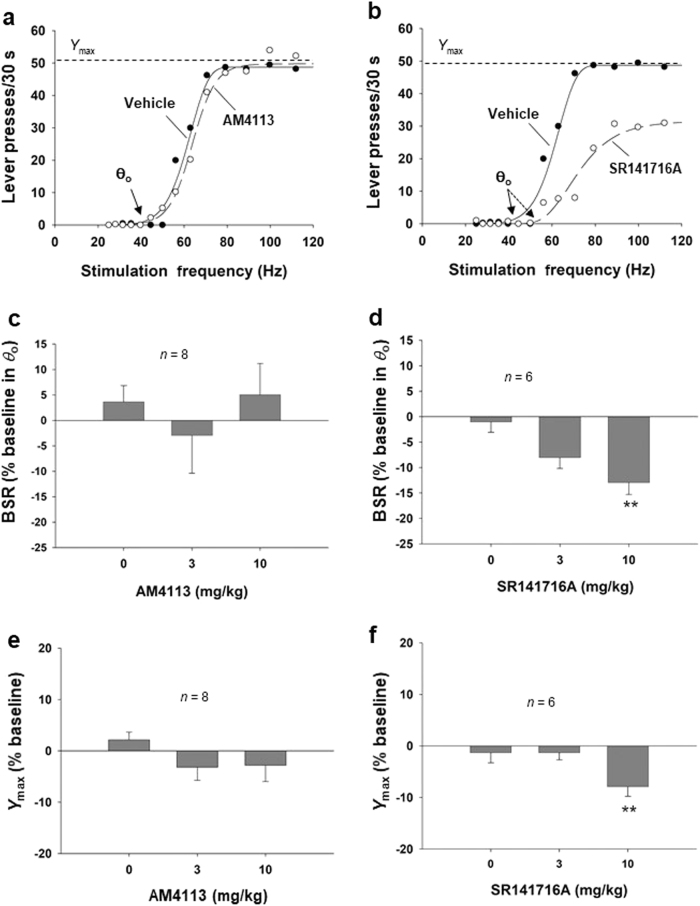
Effects of AM4113 and SR141716A on brain-stimulation reward (BSR). a, b Representative stimulation–response rate curves indicating that AM4113 had no effect on BSR, while SR141716A dose-dependently shifted the curve to the right and increased the BSR threshold (θ0). c AM4113 pretreatment did not affect the BSR threshold (θ0) at either dose tested. d SR141716A (10 mg/kg, i.p.) significantly decreased BSR, as assessed by the increased stimulation threshold (θ0) value. e AM4113 did not alter maximal operant responses (Ymax level). f SR141716A dose-dependently decreased the maximal operant responses (Ymax level). Data are presented as the mean ± SEM. **P < 0.01 vs. vehicle (0 mg/kg, i.p.)

References

    1. Brady JE, Li G. Prevalence of alcohol and other drugs in fatally injured drivers. Addiction. 2013;108:104–14. doi: 10.1111/j.1360-0443.2012.03993.x. - DOI - PMC - PubMed
    1. Naim-Feil J, Zangen A. Addiction. Handb Clin Neurol. 2013;116:613–30. doi: 10.1016/B978-0-444-53497-2.00049-8. - DOI - PubMed
    1. Jing L, Qiu Y, Zhang Y, Li JX. Effects of the cannabinoid CB(1) receptor allosteric modulator ORG 27569 on reinstatement of cocaine- and methamphetamine-seeking behavior in rats. Drug Alcohol Depend. 2014;143:251–6. doi: 10.1016/j.drugalcdep.2014.08.004. - DOI - PMC - PubMed
    1. Robson PJ. Therapeutic potential of cannabinoid medicines. Drug Test Anal. 2014;6:24–30. doi: 10.1002/dta.1529. - DOI - PubMed
    1. Xi ZX, et al. Brain cannabinoid CB(2) receptors modulate cocaine’s actions in mice. Nat Neurosci. 2011;14:1160–6. doi: 10.1038/nn.2874. - DOI - PMC - PubMed

MeSH terms